We support an environment of holistic well-being, as it pertains to the emotional,
interpersonal, and academic development of the entire Tech community, through clinical
services, outreach, psychoeducation, and consultation.
Vision:
Building a skillful, inclusive community where students, faculty, and staff are empowered
to reach their full potential.
Days and Hours
Monday-Friday: 8 a.m. - 5 p.m.
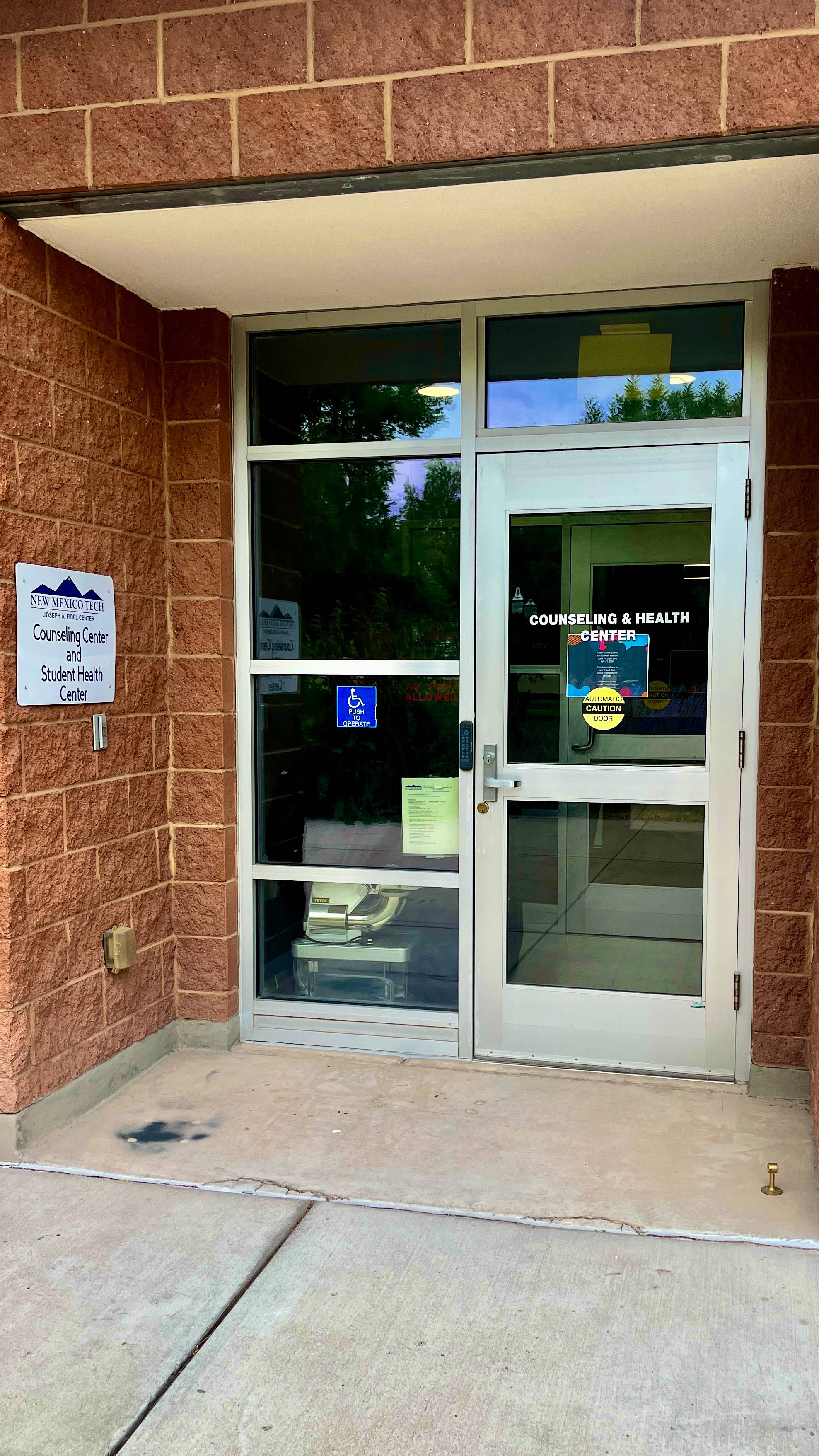
The Counseling Center is located on the first floor of the Joseph A. Fidel Center.
The entrance is outside of Fidel on the NW side of the building, adjacent to Workman.
We are co-located with the Student Health Center.
NMT has also contracted with UWILL for after-hours on-line/phone support.
Individual Counseling
24/7/365 Direct Crisis Support
Call 833.646.1526
Students cannot see a UWill counselor while also seeing an NMT clinician.
Scheduling an Appointment
Eligibility
Currently enrolled NMT graduate or undergraduate degree-seeking students registered
for a minimum of 6 credit hours are eligible for our services of up to 8 sessions
per semester (not including emergency sessions). The initial needs assessment is an
opportunity for a clinician to determine if the services we offer are appropriate
for your needs and for you to decide if our services are a good fit for you.
Once submitted, you will get an email indicating the scheduled day and time of your
appointment.
Online counseling:
We're here for U when you need someone to talk to
Students have free immediate access to teletherapy, crisis support, and wellness resources
with Uwill.
Scan the QR code to get started
Returning Clients
If you have been seen before by the Counseling Center, please complete the returning clients form
below. (Unless it has been within the current academic year, then just email counseling@nmt.edu).
Please be sure to include 3 dates and times that you are available.
Purpose: The purpose of this document is to provide guidance to students regarding no-shows
or late cancellations of appointments for the Counseling Center. Why: The Counseling Center is funded, in part, by student fees, and there is an expectation
that student fees be handled in a responsible way. When students do not show up to
a scheduled appointment, valuable professional time goes without being used, and other
NMT students are not able to access services in a timely manner. How: In order to cancel an appointment, students need to call the Counseling Center at
575-835-6619 or email at counseling@nmt.edu by 3 pm the day before the scheduled appointment.
A $25 No-Show Fee will be billed to the student account for any missed in-person or tele-therapy appointments
not cancelled by 3 pm the day prior. Waivers: We understand that there are unforeseen circumstances that may prevent someone from
providing adequate notice of a cancellation. If you believe that you have a justifiable reason
for missing an appointment without notification and would like consideration for waiving
this fee, notify the Counseling Center in writing within 1 week (5 business days)
of the missed session. Every late cancellation or no-show waiver will be assessed
on an individual basis, and each student will only be allowed 1 waiver. We reserve
the right to deny services to any student who has missed two or more counseling appointments
without notice during the course of the academic year. Students who are denied services
will be referred out to local/community providers for their mental health needs.
Cancellation of Appointments
We require 24 hours notice by phone 575-835-6619 or email counseling@nmt.edu. Students who miss two or more appointments (without providing notice) may be referred
to community services should they require psychological care.
Scope of Our Clinical Services
The Counseling Center utilizes a brief, solution-focused counseling model in which
individual therapy sessions are offered on a short-term basis designed to help students
manage immediate problems and provide short-term solution-focused therapy to facilitate
adjustment to college. These services are ideal for issues that have arisen recently
or that are expected to be resolved relatively quickly. Brief Therapy is often about
bringing successes into the client's awareness, which tends to increase hopefulness.
The goal is for clinicians to work as quickly as possible to facilitate adjustment,
healthy functioning, problem resolution, symptom relief, reduction of emotional distress,
and increase resilience with students to continue attending college and pursue their
personal, but more specifically, their academic goals. Students who would like to speak with a clinician regarding a concern, but are not
considering therapy at the Counseling Center for themselves, may schedule a “consultation.”
Services within the Counseling Center
The first step is the initial needs assessment appointment, where the clinician determines
the nature and impact of the presenting concerns and identifies options for addressing
these issues. If additional treatment is indicated, the clinician will recommend the
most effective method of treatment, which may include brief-solution focused treatment,
group counseling, career exploration, Academic Advising/Student Success, Student Access
Services, skills workshops, support from a peer supporter, or referral to an off-campus
mental health provider. In some cases, the assessment appointment is sufficient for
identifying ways to address the problems.
Some of the concerns that are commonly addressed in short-term counseling at the Counseling
Center are:
Students whose needs fall outside the scope of services or scheduling availability
of the Counseling Center are referred to community resources. The Counseling Center
provides referral services after the initial needs assessment or as these factors
become more apparent during the course of services. Some of the issues that are commonly
addressed through referral to services outside of the Counseling Center for longer-term
or more intensive counseling include:
A desire or need to be seen weekly or desire for ongoing long-term psychotherapy
History of multiple hospitalizations; chronic suicidality and/or self-injurious behaviors;
history of repeated suicide attempts
Clear indications of a need for more intensive services
Indication that short-term therapy may be detrimental or non-beneficial
Evidence or risk of progressive deterioration in mental or emotional functioning
that requires intensive intervention
Exhibiting psychotic symptoms without willingness to follow treatment recommendations
Inability or unwillingness to provide the necessary information to thoroughly assess
symptoms
Students who are already receiving ongoing therapy with another mental health provider
Students seeking therapy for the sole purpose of obtaining documentation for another
office (i.e., ESA Letters, Residential Life)
Client concerns that required open-ended, ongoing psychotherapy before coming to NMT
A need for specialized services not available through the Counseling Center, as indicated
by:
Presence of significant drug or alcohol problems such as substance dependence and/or
past failed treatments; a need for drug testing
Presence of a significant, long-standing, and/or untreated eating disorder
Request for medications or medication management
Request for psychological evaluation for the purpose of employment clearance
Request for services to fulfill clients’ court-mandated assessment or treatment requirements
The general guidelines listed above are only intended to serve as a guide to assist
treatment decisions. Due to the nature and complexity of presenting concerns, decisions
regarding treatment recommendations and/or community referrals are made on an individual
basis by clinicians in consultation with the clinical team of the Counseling Center.
Confidentiality
The State of New Mexico legally recognizes that communication between a counselor
and their client is privileged and confidential. We will not disclose your contacts
with us to your spouse/partner, your parents, professors, or anyone else without your
permission.
There are a few narrow exceptions:
If you are in imminent danger to yourself or are a significant danger to someone else,
we have a legal obligation to break confidentiality to protect you and/or others.
If you are abusing children/vulnerable adults or inform us concerning someone who
is, then we have a legal responsibility to report this to the proper authorities.
Such a report could potentially lead to disclosure of your being a client and require
testimony concerning the suspected abuse.
If, as part of an employment process or security screening, you sign a release of
records form about services received from us, we will ask that you sign our form to
ensure that you are freely and knowingly releasing a summary of your contact with
us.
Your records can also be subpoenaed by a court of law (e.g., if you claimed emotional
damages in a lawsuit).
We also reserve the right to consult with the NMT Health Center and NMT Behavior Intervention
(BIT) Team when professionally appropriate.
Release of Information (ROI)
If you would like to request a treatment summary, please follow the procedure stated
below. If you are a client who was seen more than 7 years ago, we are not able to
accommodate this request as we are only legally required to save records for 7 years.
How to Request
Since all health records are strictly confidential, including mental health records, you must provide a written request. The information required
can be e-mailed, mailed or faxed to :
The Counseling Center New Mexico Tech 149 Fidel Building 801 Leroy Place Socorro, NM 87801 Fax: 575-835-6001
Dates attended (including when you left, and whether or not you graduated)
Reason for Request
Your signature
Please allow at least two (2) weeks to process the request.
Our Providers:
We adhere to the Code of Ethics of the New Mexico Board of Clinical Mental Health
Counselors. Crisis intervention is available; counseling is provided on-site by a
New Mexico independently licensed clinical mental health counselor (LPCC).
Angela Gautier, MS, LPCC - Director
EDUCATION
Northeastern University, Boston, MA Master of Science, May 2004 Counseling Psychology
Northeastern University, Boston, MA Master of Science, September 1998 Criminal Justice
University of Massachusetts, Boston, MA Bachelor of Arts, May 1997 Summa Cum Laude