Blog 2025
8-G: Oceanic Crust Hydrothermal circulation Offshore - Guerrero
This is a blog post from the fall 2025 8-G cruise, written by members of the science party onboard the R/V Marcus G. Langseth from December 2-26, 2025. The research project is supported by grants from the National Science Foundation. The R/V Marcus G. Langseth is part of the UNOLS academic fleet, and is operated by Columbia University's Lamont-Doherty Earth Observatory.
December 2, 2025 (posted by Glenn Spinelli)
Over the last 2 days the science party for our research cruise assembled in Manzanillo, Colima, Mexico. After the staff at Lamont Doherty Earth Observatory (LDEO; the operator of the R/V Langseth) completed a mountain of paperwork to get the science party cleared through customs and immigration, and through the port facility in Manzanillo (thank you Sean Higgins and Jesus Gaytan for your hard work) -- we finally made a small-boat transfer from a dock in Manzanillo to the R/V Langseth at anchor in the bay.
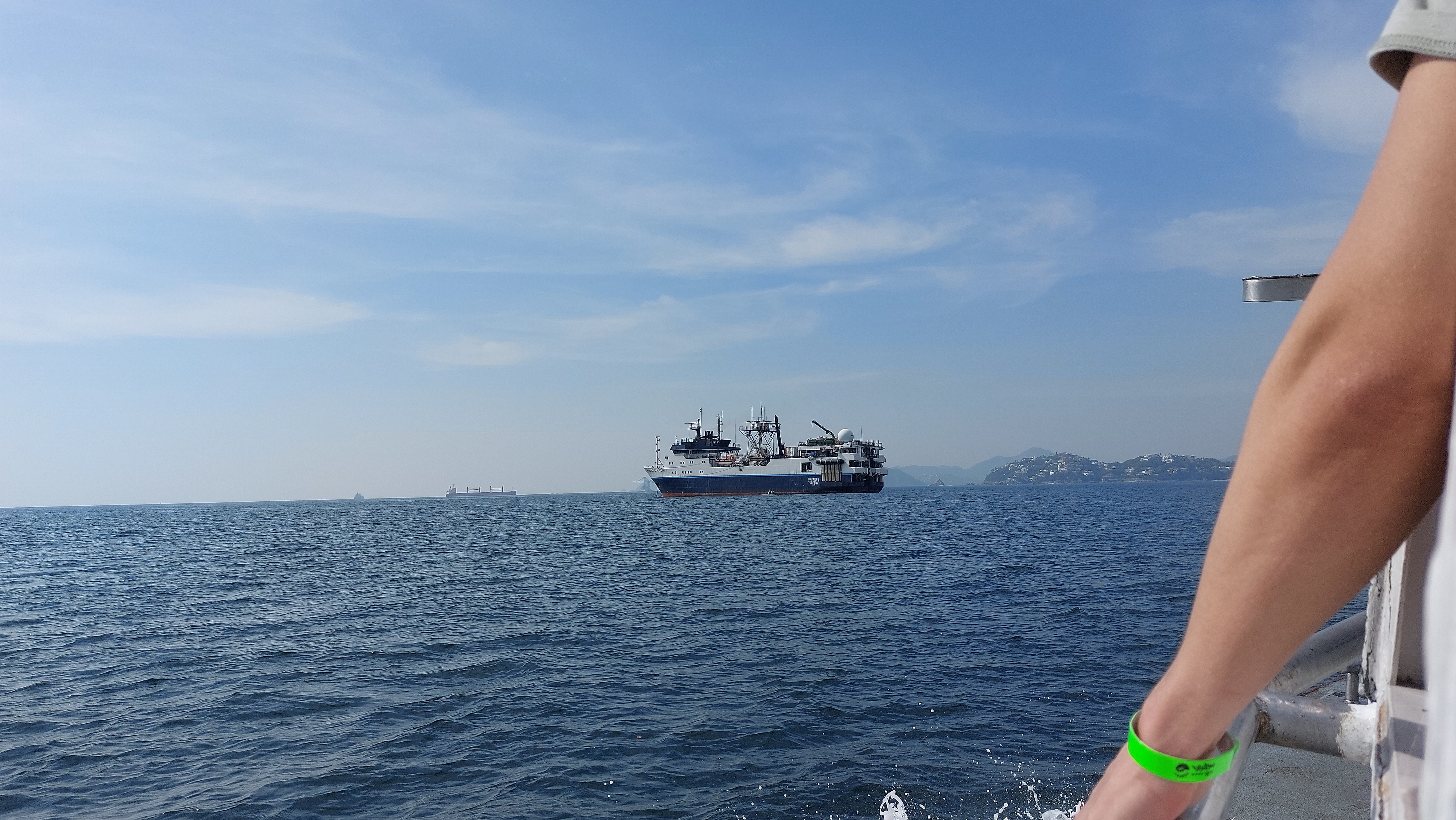
Photo: On the small-boat transfer to the Langseth at anchor in Manzanillo Bay (photo credit: Jeffrey Poort).
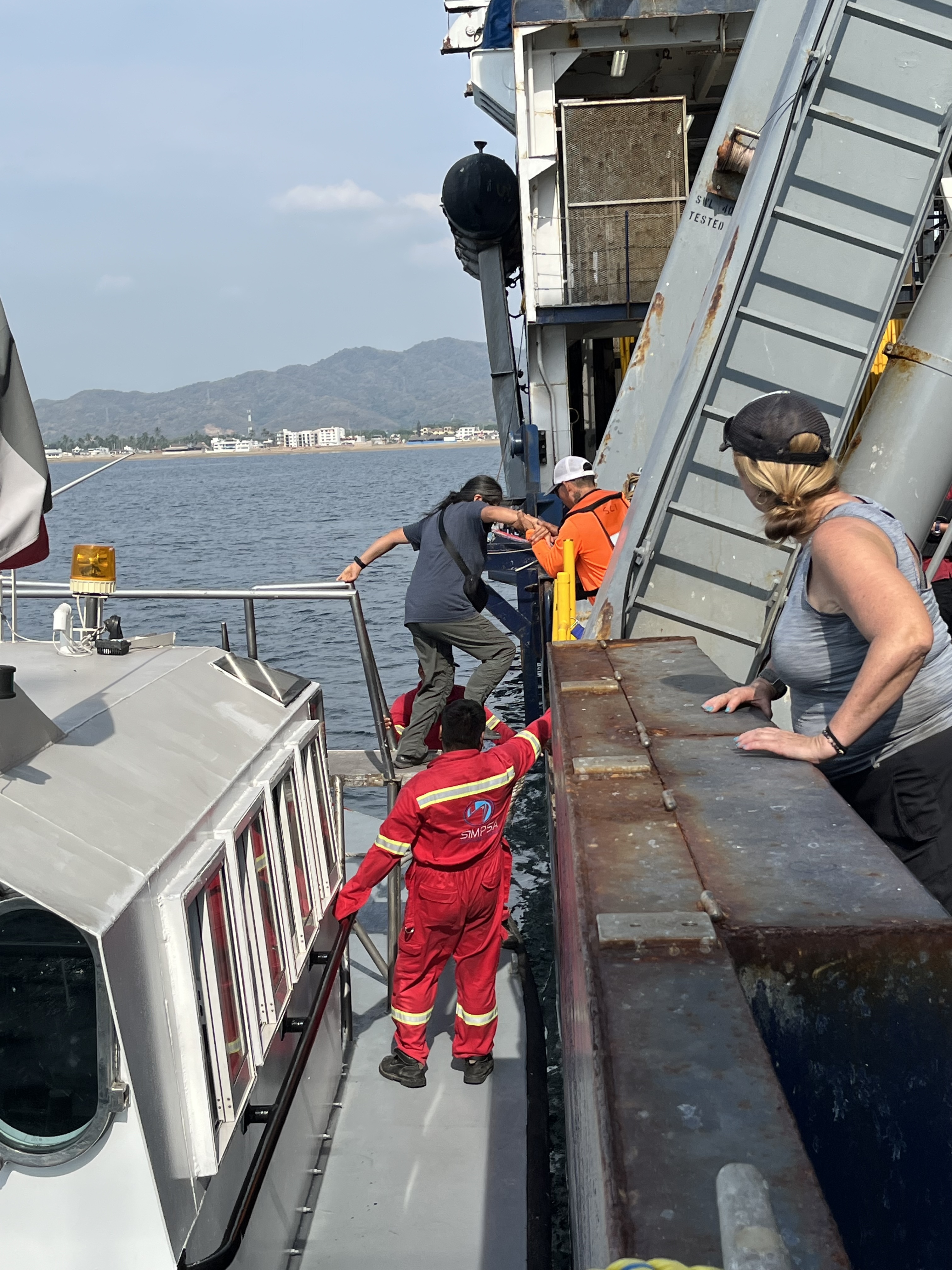
Photo: Ana (one of the protected species observers) stepping from the small boat onto the Langseth in Manzanillo Bay.
Now we are all onboard and looking forward to getting to work.
December 3, 2025 (posted by Glenn Spinelli)
Our first day at sea was spent transiting from Manzanillo to our study site and calibrating an instrument that will help us to know the location of the heat flow probe when it is on the seafloor. That cailibration involved sending a beacon down to the seafloor and driving the ship around the location while "pinging" the beacon. Then, the beacon is released from the seafloor and floats bring it back to the surface.
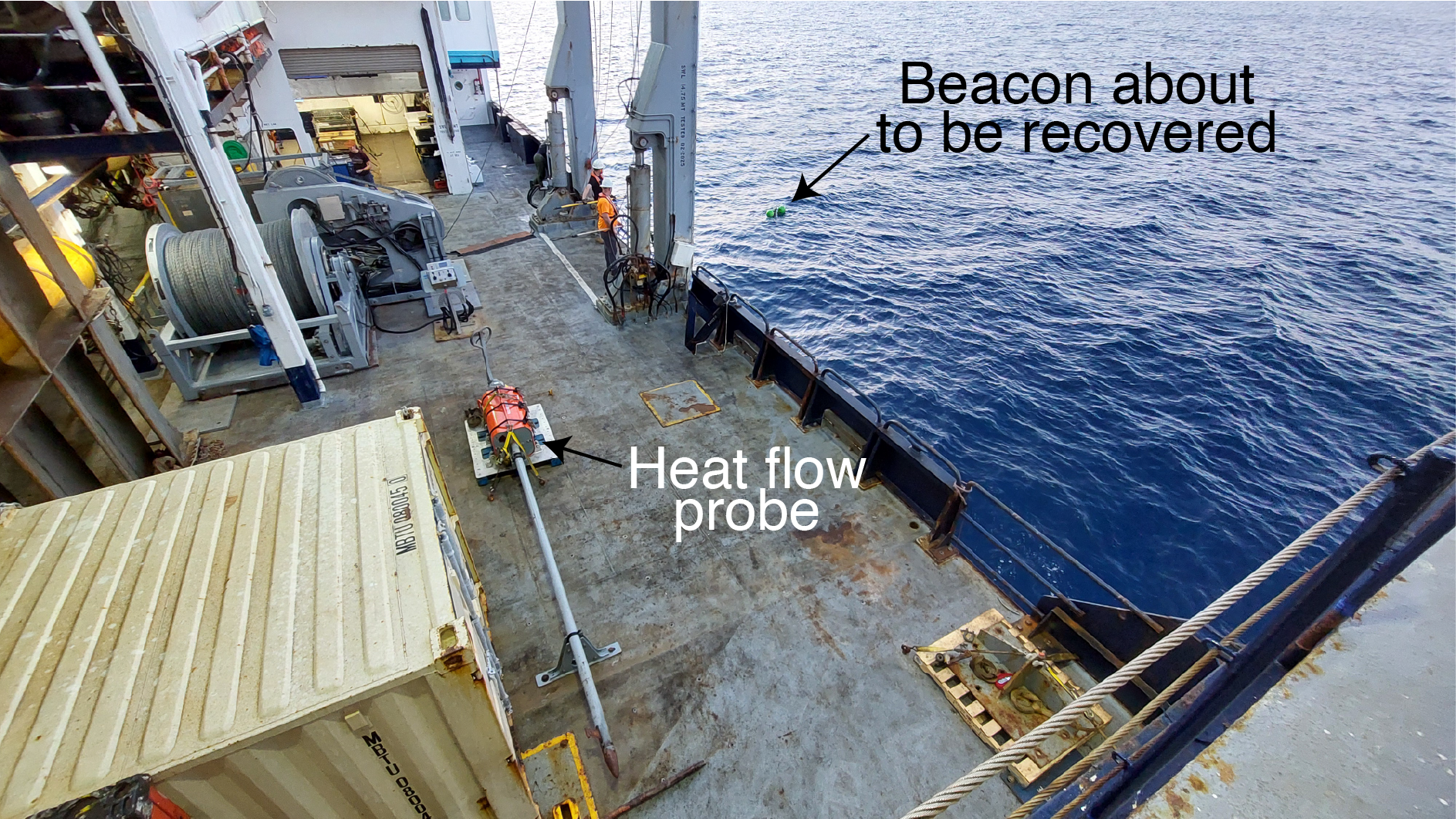
Photo: The heat flow probe sitting on deck and the beacon used for calibration (with its green floats) about to be recovered by techs on the Langseth (photo credit: Jeffrey Poort).
December 4, 2025 (posted by Maddie Hurd and Elizabeth Houghton)
Streamer deployment began the night of December 3 at approximately 23:00. Although the Langseth is equipped with several reels of streamer cable, the four-kilometer-long “Streamer 1” will be used for this particular study. The streamer cable houses hydrophones that will record energy reflected from the seafloor and subsurface layers. Two air guns are also towed behind the ship, acting as the source of this acoustic energy. The deployment process involves the installation of weights, digibirds, and seismic recovery devices (SRDs) at specific intervals determined by the ship’s seismic crew. Digibirds are controlled from the vessel and help to manage the depth at which the cables are towed.
We are now collecting seismic reflection data on the westernmost lines within the study area.
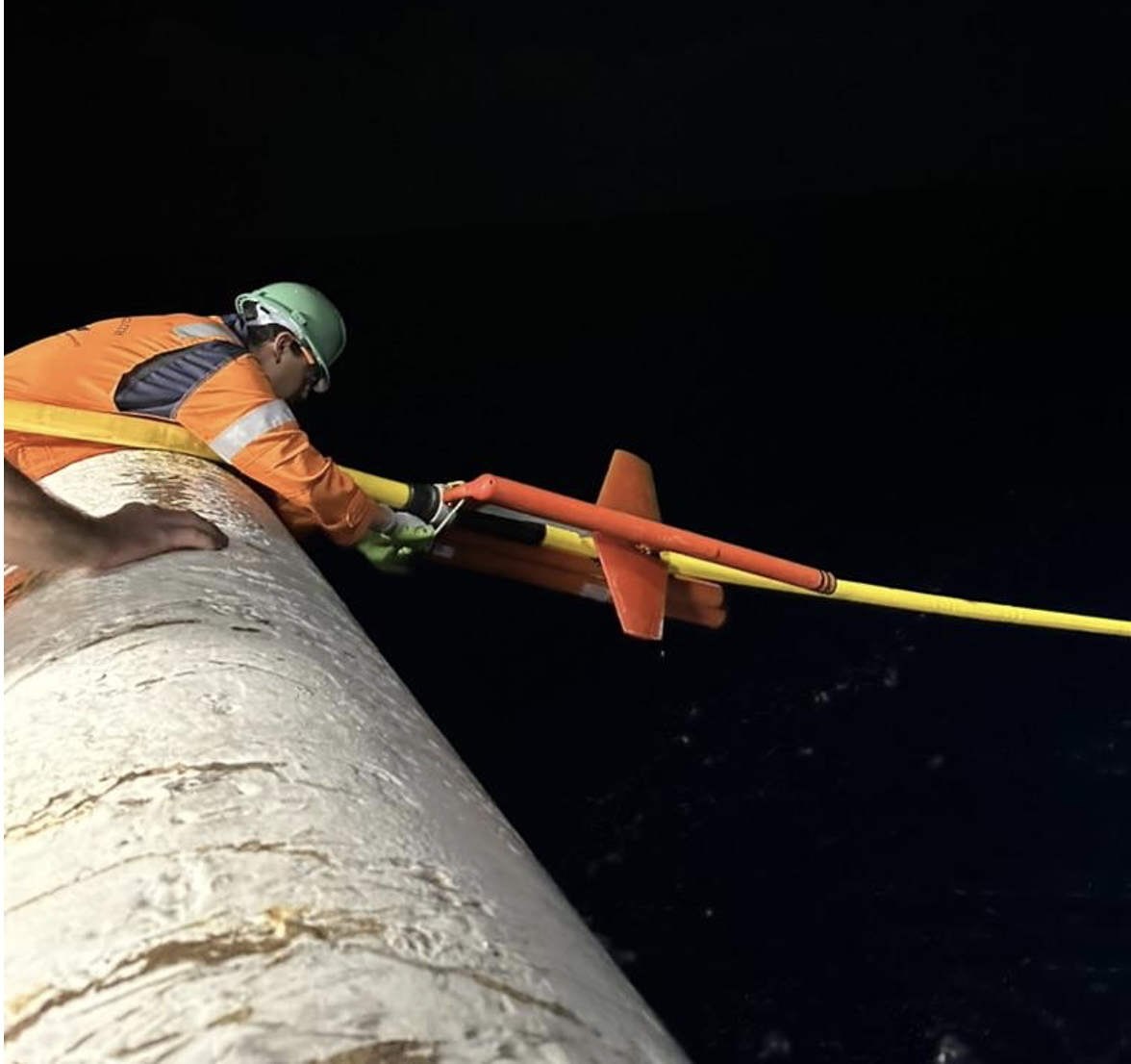
Photo: Seismic contractor, Jose, ensuring the digibird/SRD unit is properly connected to the cable.
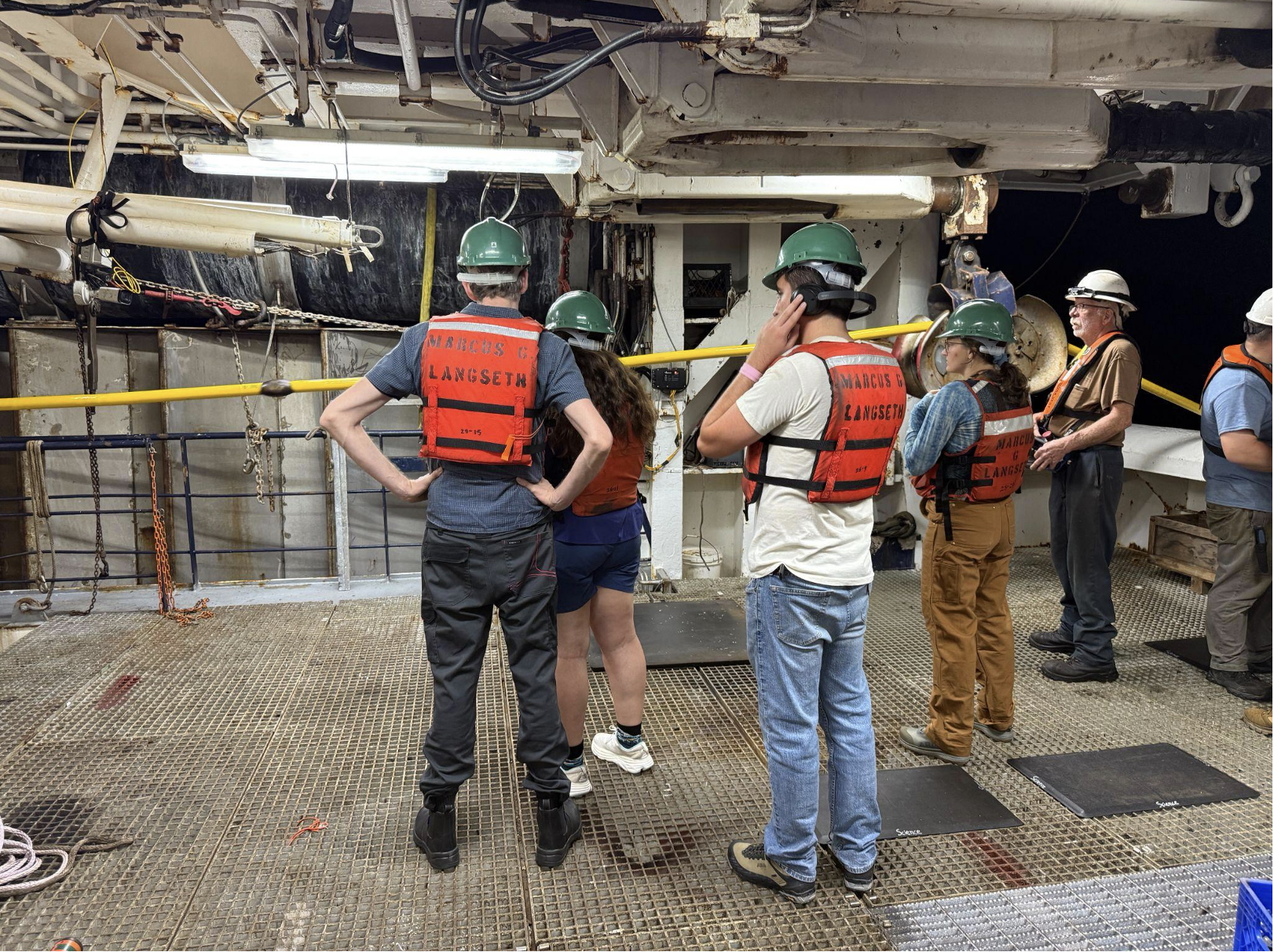
Photo: (Left to right) Jeffrey, Adriana, Joel, Elizabeth (science party), Ray (research technician), and Cody (chief science officer) work during the “sunrise shift” to deploy the Streamer 1 off the back of the Langseth. A black weight is visible on the yellow streamer cable.
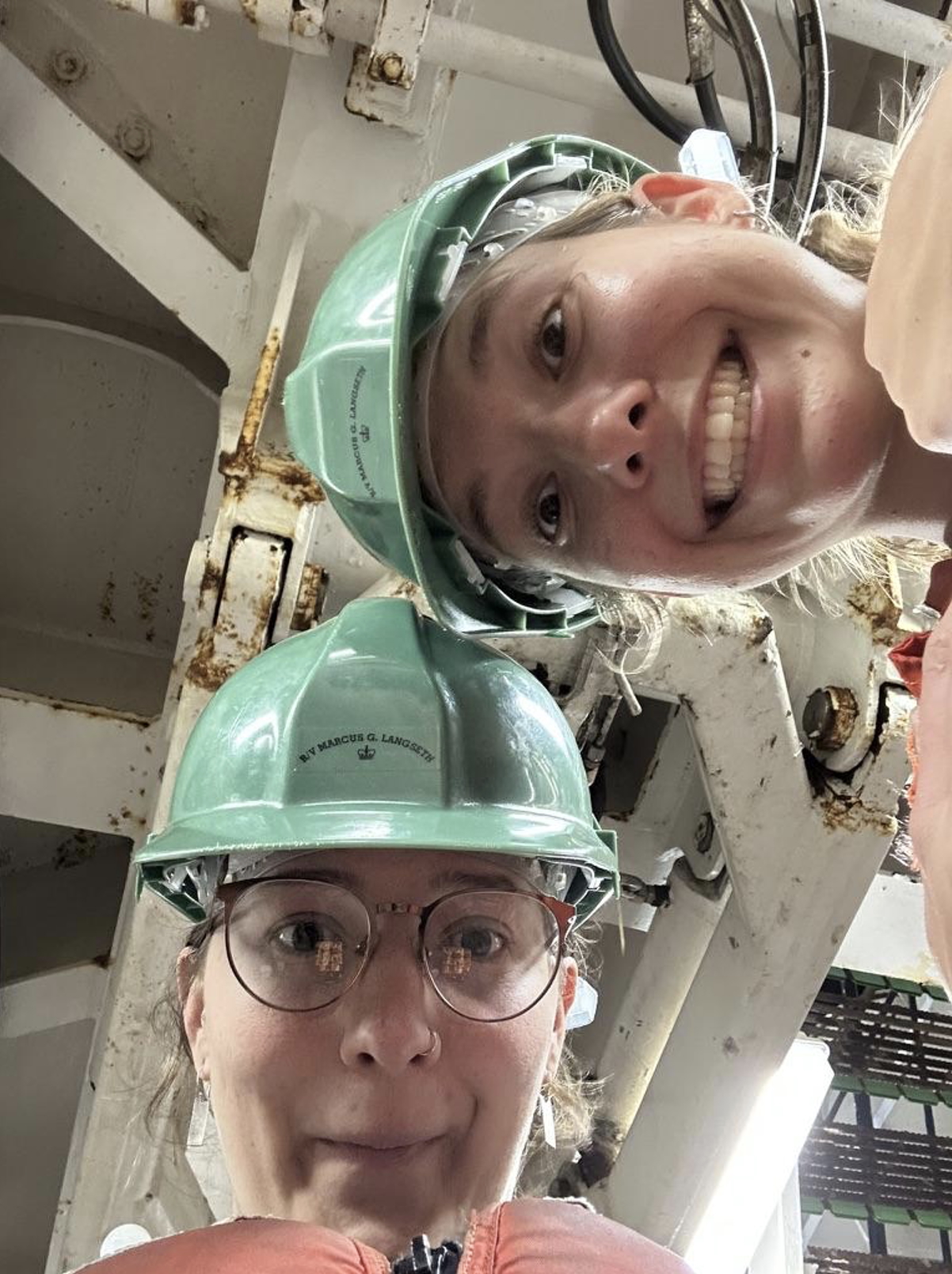
Maddie and Elizabeth (in their PPE) snag a quick selfie on the streamer deck at their 00:00 shift change. Like ships passing in the night.
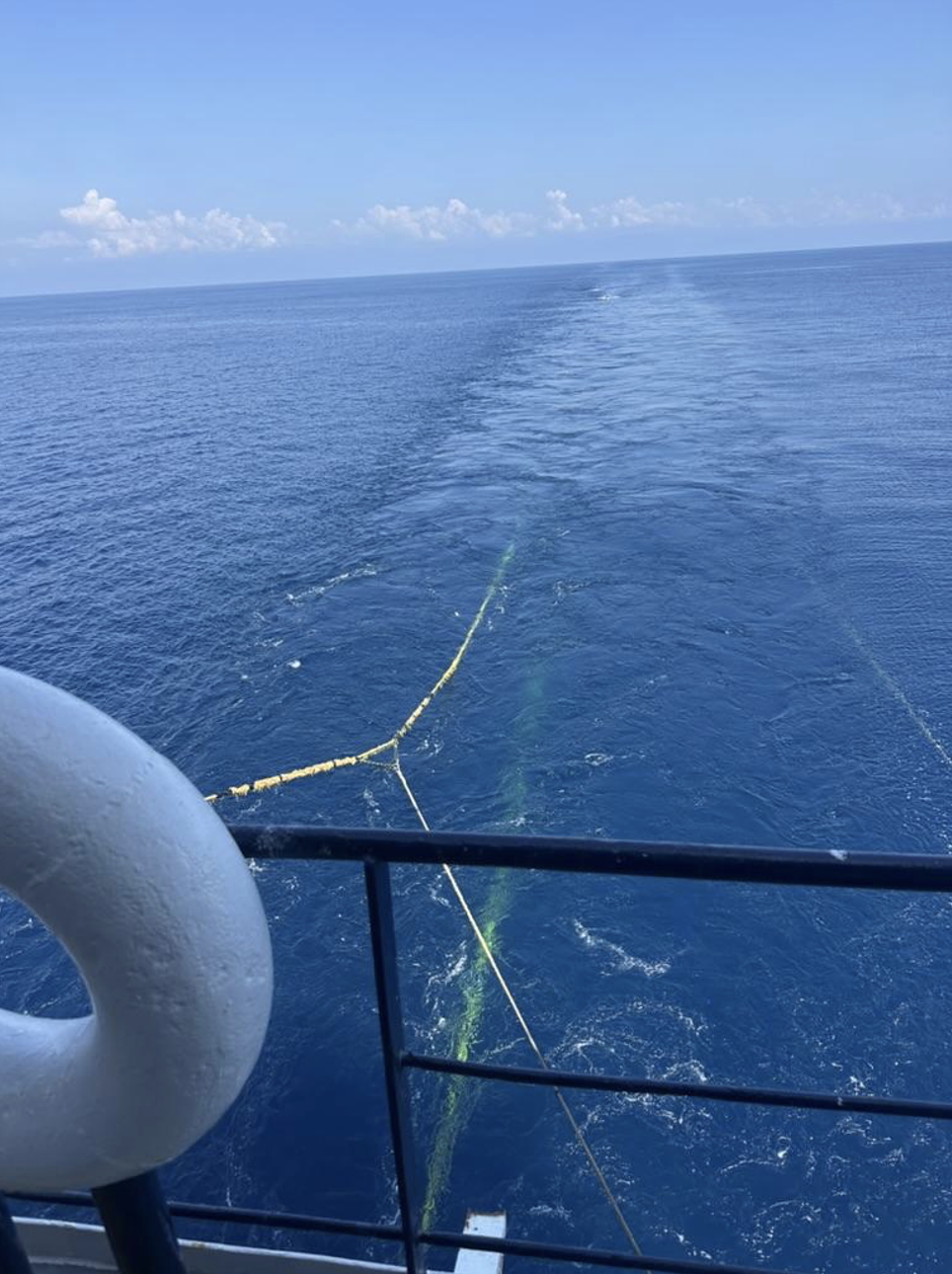
Photo: The streamer cable is towed behind the Langseth, seen the morning after deployment.
December 7, 2025 (posted by Lindsay Worthington)
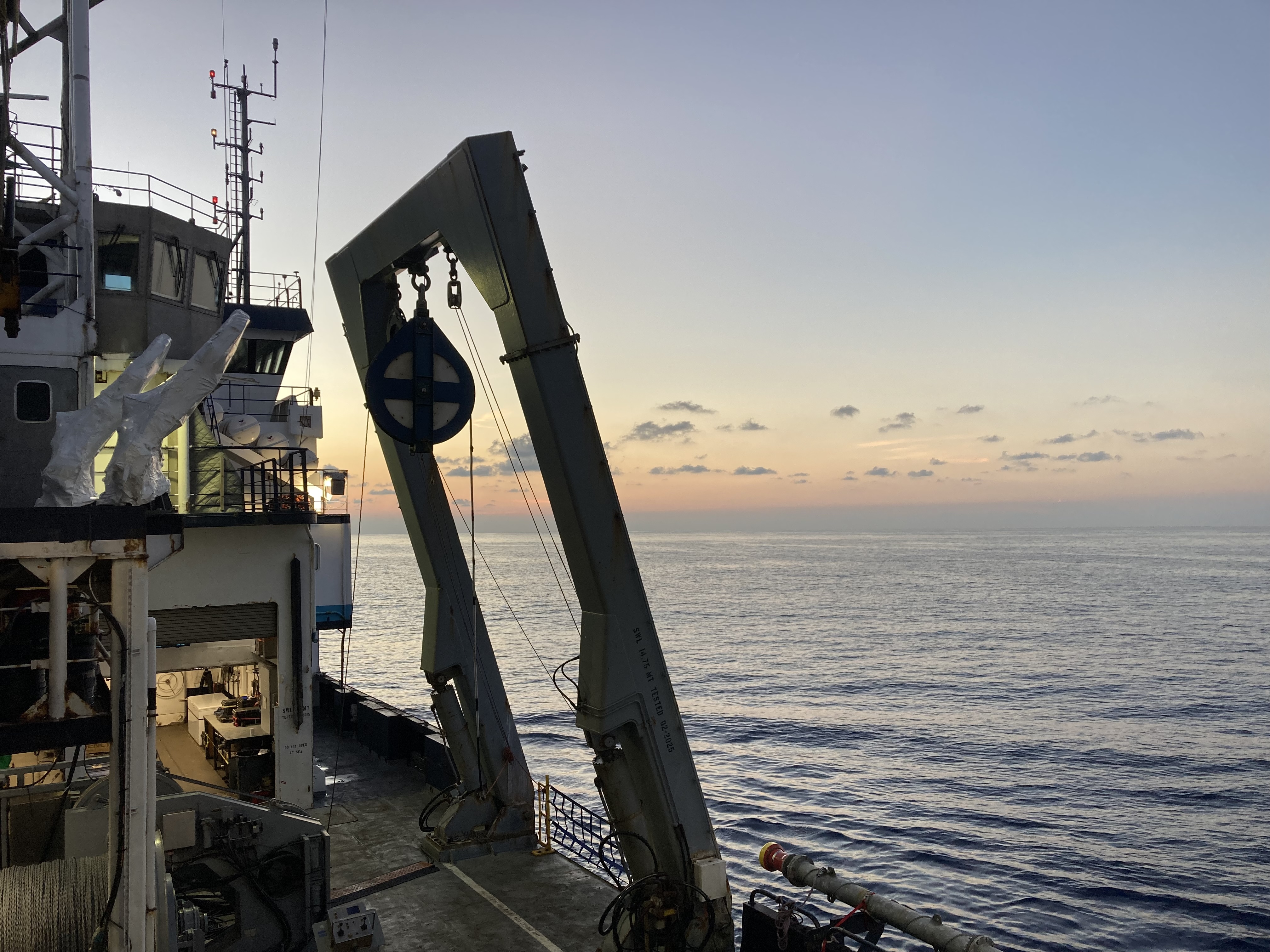
Photo: A view of the A-frame and starboard main deck at sunrise offshore Mexico, on the R/V Marcus G. Langseth.
Wow! It’s amazing how time flies when you’re at sea and having fun….and troubleshooting and collecting data and learning software and getting used to ship life!
We started our mission about 5 days ago, but if feels like so much has happened. I’m mostly supervising the imaging part of the cruise so I’ll give the run down so far.
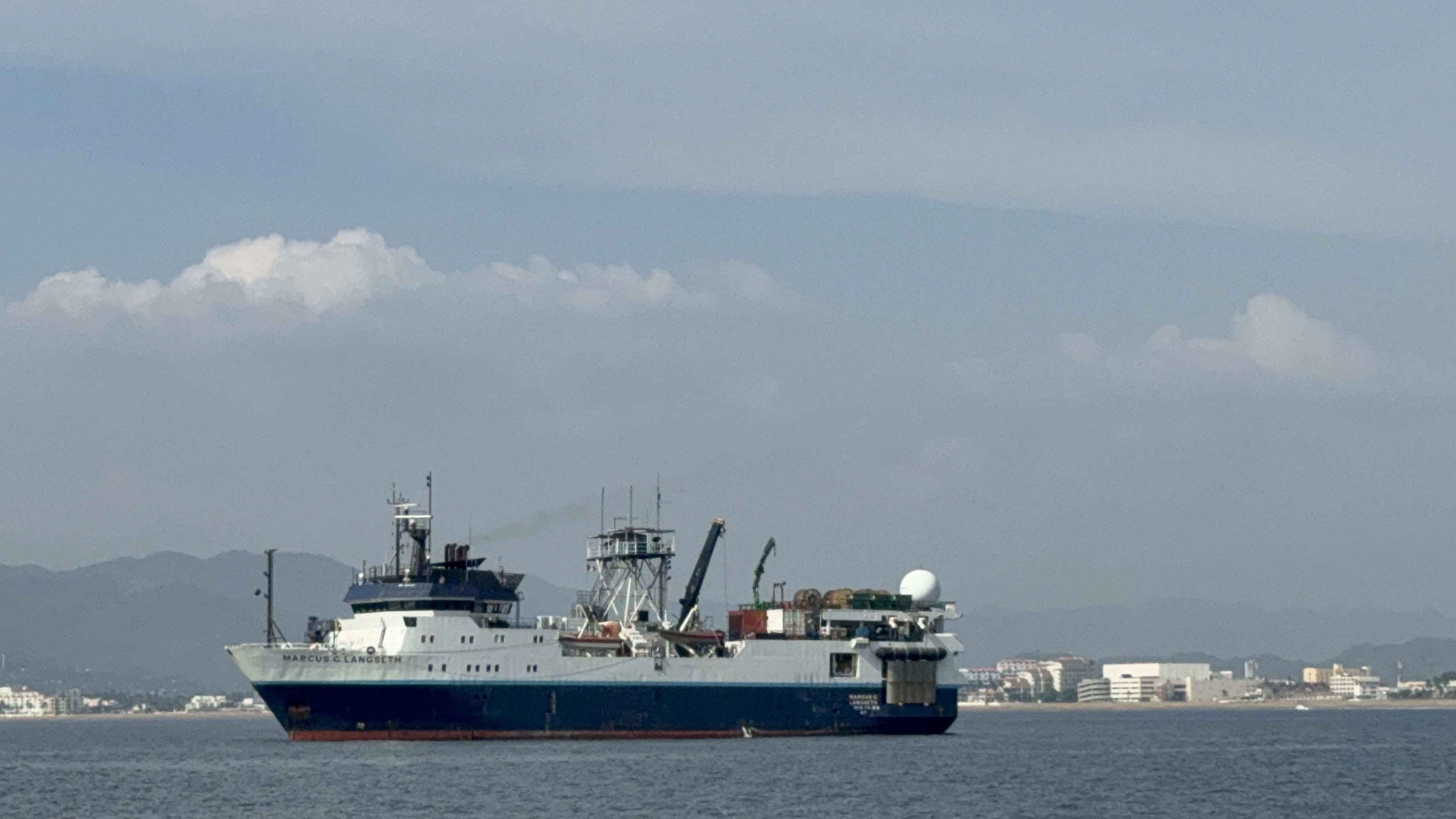
Photo: R/V Marcus G. Langseth at anchor in the port of Manzanillo, Mexico. Photo from the water taxi on our way to get onboard.
We transited for about a day and half after leaving Manzanillo—which in itself was an adventure of driving back and forth from immigration to the port to the bag check to another bag check to the dock for the water taxi back to the port and then finally to the Langseth, which was anchored out in the harbor. We all safely made the “jump” from the water taxi onto the ship and bags and luggage we handed ably to and fro by the water taxi folks and the Langseth ship’s crew.
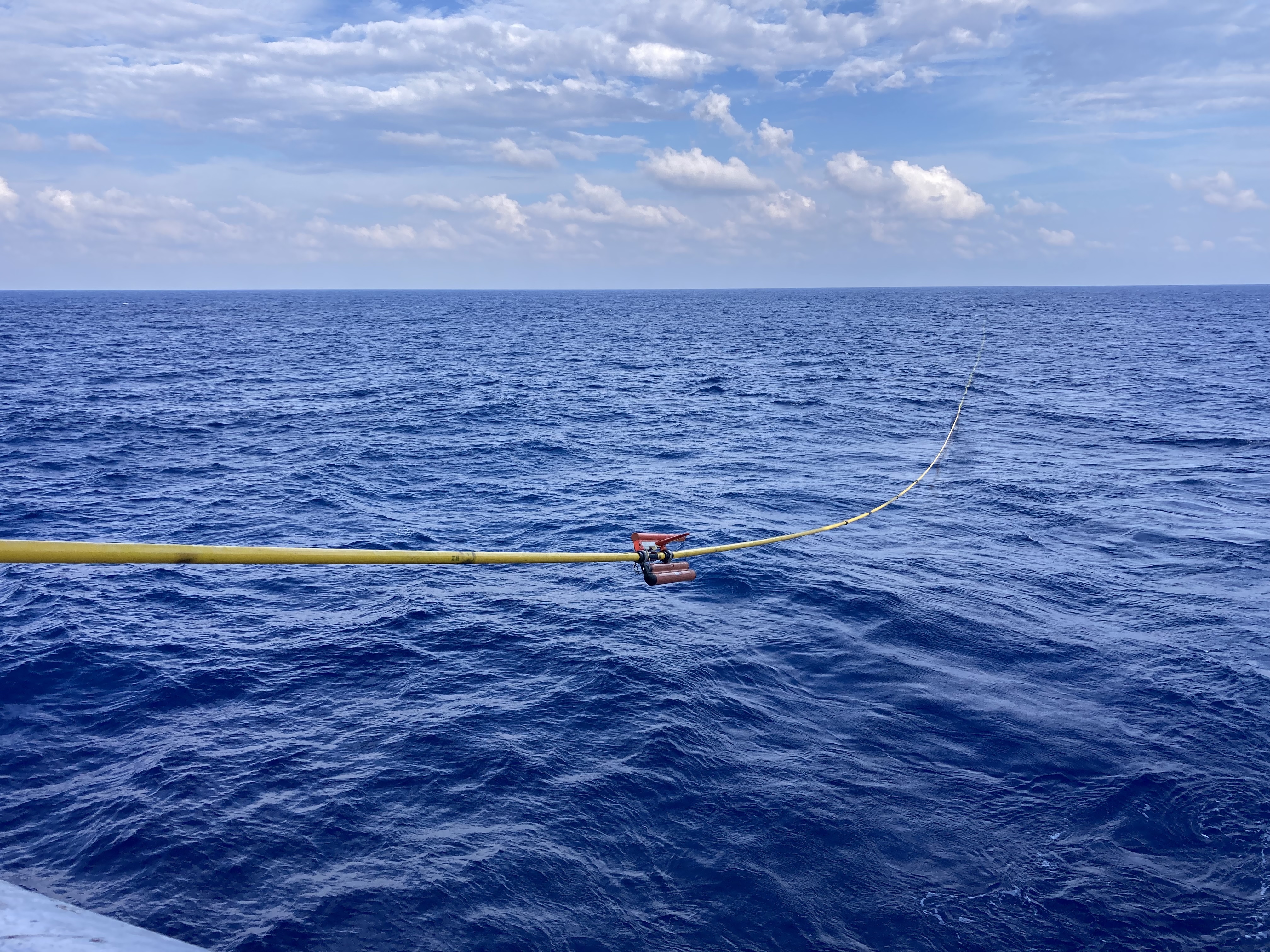
Photo: The sensor cable extended off the back of the ship with a ‘bird’ attached that helps to hold it at a constant depth.
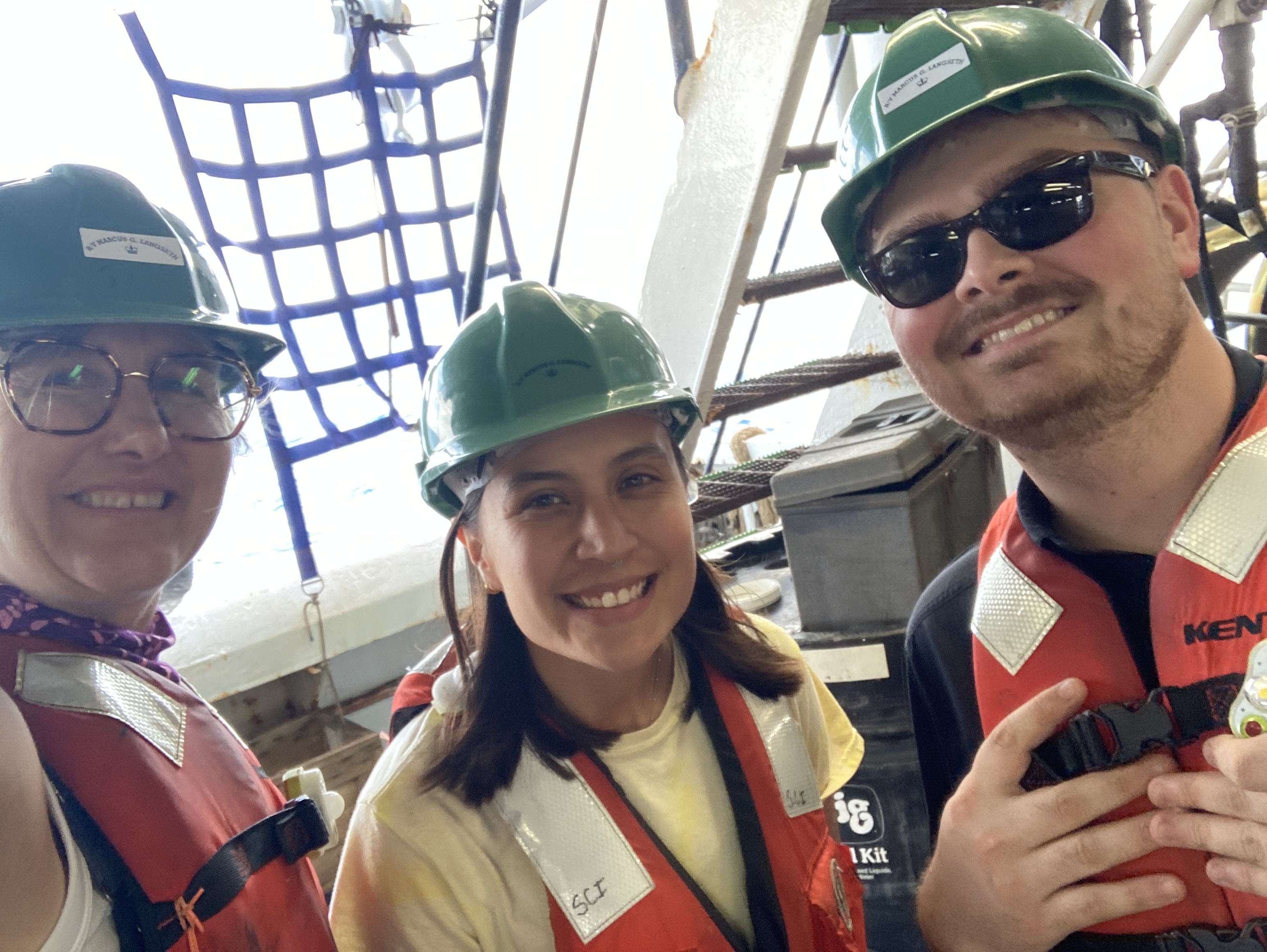
Photo: Science party members (Lindsay, Isabela, Kain) on the streamer deck while bringing the cable back on board.
Anyway…..back to the start of science operations. We began with sub-seafloor imaging to help make sure our heat probe stations would be in a softer spot, away from hard oceanic crust rocks. For this mission, we are using a ‘short’ 4 km cable that trails behind the ship. There is a sensor every 6.25 meters, for a total of 648 sensors that record every shot from two airguns that are towed in the water between the ship and the cable.
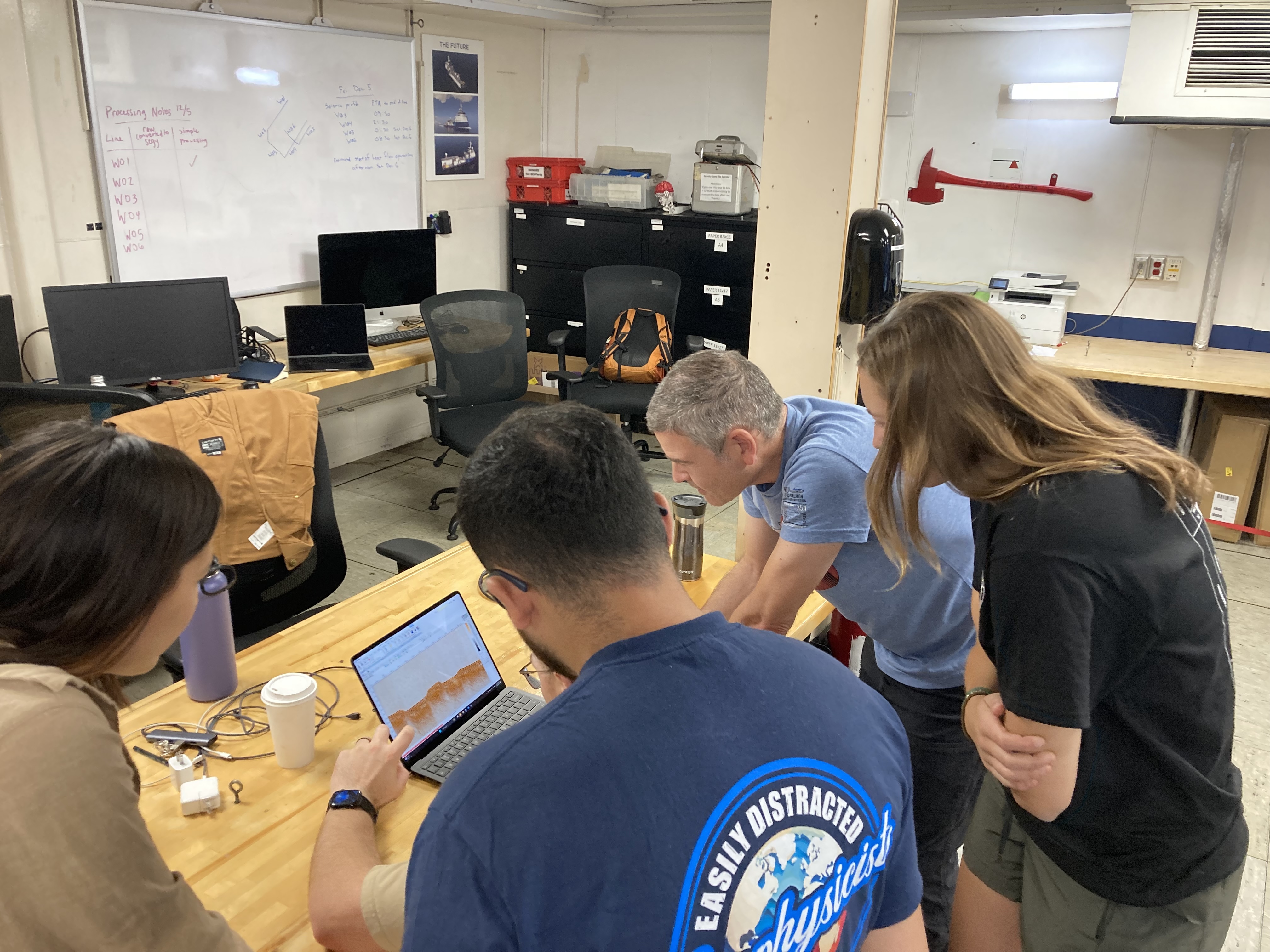
Photo: Science party in the lab taking a peak at some of our first seismic imaging data to investigate the structure below the seafloor.
Imaging went really well! The data is so detailed and we can see subsurface structures up to a few miles below the seafloor. More soon with some data sneak peaks!
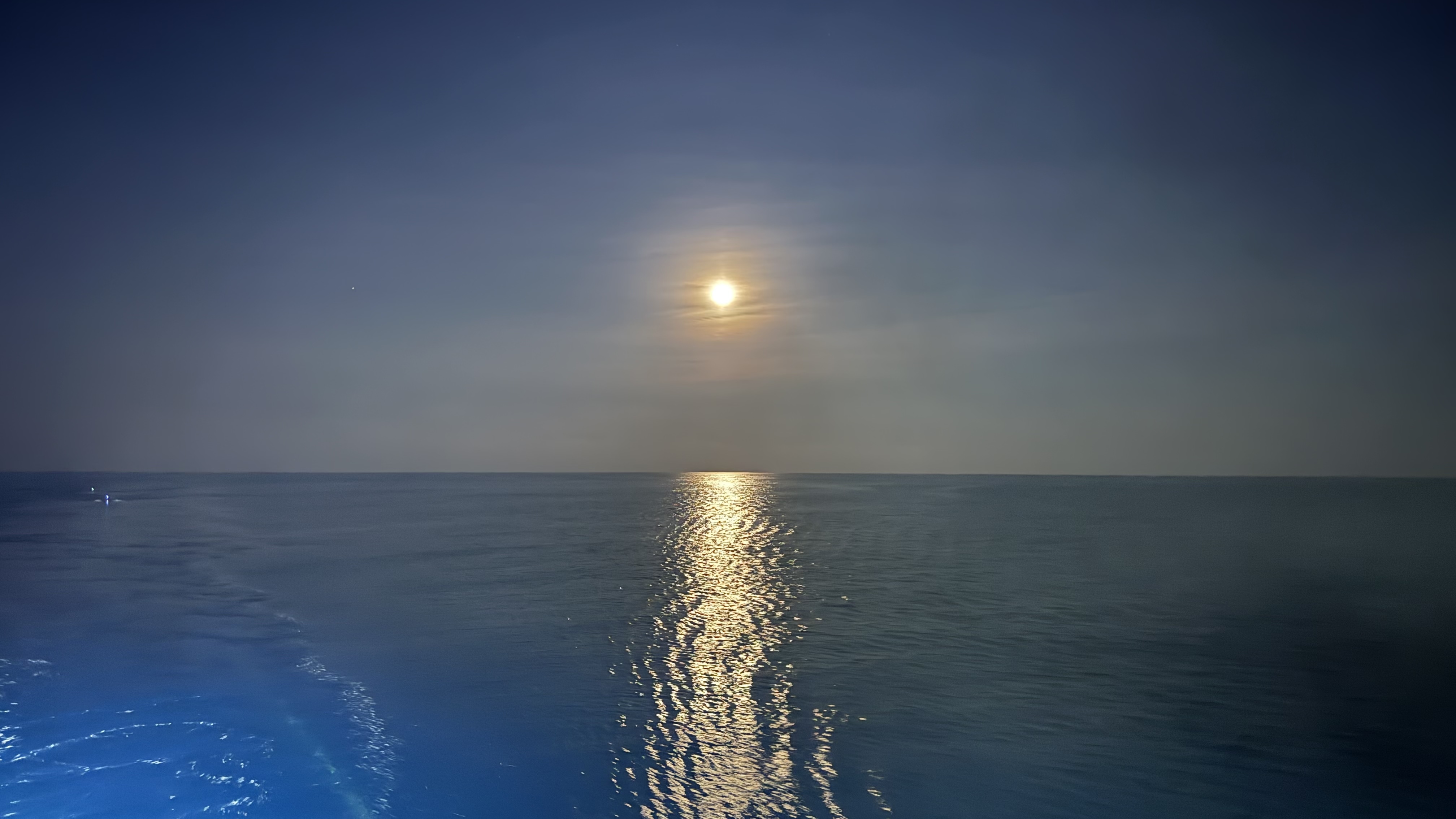
Lindsay's advice -- get outside every day.
December 8, 2025 (posted by Glenn Spinelli)
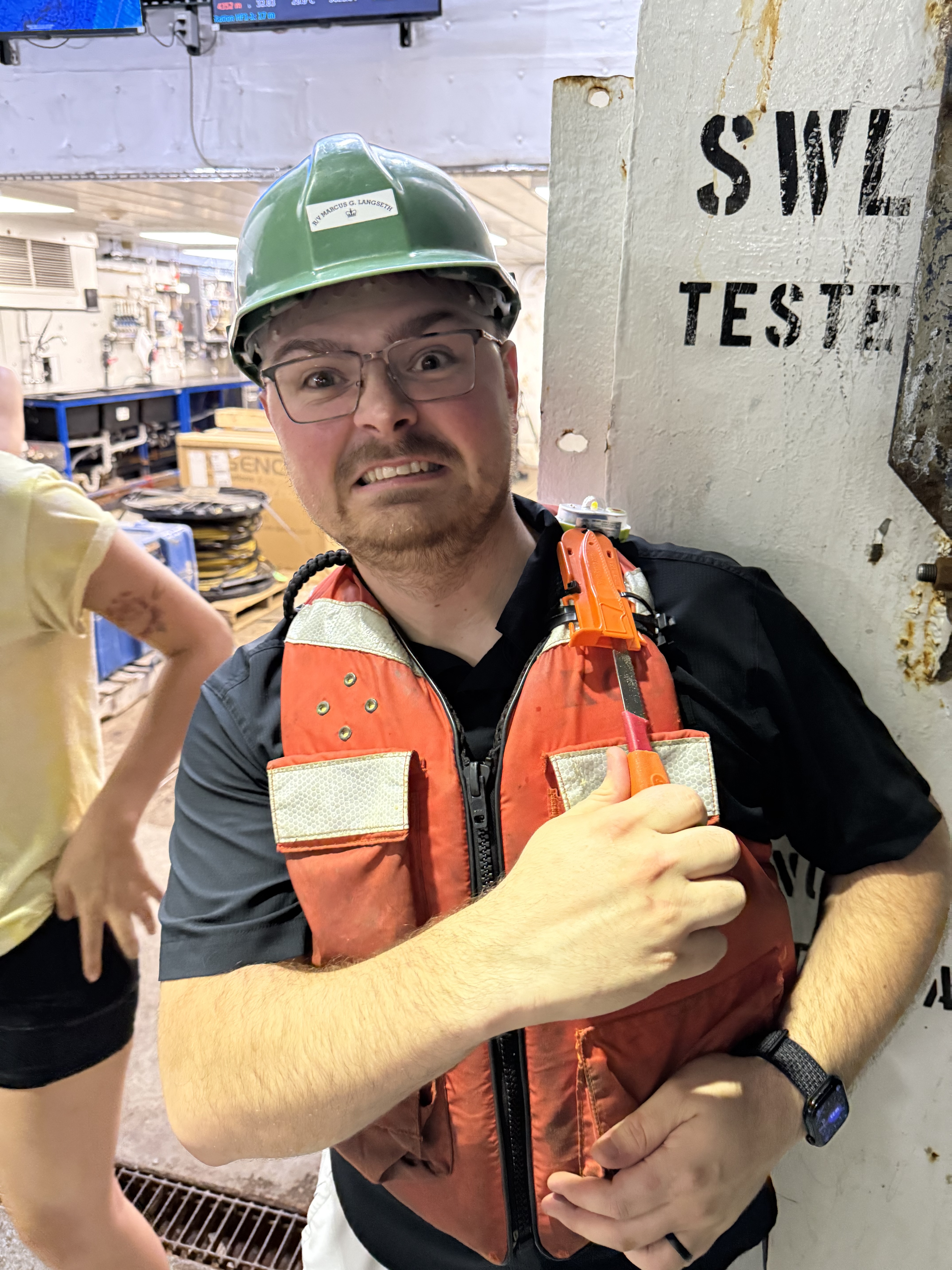
Some of the life jackets that we use when on deck to attach birds to the seismic streamer or deploy/recover the heat flow probe have a knife on the shoulder. The intension is for this to be available if you are in the water and tangled in rope. Apparently, Kain also believes that it could be useful to repell a boarding party (thankfully, the chance of us needing to repell boarders is exceedingly small).
December 9, 2025 (posted by Manet Peña Salinas)
One of my favorite moments has always been watching sunsets at sea. After a week on the ship, I finally took a moment to step outside and enjoy the view. Today, I was lucky to see one of the most beautiful sunsets, with the red sun sinking into the horizon, a reminder that science can give unexpected gifts. Excited to see what the rest of the expedition will bring.
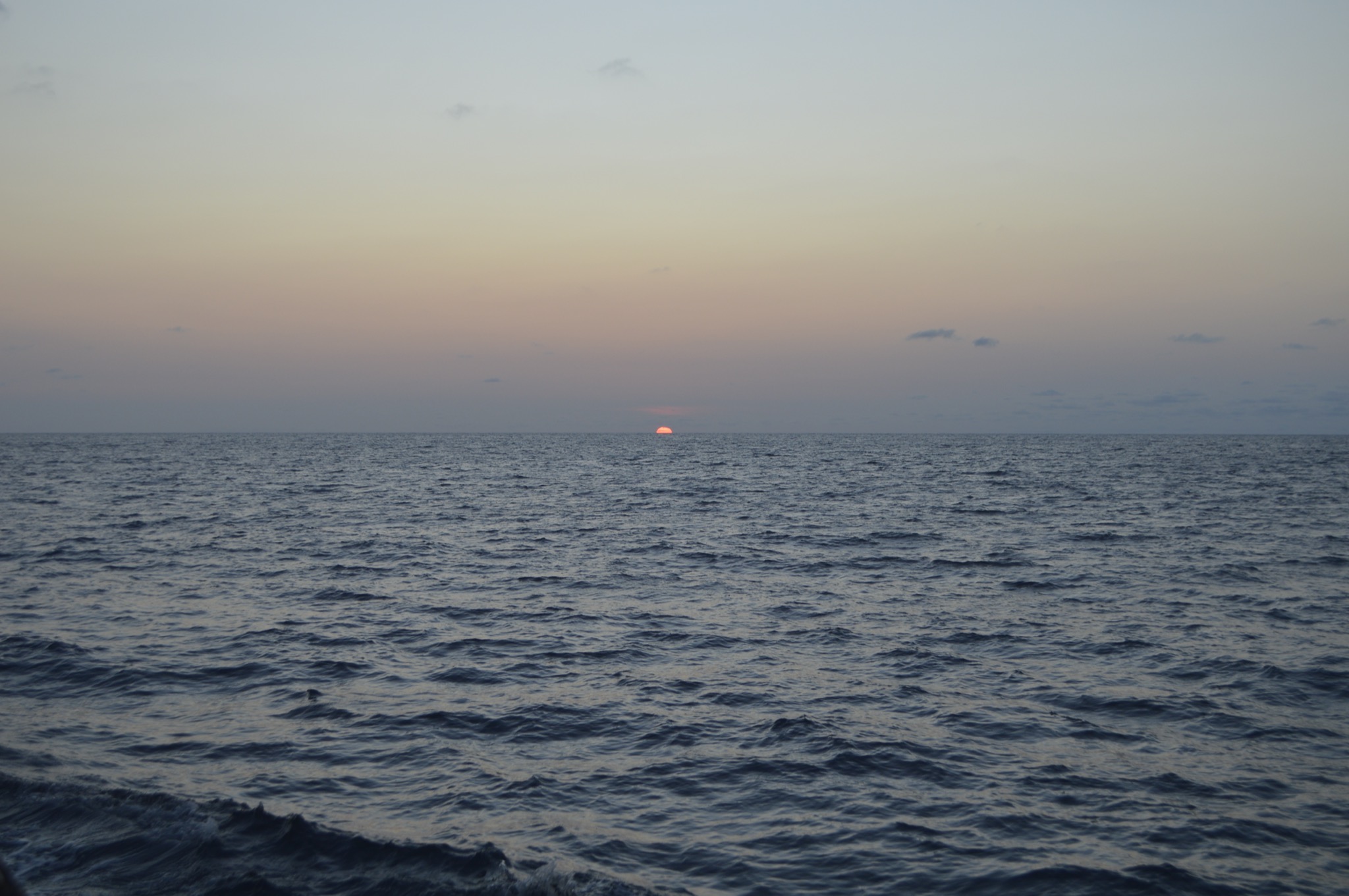
December 10, 2025 (posted by Manet Peña Salinas)
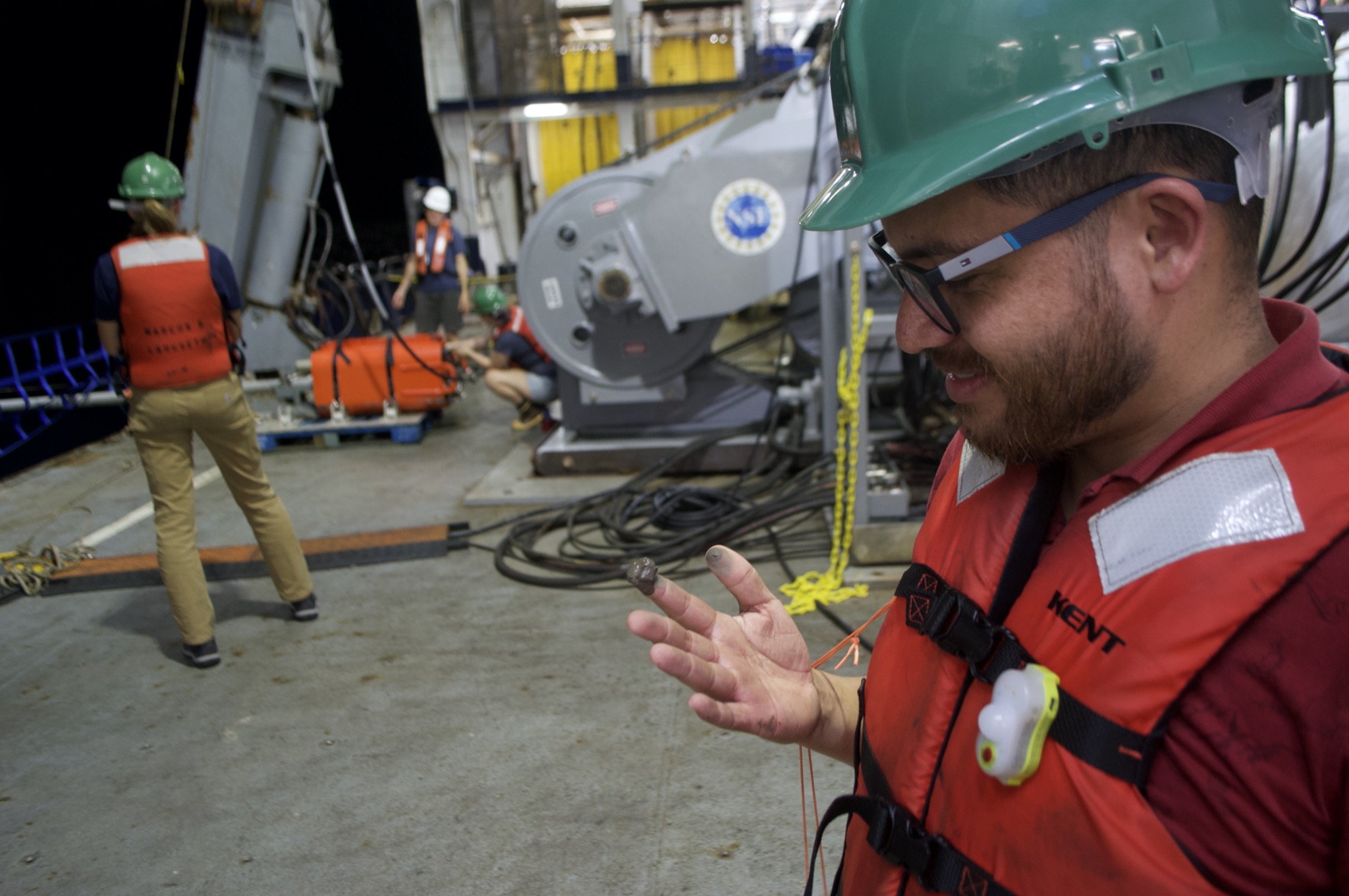
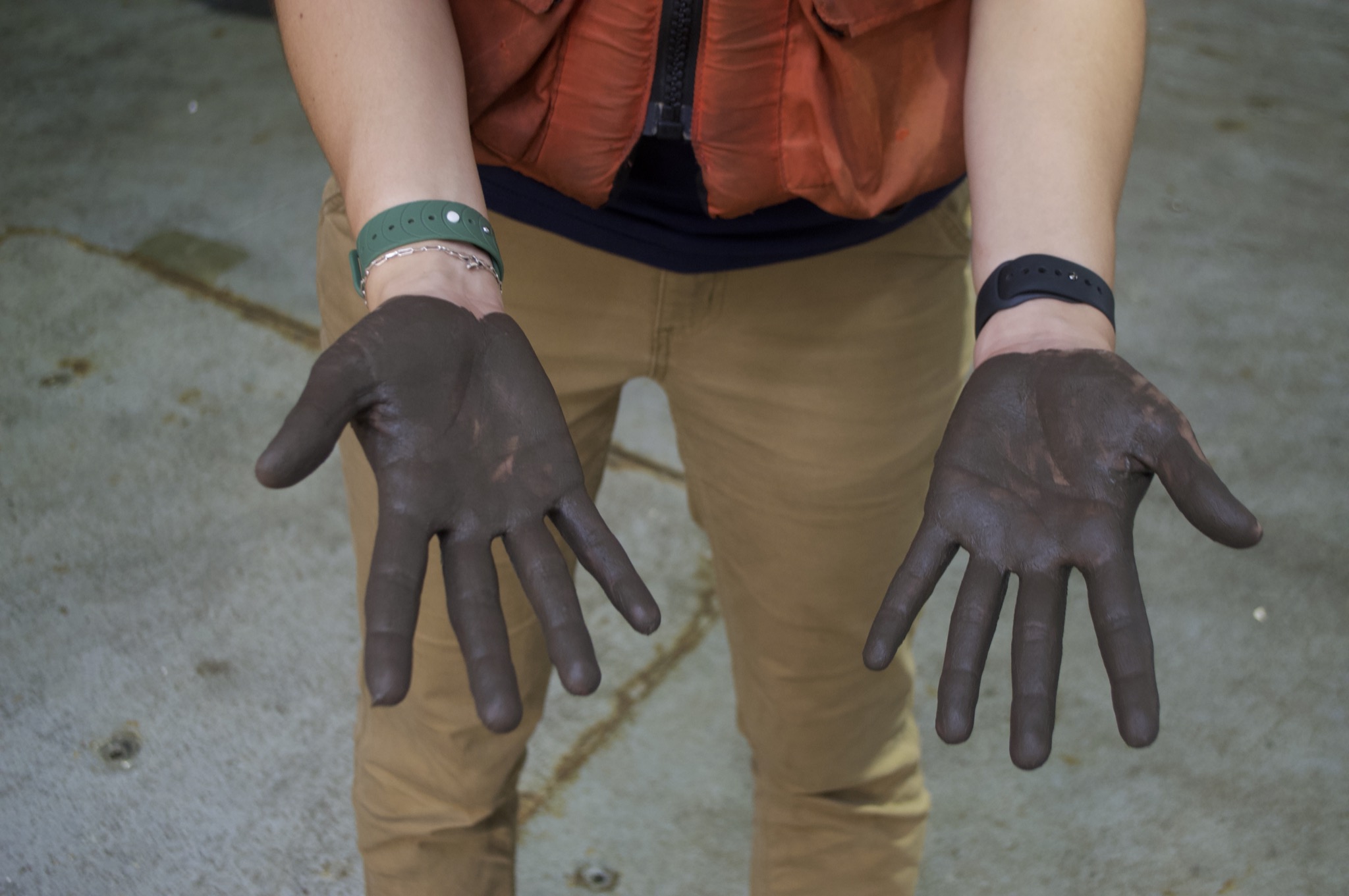
A few days ago, I had the chance to take some photos of Maddie and Harol retrieving the heat flow probe. I loved seeing their excitement and surprised faces as they handled a bit of the mud that came up from 4,000 meters below. It was amazing to watch them react to the soft texture of the sediments, as if suddenly all the theory we study in books became real. Experiencing moments like this is what makes expeditions so memorable.
December 12, 2025 (posted by Lindsay Worthington)
Hi everyone at home! We have finished up our second phase of seismic imaging and are now lowering the heat probe for our second round of heat flow measurements. Time has been flying by and it’s been fun to look at the data!
Here’s a map of where we’ve been so far – we’ve now covered the furthest eastern and western extents of our study area.
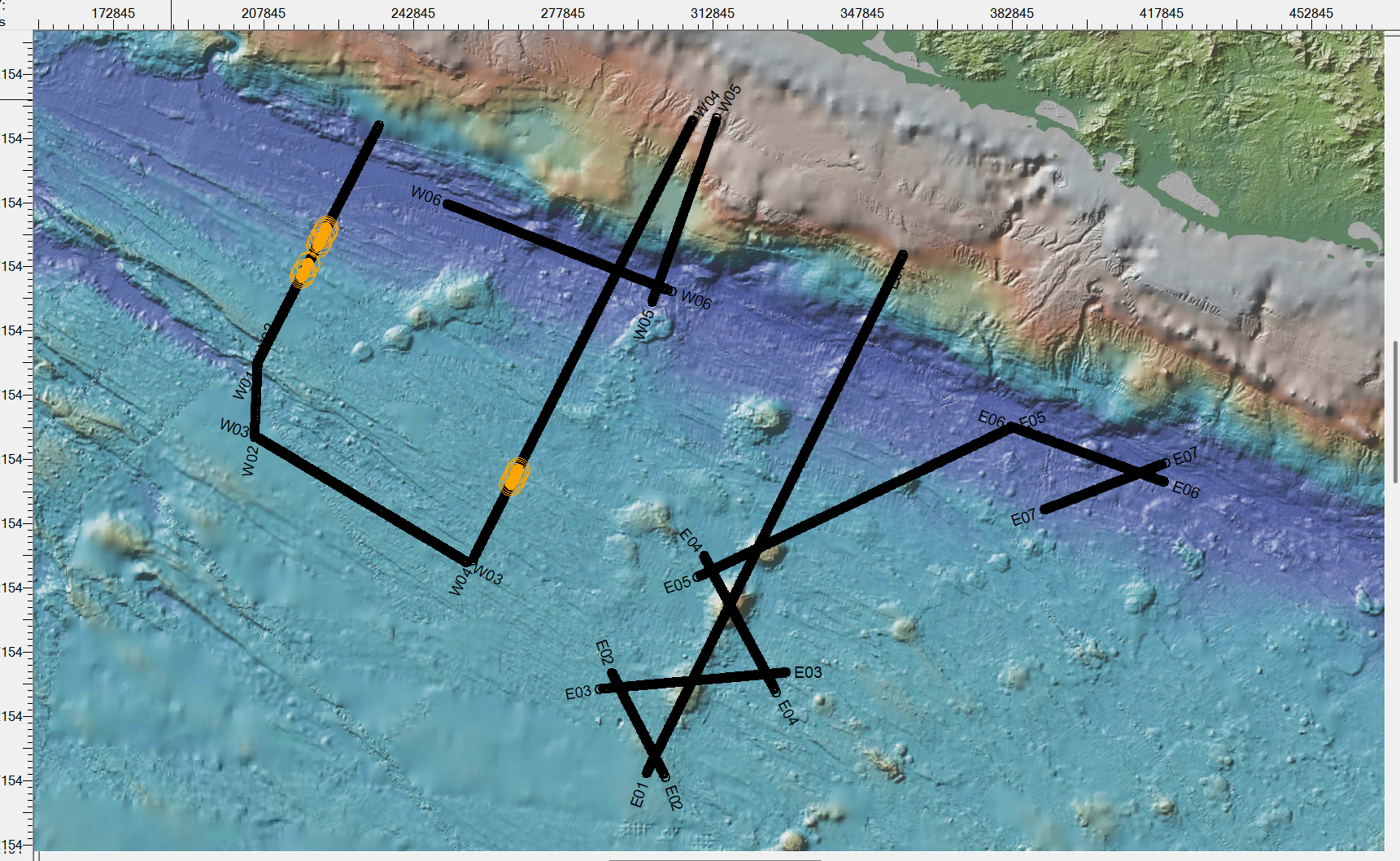
Map of the study area offshore southwestern Mexico, near Acapulco. Black lines show where we collected seismic imaging data. Orange circles mark heat flow station locations.
Here’s a look at some of our seismic imaging data. Our goals for this work were to get really detailed pictures of the upper few meters of sediments that are covering the ocean crust.
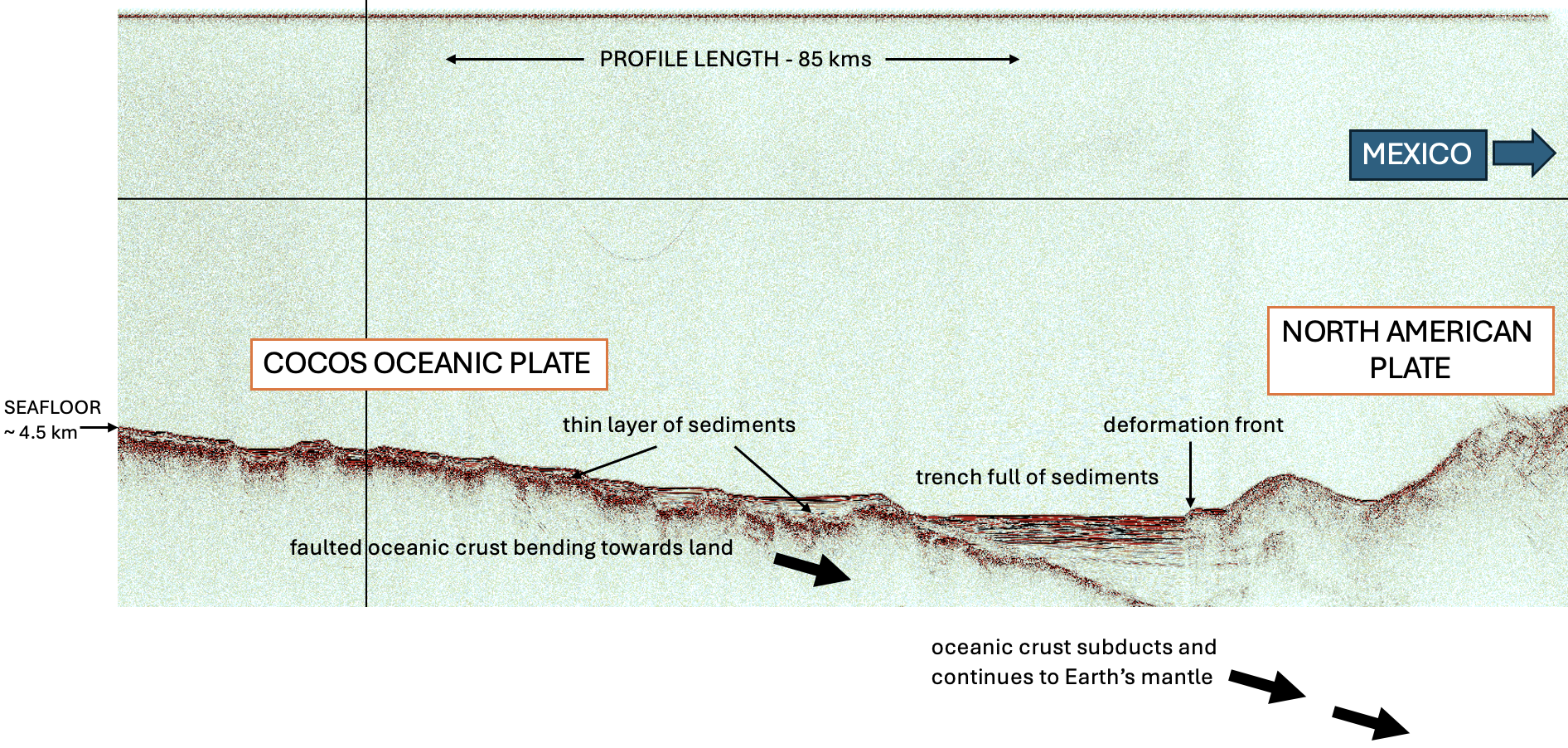
Seismic imaging profile showing the full 85 km-long profile on the western edge of the study area.
In the seismic image, we can see the faulted oceanic crust of the Cocos plate bending towards North America and beginning to subduct. The faults are caused by the bending of the plate. The oceanic plate is covered by a thin layer of sediments. Near the start of the subduction zone, the trench is full of sediments. The North American plate is built up of highly deformed sediments and rocks, causing the material to build up and uplift.
We want to make sure that the heat flow probe doesn’t hit any hard rocks or very rough sea floor, so we are mainly looking for flat-lying, coherent reflections around our heat flow sites. Here’s a close up of the heat flow sites that we chose along the profile.
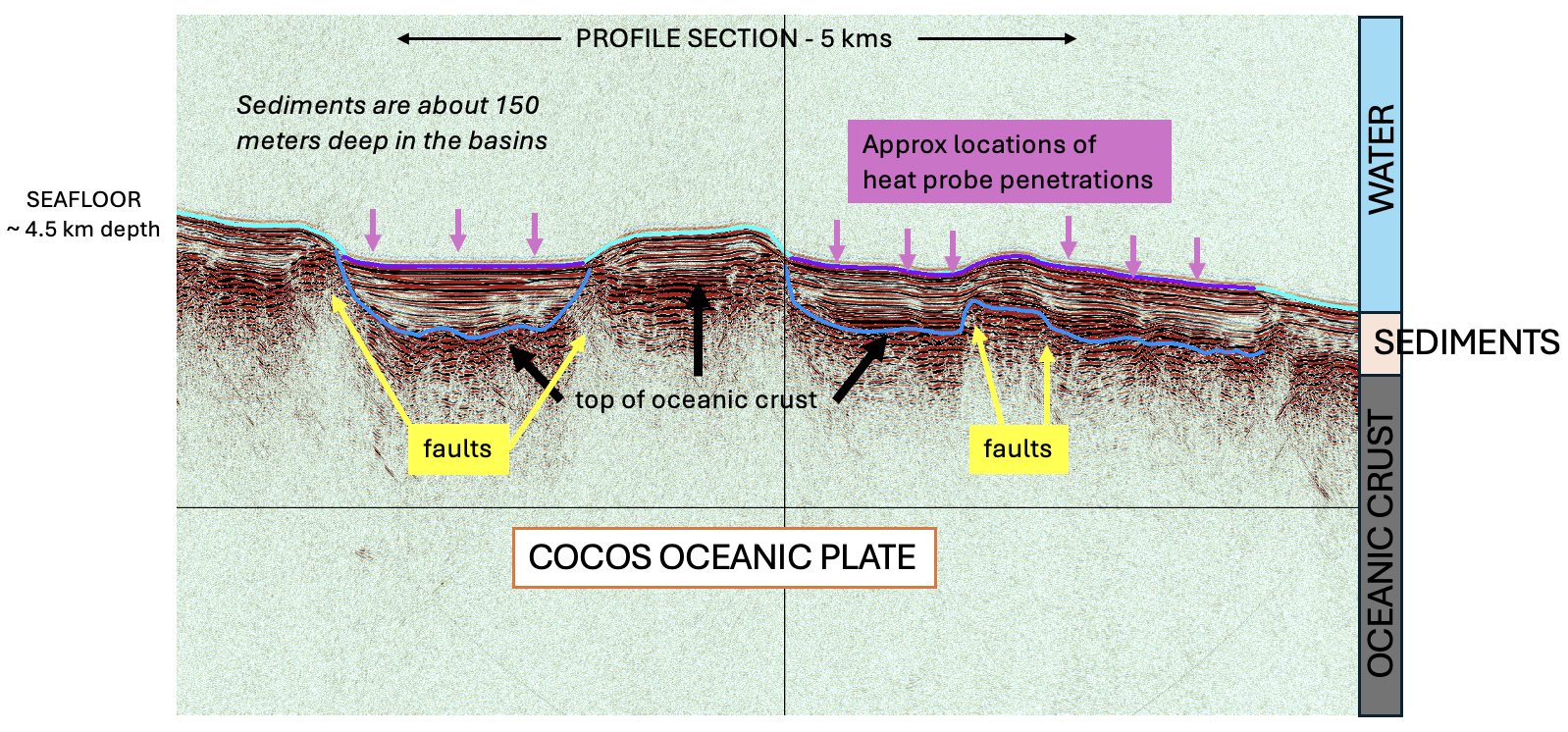
A close up view of the heat flow station location.
When looking closer at the heat flow station location, we can see the sedimentary layer in a bit more detail – the sediment is lots of layered marine muds and clays. The very bright layer is the top of the oceanic crust. It is more dense and harder to penetrate with the seismic imaging than the sediments, that’s why the image gets pretty faint below the top of the oceanic crust.
Lots of good stuff to investigate further in these data! Go science!
December 13, 2025 (posted by Isabela Macías Iñiguez)
One of the coolest things about life at sea is that sometimes your ceiling is just the sky. As the cruise goes on, I’ve been learning the ship better—where you get the clearest view of the sky, which decks feel nicer when the sun is out, and the quiet spots at night.
Photo: Isabela trying to catch the sky.
What still amazes me is how there are always moments that impress you, no matter how many times you go out to sea. Last night was one of those moments. We spent some time looking at the sky and were able to see a few shooting stars. Being in the middle of the ocean, far from city lights, really makes a difference.
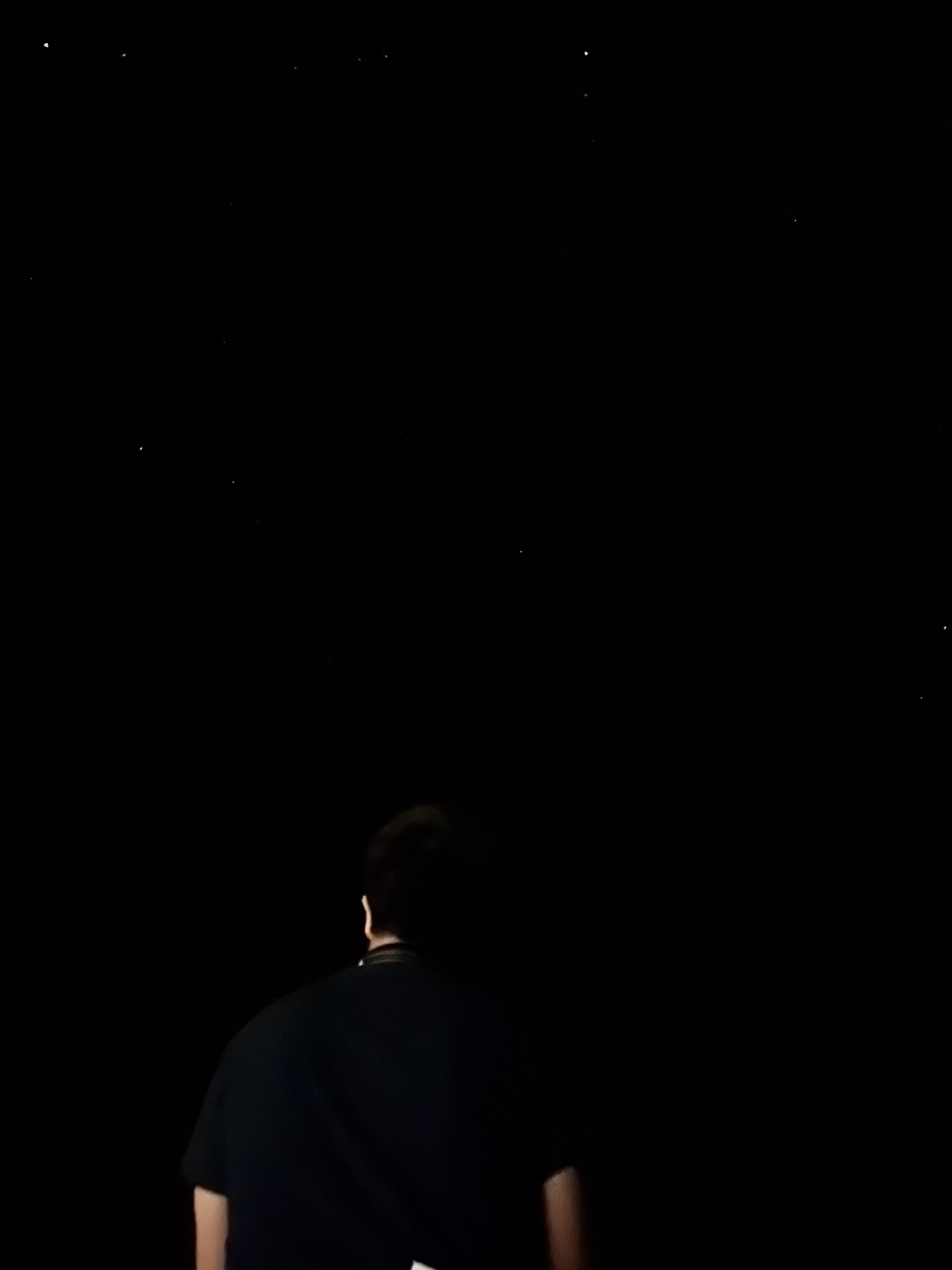
Photo: Joel waiting for more shooting stars.
The ship at night feels completely different. On nights without a full moon, you can’t really see anything around you—only the stars above and the ship’s lights reflecting on the ocean. It can feel a bit intimidating at first, but it quickly becomes part of daily life on board.
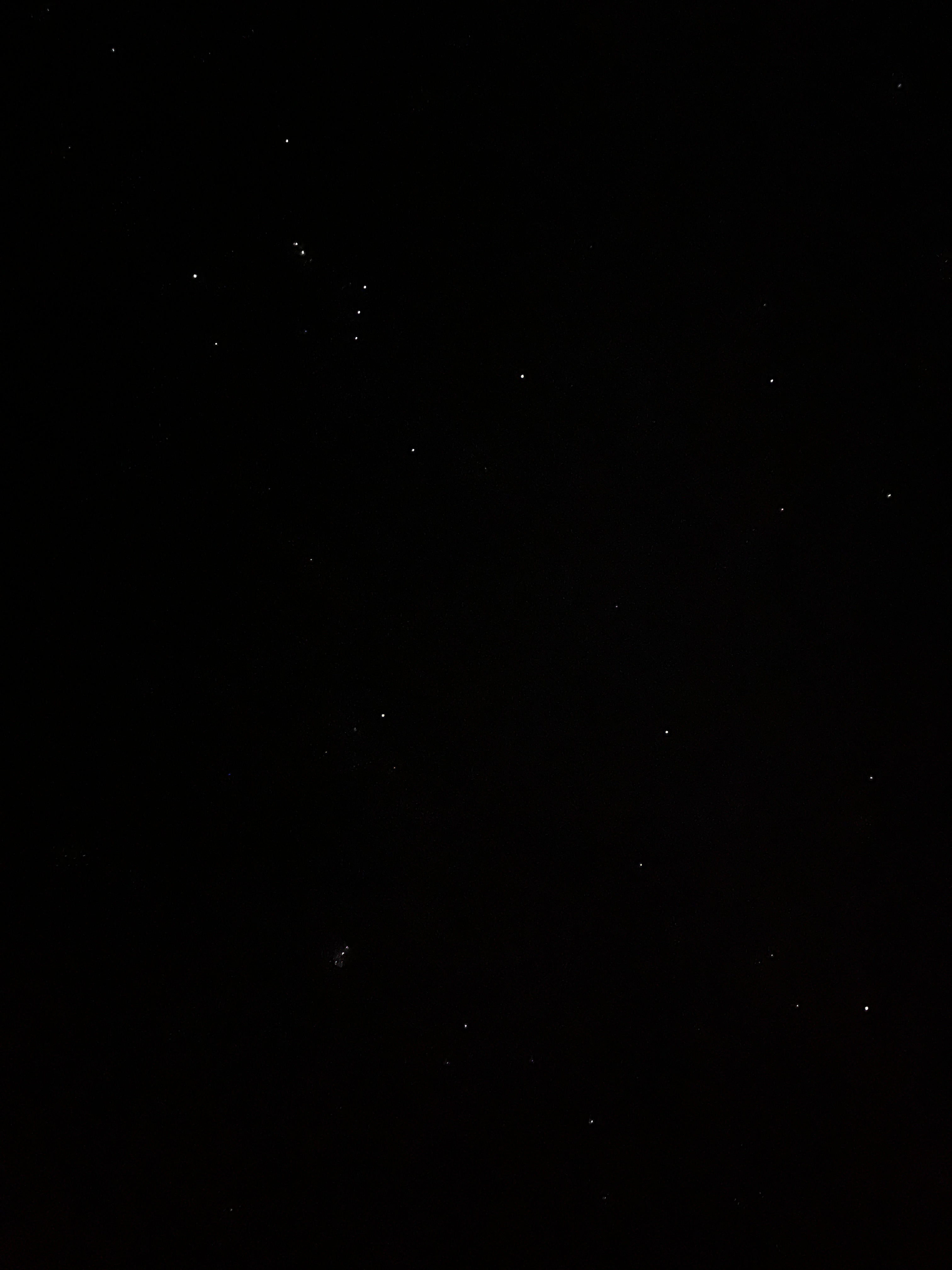
Photo: A stary sky in the middle of the ocean.
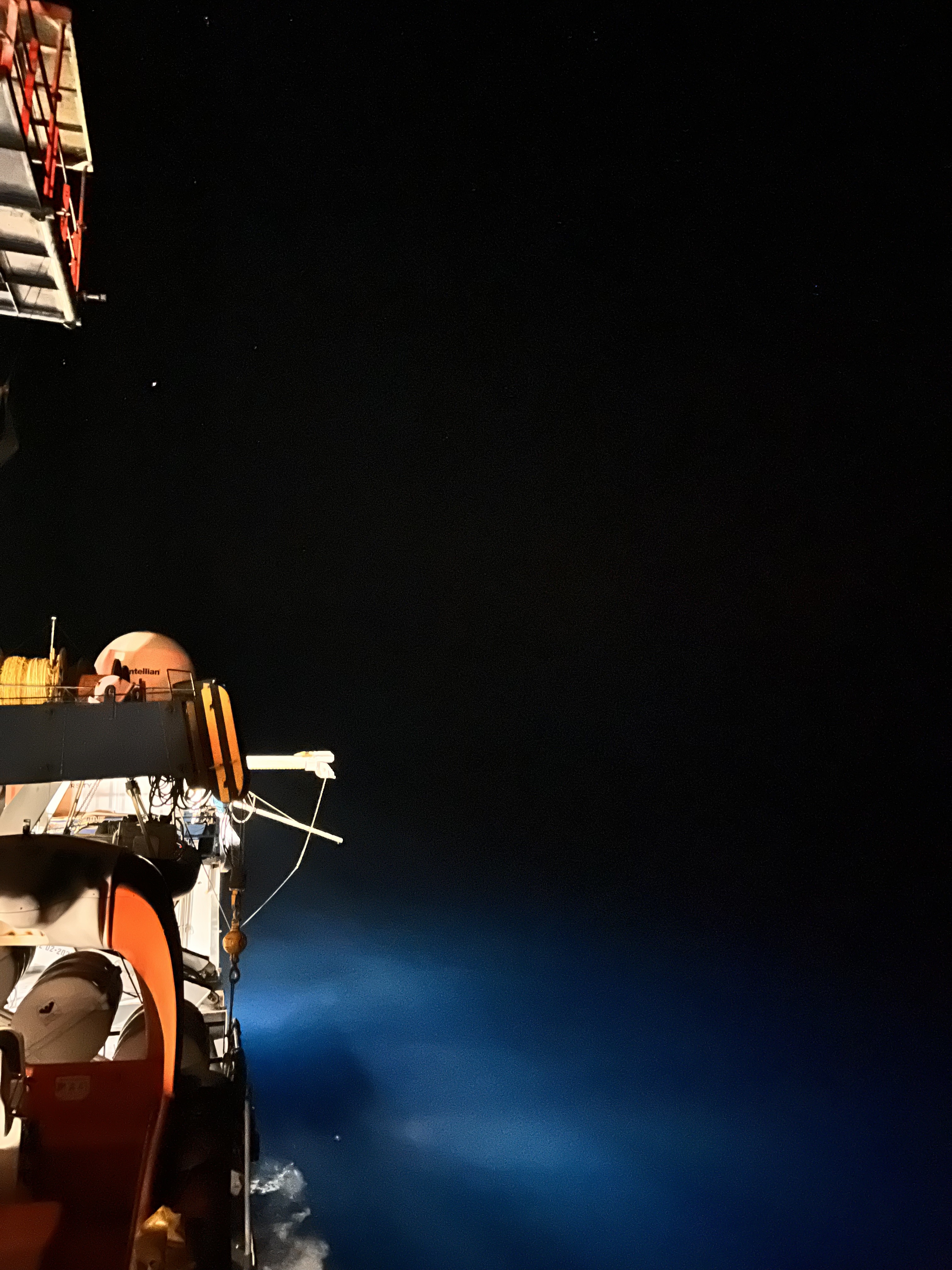
Photo: The ship at night.
December 14, 2025 (posted by Elizabeth Houghton and Maddie Hurd)
Decking the decks on the R.V. Marcus G. Langseth!
We are really getting in the Christmas spirit! Over the past couple of days (and nights), we have all pitched in to help decorate the main lab. Everyone has a stocking with their name on it, ready to receive small treats, notes, or surprises (ie, origami birds, frogs, butterflies, etc.). We even have a green hard-hat Christmas tree, complete with XBT copper-wire tinsel and an earplug garland. We’re having ourselves a merry little Christmas!
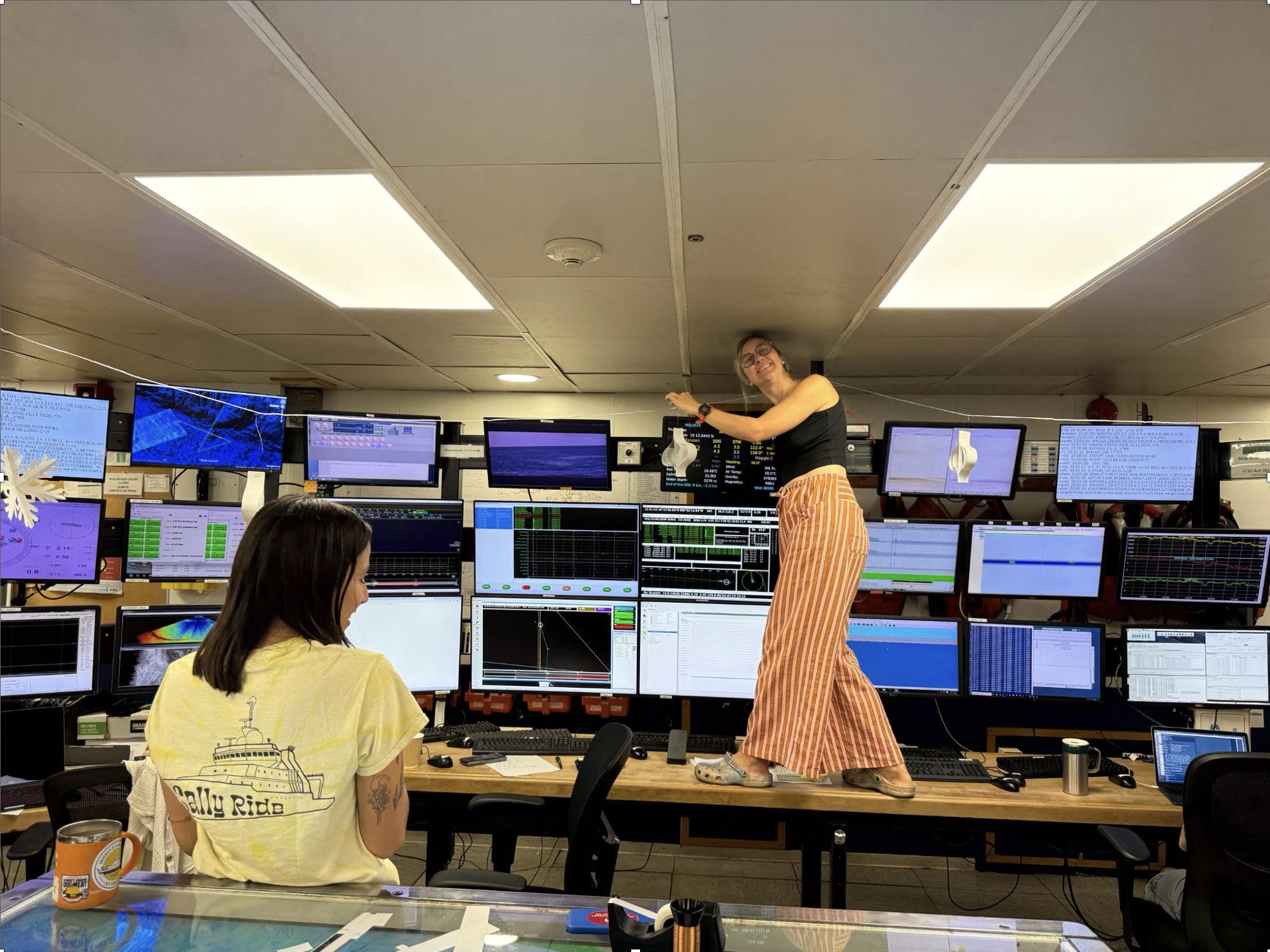
Photo: Isabela and Lindsay ensuring that no spot goes undecorated!
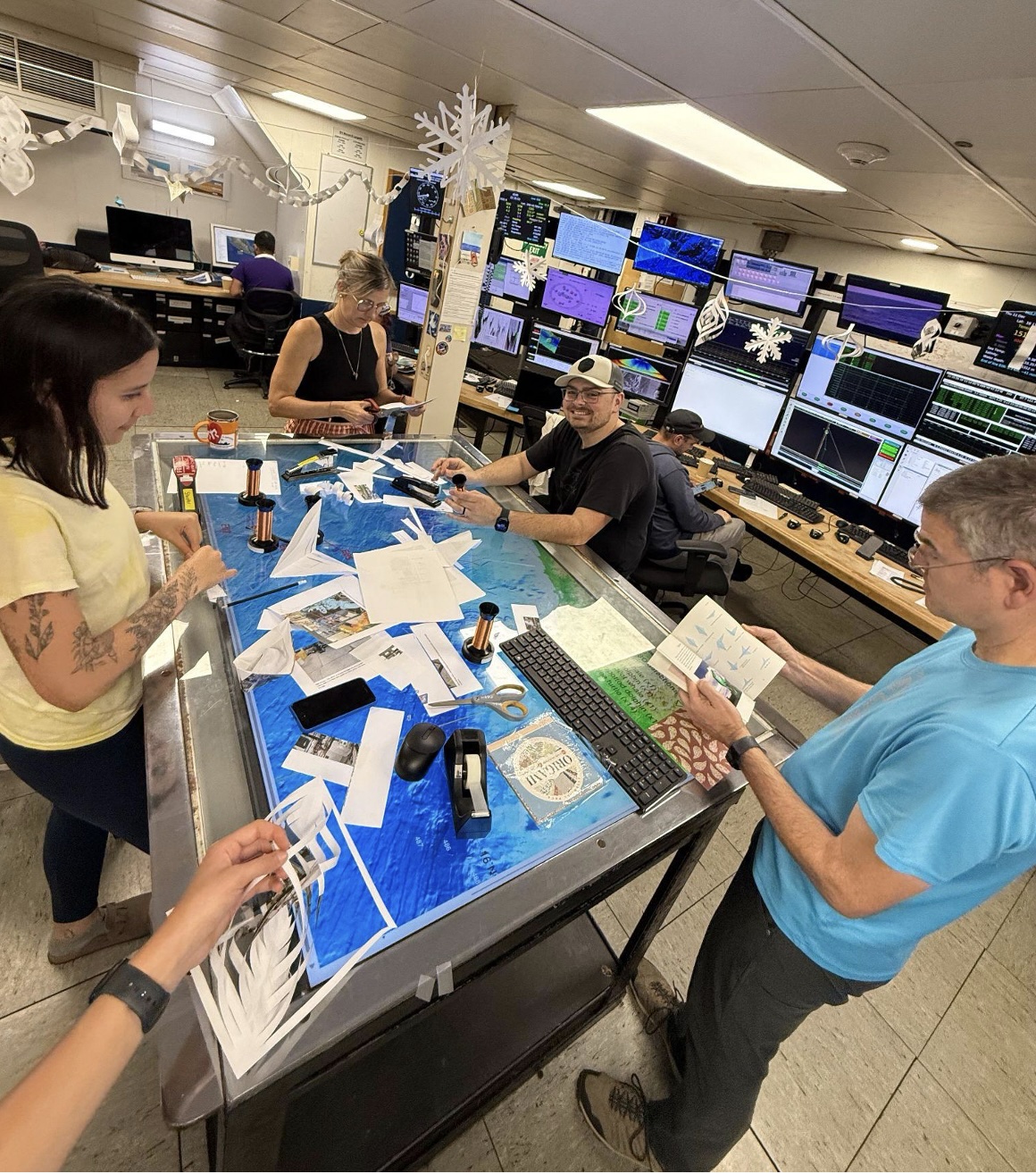
Photo: Isabela, Lindsay, Kain, Glenn, and Maddie craft ornaments from scrap paper to hang around the lab.
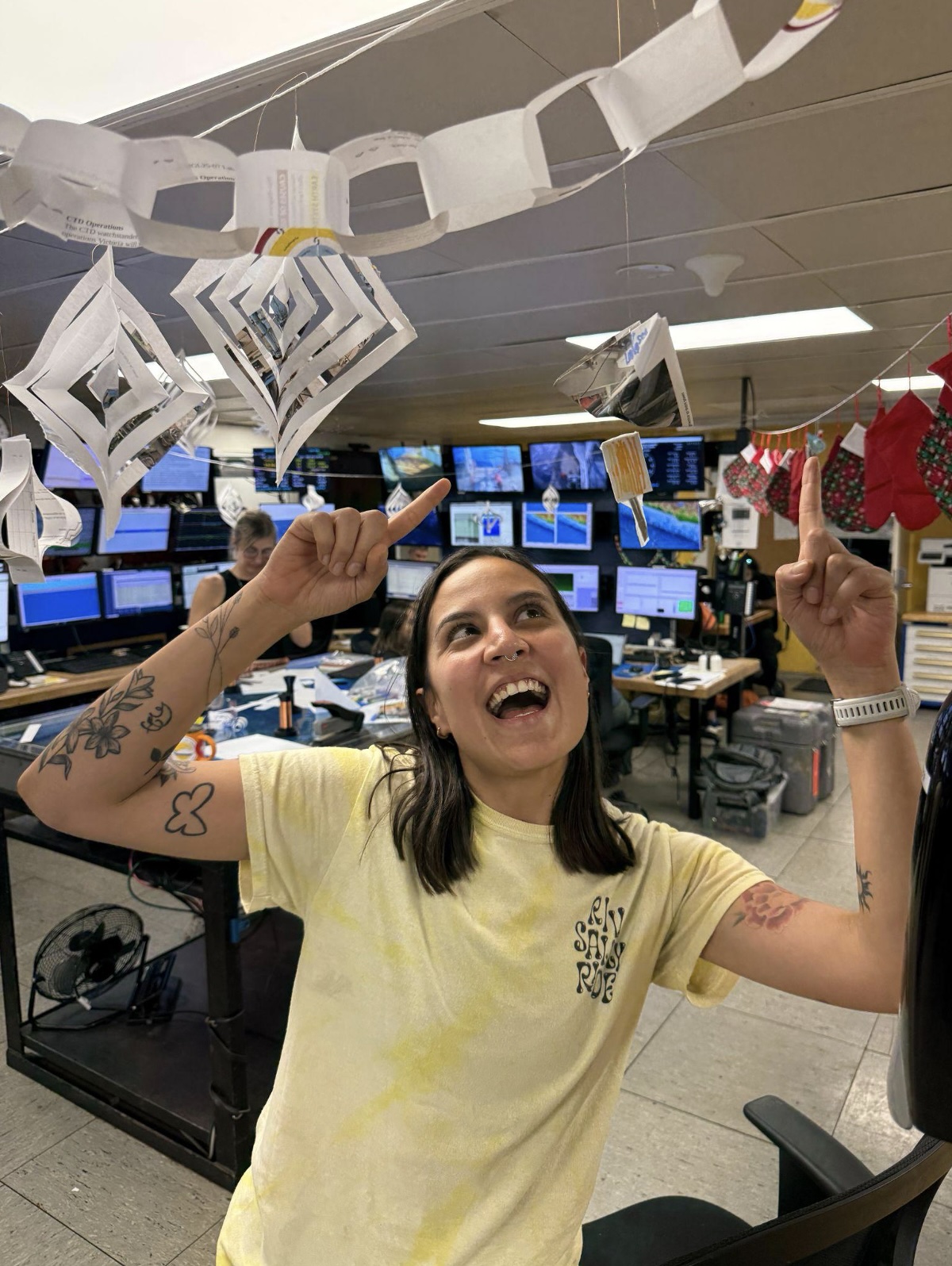
Photo: Isabela made a specialty ornament: the R.V. Langseth, complete with a heat flow probe!
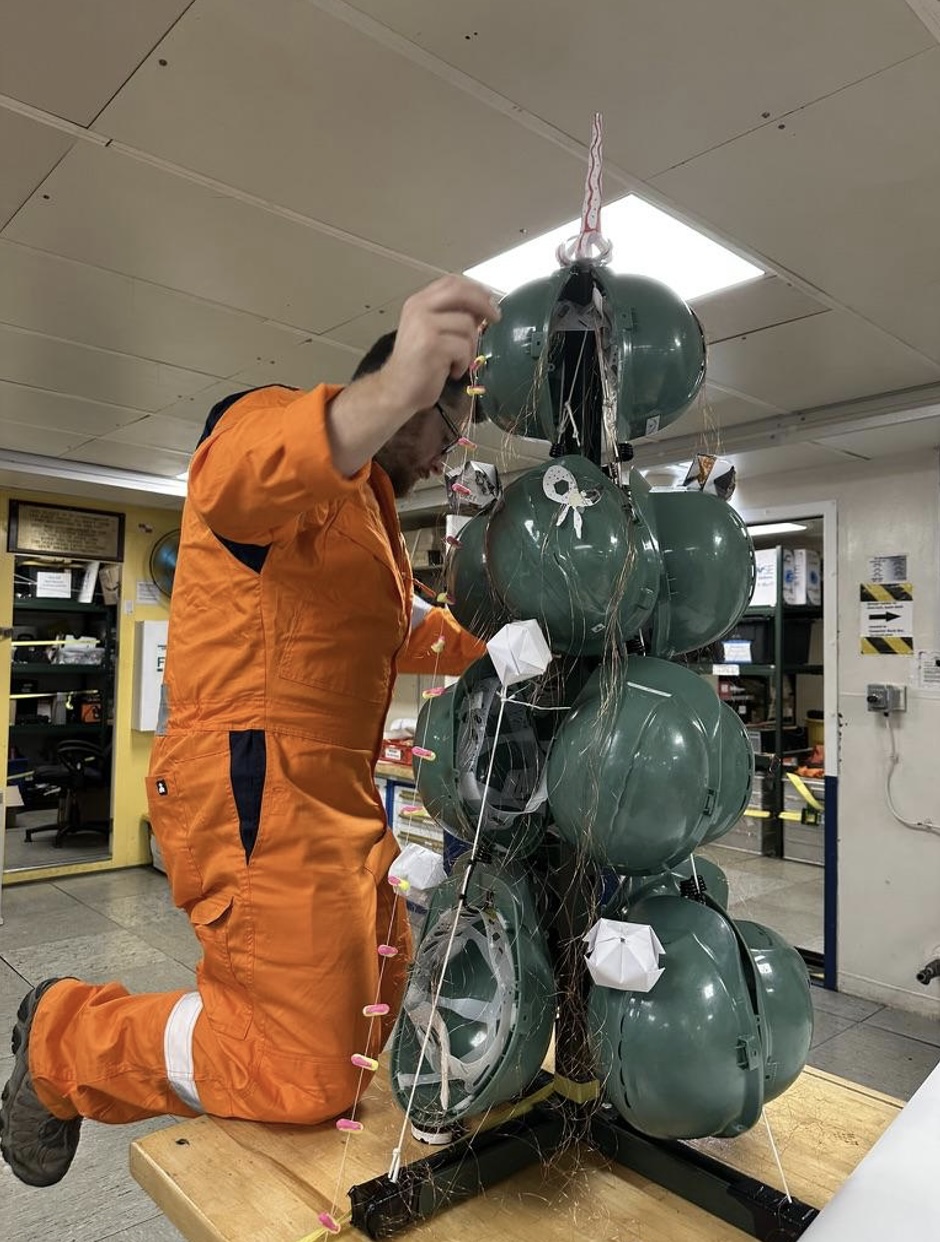
Photo: Cody suited up to add finishing touches to the tree!
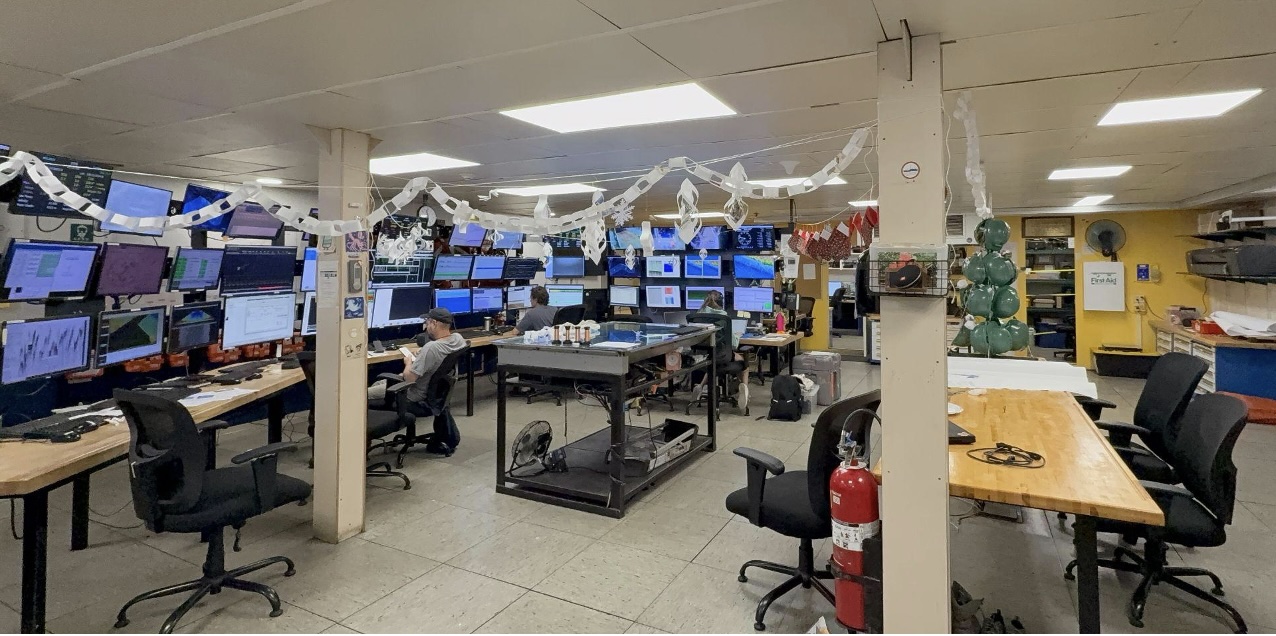
Photo: The Main Lab in full decor!
December 19, 2025 (posted by Manet Peña Salinas)
Sharing Science at Sea: A Talk with the Marine Crew
Our principal investigators, Glenn and Lindsay, gave a talk to the marine crew on
board about the research we are carrying out during this expedition in Guerrero.
They talked about the main scientific goals of the cruise, the instruments we are
using (such as seismic reflection systems and the heat flow probe), and why this region
is so important to study. It was a great opportunity to share how the work happening
on deck and in the labs connects to the broader questions we are trying to answer
about the ocean and the Earth.
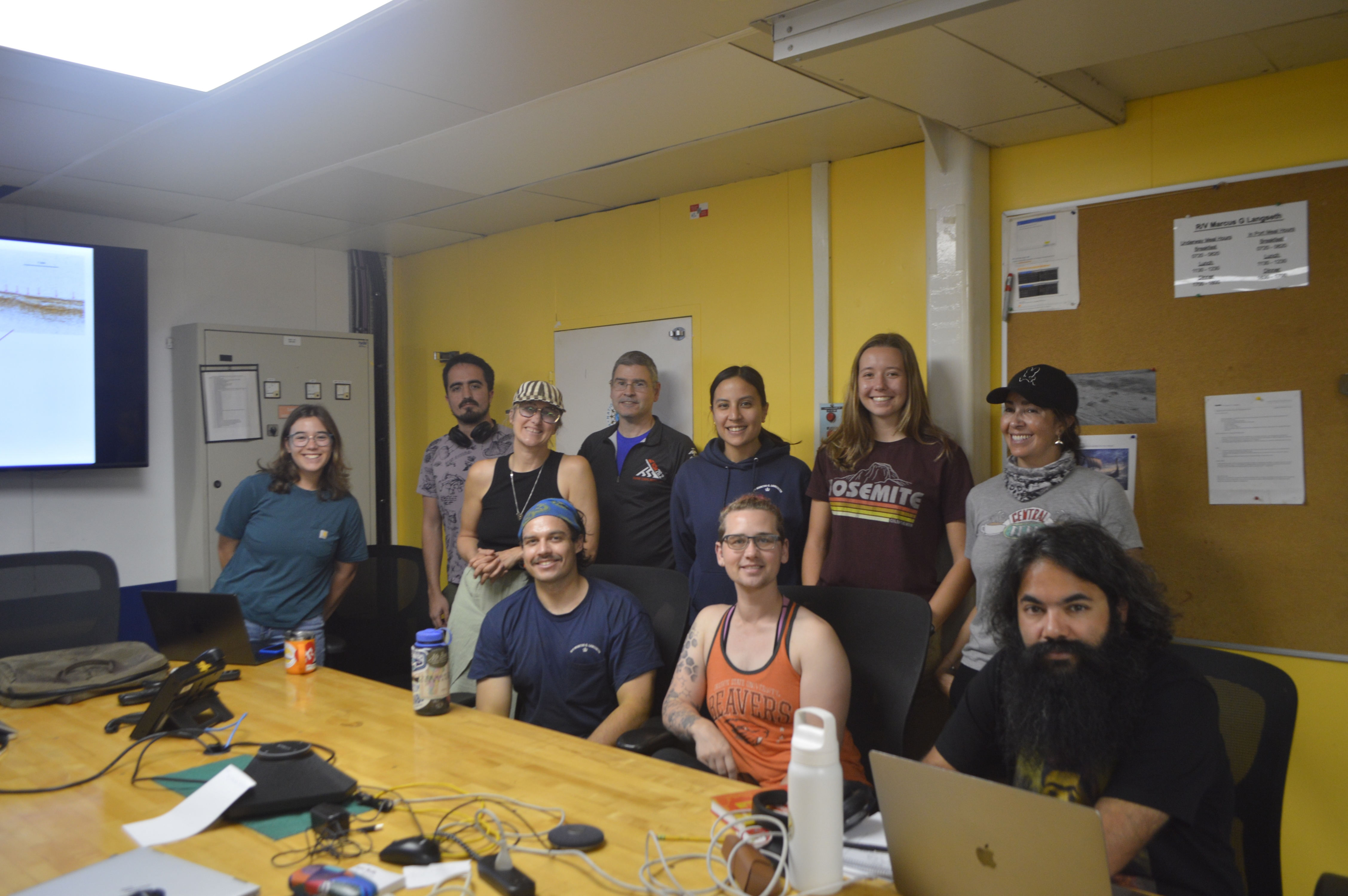
These moments of exchange are especially meaningful at sea, where scientists and crew
work side by side every day to make the expedition possible.
December 21, 2025 (posted by Lindsay Worthington)
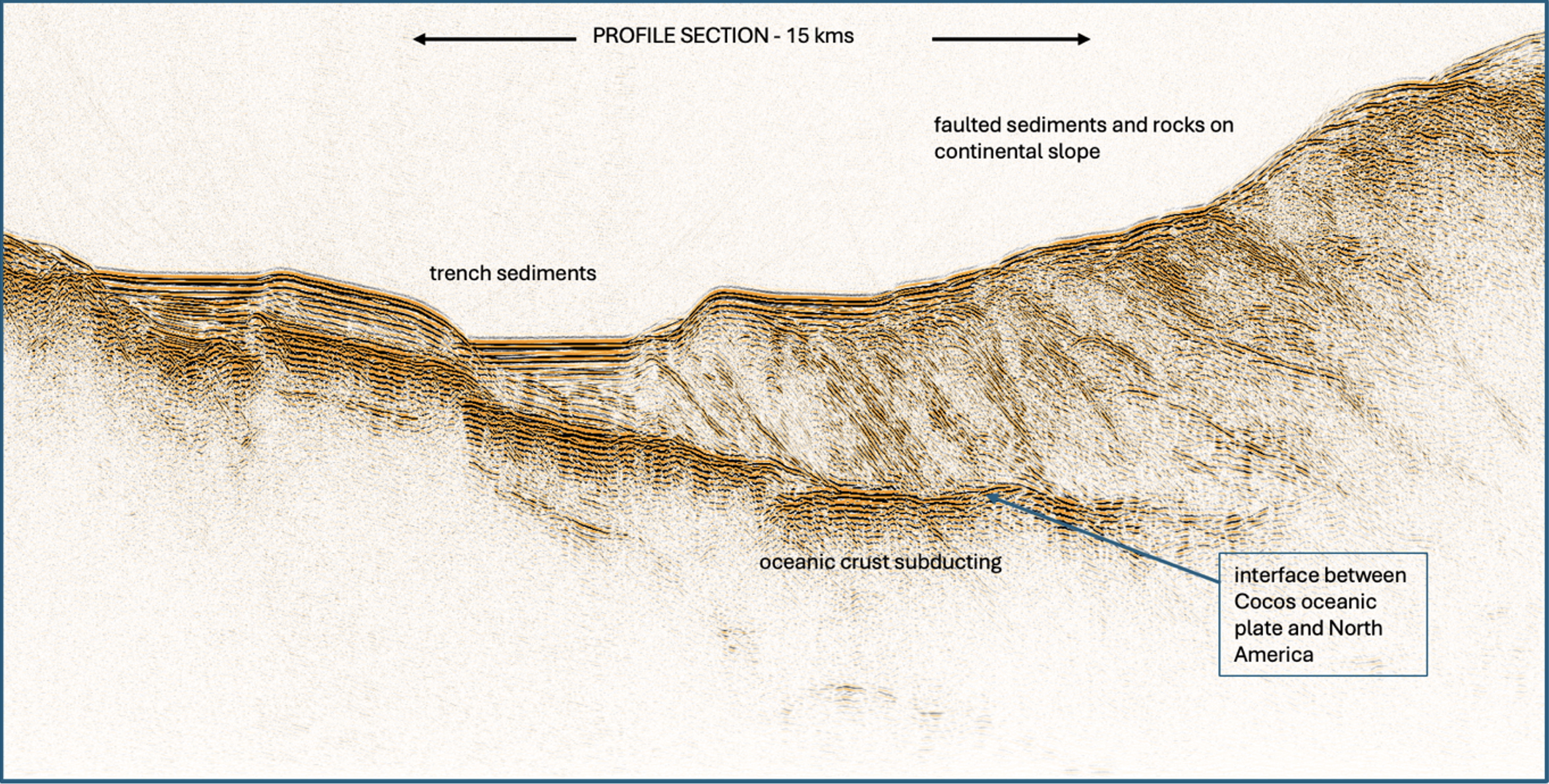
Just popping in to share a beautiful image across the subduction trench collected a few days ago. The imaging clearly shows the plate interface and the subducting oceanic crust, along with some layered structure within the basaltic oceanic crust itself. We can also see stacked thrust faults on the overriding plate. Just awesome! <3
December 26, 2025 (posted by Glenn Spinelli)
We finished up science operations (our last heat flow station at 2:00 AM on December 25 -- and the last few measurements include some very interesting results around a normal fault in the Cocos plate just seaward of the trench. After recovering the heat flow probe and securing everything, we started the approximately 24 hour transit back to port in Manzanillo. Along the way, there was cleaning and packing to do. But, we also took time to have fun on the holiday. Elizabeth and Maddie were crowned the champions of a corn hole tournament. We had a white elephant gift exchange, and opened stockings. And, in the evening, the Protected Species Observers organized an energetic round of Lotería (a.k.a. Mexican bingo).
Finally, as we were arriving in the harbor in Manzanillo, we had one final special treat -- two humpback whales (a mother and calf) gave us a fantastic show, breaching multiple times just outside of the harbor.
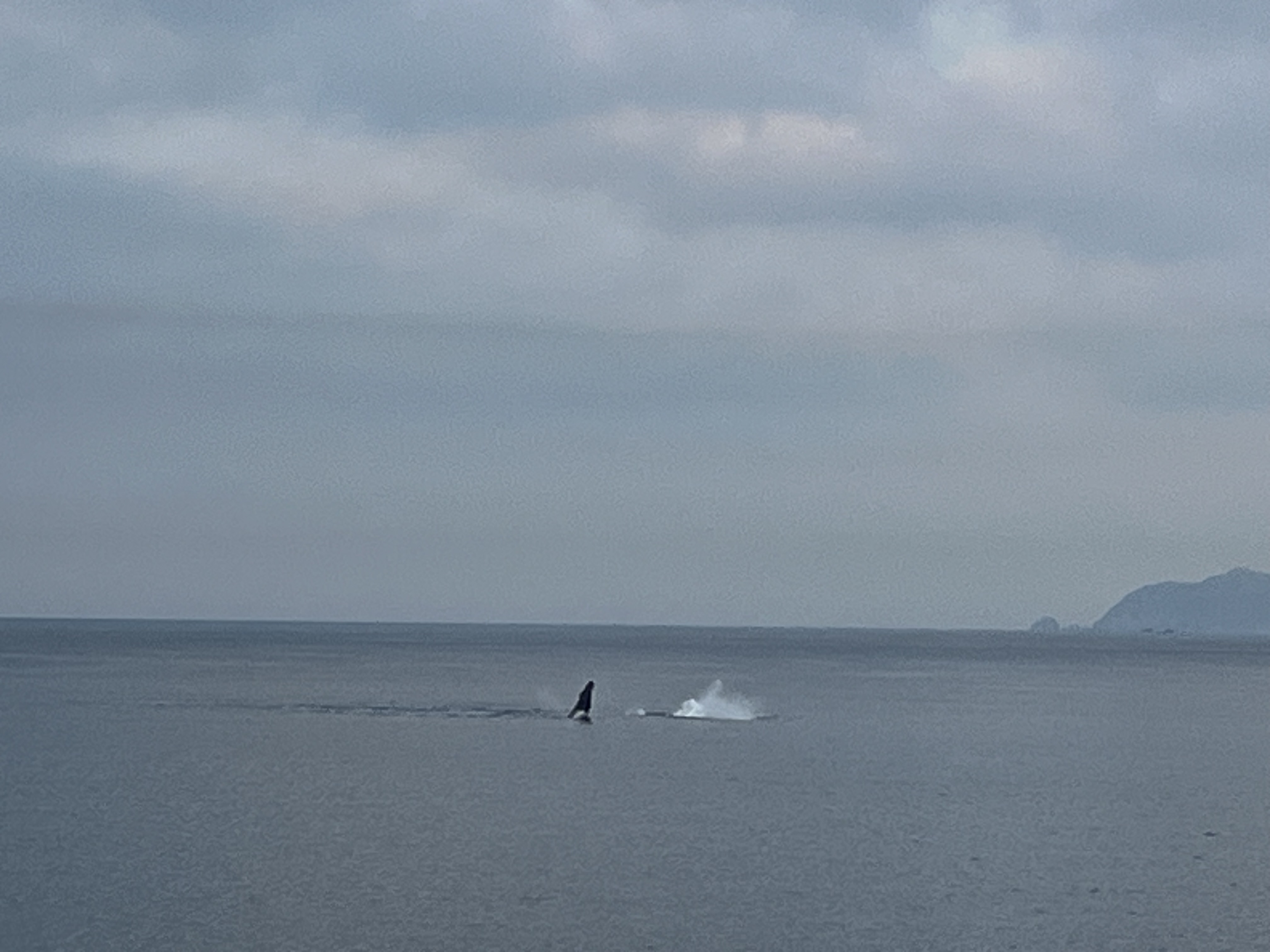
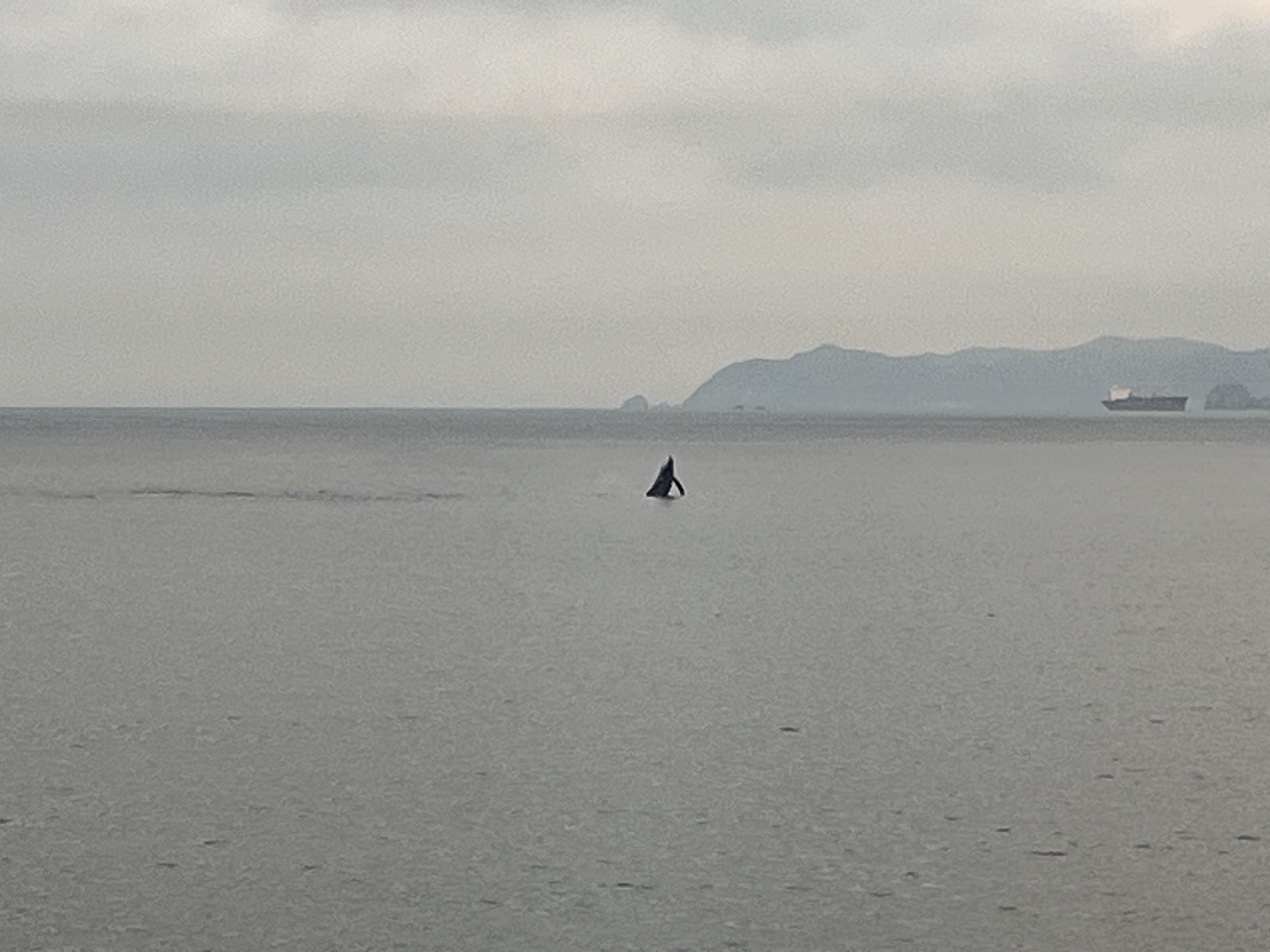
Photos: Mother and calf humpback whales breaching just outside of the harbor in Manzanillo.
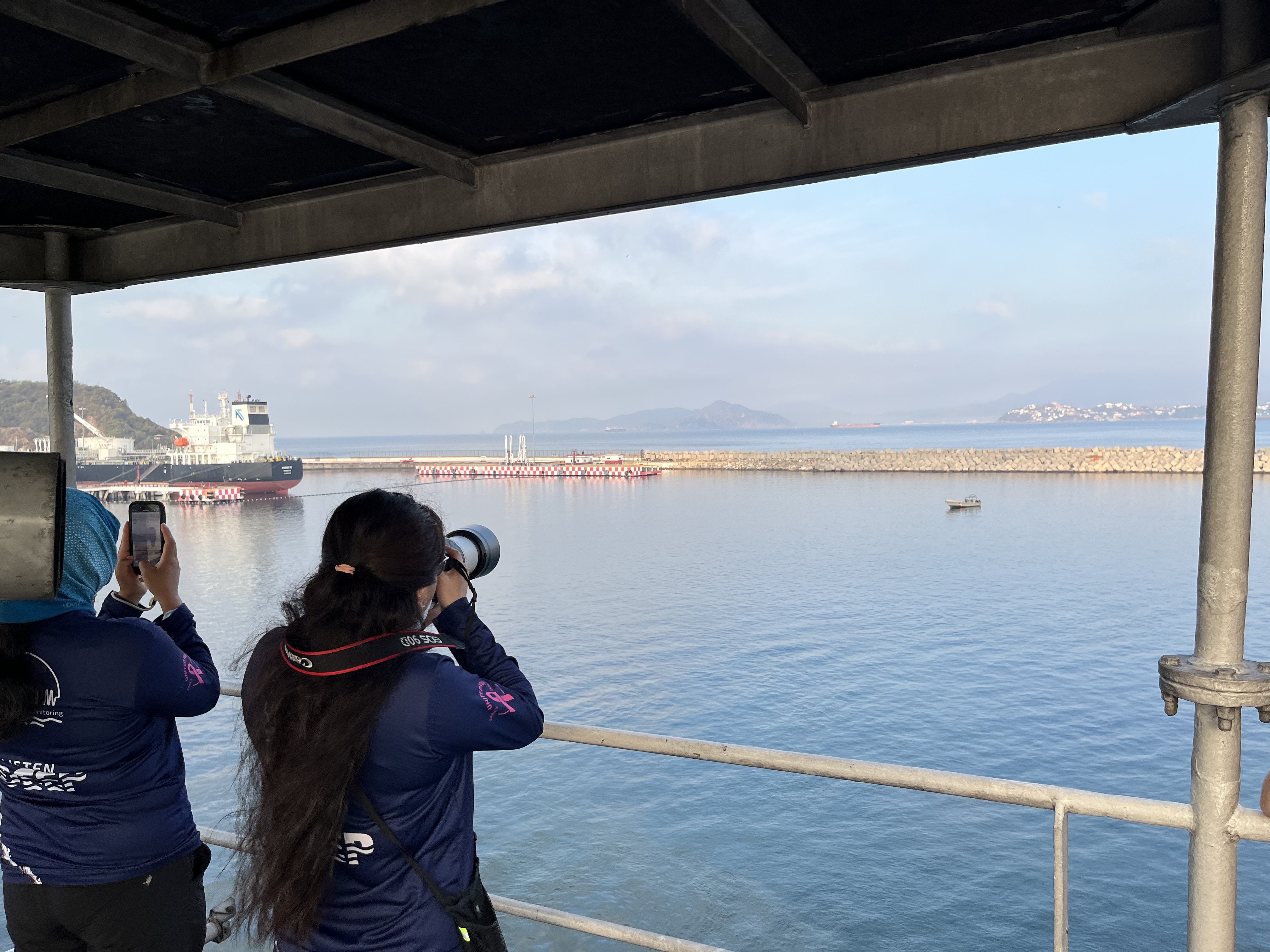
Photos: A couple of excited Protected Species Observers getting photos of the mother and calf humpback whales just outside of the harbor in Manzanillo.
It was a very sucessful research cruise, with a wonderful science party and great crew. Now, we are looking forward to the analyzing the great data that we collected and learning a lot more about subduction zone processes. Safe travels for all of our scientists and crew heading home for some belated holidays.