New Study Suggests an Embryonic Planet Once Shared Earth’s Solar System
August 5, 2026
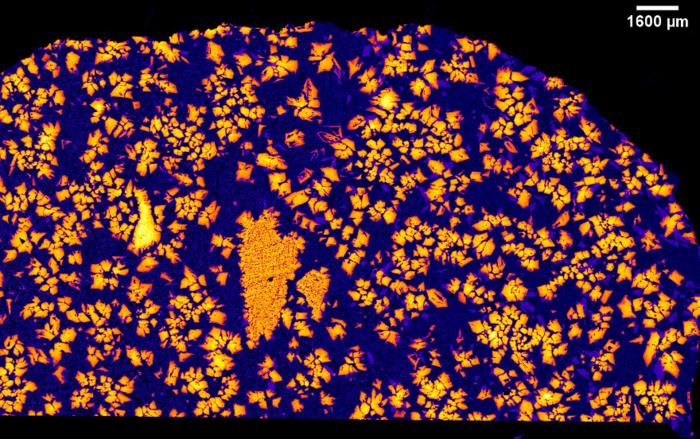
An X-ray image of NWA 12774. Credit: Aaron Bell/CU Boulder
Scientists on the third rock from the sun, including a geologist based in Socorro, New Mexico, have traced the origins of a rare space rock to a protoplanet, an embryonic moon-to-Mars-sized planetary body formed just a few million years after Earth’s 4.56 billion year-old solar system began.

The new collaborative study by researchers from New Mexico Tech and the University of Colorado Boulder, published recently in the journal Earth and Planetary Science Letters, suggests the volcanic rock, named NWA 12774, originated from a full-fledged world scientists never knew existed. Their findings are based on the fragment’s novel chemical composition, which can’t be attributed to any known celestial body.
“Essentially, we found evidence of a massive, long-lost planet formed early in the history of the solar system but destroyed through impact,” said Laura Waters, an associate professor of Earth and Environmental Sciences at New Mexico Tech and co-author of the study.
Like a chip off the old block, NWA 12774 was likely hewn from its parent protoplanet in a cataclysmic collision that launched its journey to earth’s surface. There the fragment waited an eon for scientists to trace its geological DNA. Now, this miniscule meteorite, weighing only about half a kilogram (one pound), could be the key to unlocking an entire epoch of planetary evolution.
Origin Story
NWA 12774, one of the oldest relics in cosmic history, was uncovered in 2019 in Northwest Africa at a meteorite site in the Sahara Desert. Based on its composition, the rock was classified as one of an exceedingly rare group of meteorites called angrites. Fewer than 70 of the 80,000 meteorites cataloged on Earth fall within that classification.
Angrites are distinguished from the vast meteoric pack by one missing chemical compound. They contain only a trace amount of silicon dioxide (silica), which is a major component of all rocky planets in Earth’s solar system. This geochemical difference proves angrites don’t share a genetic tree with terrestrial planets, leading scientists to conclude the fragments originated from small asteroids.
Waters and her colleagues from the University of Colorado Boulder are the first to challenge this assumption. Their examination of NWA 12774 revealed an unexpectedly large amount of aluminum-rich clinopyroxene crystals. These crystals only form under great pressure, suggesting the sample originated from a planetary body much larger than an asteroid.
Beneath the Surface
To explore this discovery further, the joint team devised a computational tool, a geobarometer, to reconstruct the pressure conditions needed to form the crystals found in NWA 12774. After a year in development and testing, the computer model returned astonishing results.The angrite’s clinopyroxene crystals formed at a minimum pressure of 17.5 kilobars, more than 15 times the pressure at the bottom of the Pacific Ocean roughly 36,000 feet deep.
This initial finding indicated the parent body of NWA 12774 was much larger than a typical asteroid. The team calculated a minimum radius of 1,000 kilometers (621 miles), which is comparable to Earth’s moon
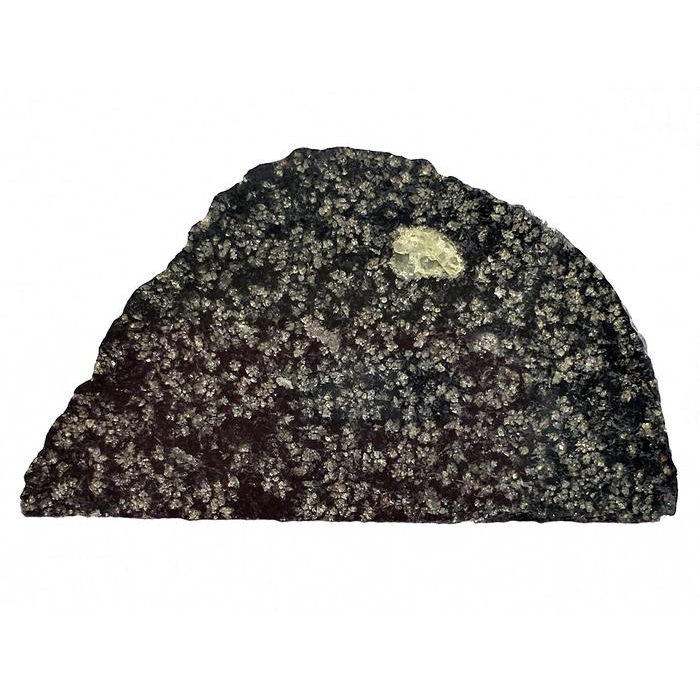
A slice of NWA 12774.The green circle is an olivine crystal, a magnesium-rich mineral. (Credit: John Kashuba)
The potential size of the protoplanet grew as other clues surfaced. For example, the crystals inside the angrite still retained sharp edges and chemical patterns, which would have melted if stored for long periods of time at shallow depths. While the sharp edges indicated the crystals formed deep in the planetary interior and were extracted quickly, presumably by impact, the aluminum-rich compositions pointed to growth at high pressure in a body with a radius closer to 3,300 kilometers (2,050 miles). Think roughly the size of Mars.
“For a planet of this size to exist when our solar system was so young suggests the process of planetary accretion occurs much faster than previously thought,” said Waters.
Planetary accretion, or the formation of planets, is believed to take anywhere from 50 to 100 million years. At least, that’s what numerical models have calculated. The work by Waters and her colleagues offered a dramatically shorter time span – only 4 million years – for planets to form.
The finding of a high pressure rock this old also supports pebble accretion, the idea that planet-sized bodies are formed by an accumulation of particles, ranging from centimeters up to meters in diameter. The alternative theory is that planetary accretion occurs by merging asteroid-sized bodies.
Many questions remain related to protoplanets and the angrites scattered throughout space and time. Is there definitive evidence of how these large bodies formed? What contributed to their demise? Looking ahead, the team hopes to study the vast array of meteorite fragments available to scientists to discover far-reaching insights on Earth’s beginnings.
Laura Waters joined New Mexico Tech in 2020. She is primarily interested in constraining the processes that govern the evolution, differentiation, and stratification of continental crust through petrographic (studying minerals and whole-rock compositions) and experimental studies of volcanics related to subduction and extension.
Aaron Bell, an assistant research professor in the Department of Earth Science at the University of Colorado Boulder was the study’s senior author.
Publication details
Aaron S. Bell et al, High-pressure clinopyroxene in Northwest Africa 12774 and new geobarometric evidence for a planetary embryo-sized angrite parent body, Earth and Planetary Science Letters (2026). DOI: 10.1016/j.epsl.2026.120029
Journal information: Earth and Planetary Science Letters
By Kimberley Clementi