New Mexico Tech Hosts Stellar Meeting, Advancing Knowledge of the Cosmos
March 26, 2026
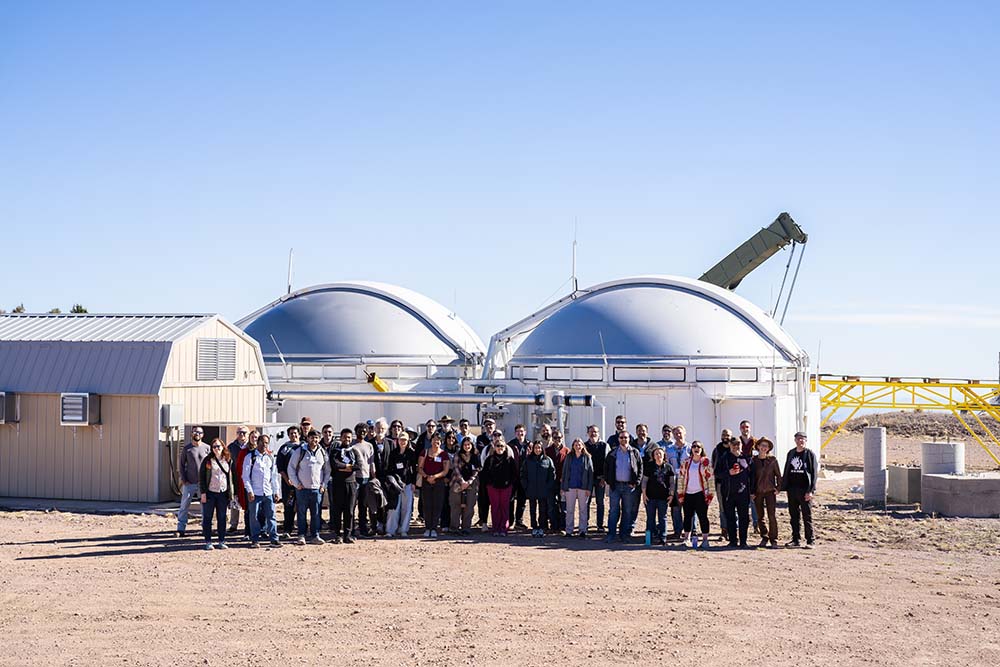
Conference attendees observe the MROI.
New Mexico Tech hosted space-pioneering astronomers and physicists from across the globe last week to discuss scientific and technical developments at the Center for High Angular Resolution Astronomy (CHARA) Array at Georgia State University and New Mexico Tech’s Magdalena Ridge Optical Interferometer (MROI) in the Magdalena Mountains. More than 100 scientists from 14 countries participated in the 2026 CHARA and MROI Science Meeting, learning the latest results from the ultramodern observatories.
“The CHARA Array and MROI are changing the way we see stars. They are advancing humanity’s knowledge of the cosmos at unrivaled angular resolution,” said Dr. Ryan Norris, an assistant professor of physics at New Mexico Tech and one of the event’s organizers.
The two flagship projects use optical interferometry (OI), a technique that combines the light gathered from multiple telescopes together to achieve high angular resolution. Smaller telescopes have low image resolution and are unable to capture some of the finer details of the objects they observe. In contrast, large telescopes sitting on Earth’s surface obtain higher resolution but require complex corrections because the atmosphere disturbs the incoming stellar light, giving stars their twinkle – a poetic, but costly, distortion.
CHARA Array and MROI overcome these limitations via a process known as aperture synthesis. The electromagnetic radiation collected at a number of separate small telescopes is combined to create an image comparable from a larger telescope, with information combined in a manner that allows the surfaces of stars and the inner regions of their circumstellar environments in astonishing detail.
A Mountain Top View of MROI
Those who attended the 2026 CHARA and MROI Science Meeting in person were given a firsthand look at MROI. The excursion traversed a rugged 8-miles to the summit of Magdalena Ridge, where the interferometric array sits 10,500 feet above sea level.
The ambitious installation currently houses two telescopes. The first telescope was assembled onsite in 2018 and the second in 2023 after a funding hiatus during the COVID-19 pandemic. The two telescopes combined data for the first time on July 12, 2025, successfully achieving what is called “first fringes”-- a milestone measurement that confirms the instrument’s complex systems can work in precise, real-time coordination.
MROI recorded “first fringes,” or an interference pattern named for its colorful tassel-like appearance, when the team targeted a bright star in the Swan constellation known as Epsilon Cygni. Since then, they’ve replicated their success with dozens of additional stars.
“Every component, down to the concrete piers and the dozen mirrors in the light path, had to perform perfectly,” said Dr. Michelle Creech-Eakman, professor of physics and MROI Project Scientist at New Mexico Tech.
This long-awaited proof-of-concept, achieved with an 8-meter separation between the two telescopes, set the stage for the facility’s future. MROI will eventually feature 10 linked telescopes creating a “virtual mirror” 347 meters across, nearly the length of four football fields.
Team members anticipate these next steps will push the robustness and sensitivity of the telescopes further, using interferometry to produce model-independent images of faint and complex astronomical targets at resolutions over 100 times that of the Hubble Space Telescope. The implications extend far beyond astrophysics, impacting an entire ecosystem of space-related infrastructure, manufacturing, exploration, and defense.
“MROI represents a massive investment in New Mexico’s ‘Space Valley’ corridor and high-tech workforce,” said Norris.
“Space Valley” is a playful and apt spin on Silicon Valley, a reference to California’s Santa Clara Valley which was transformed from an agricultural hub into a technology hub by the semiconductor revolution of the 1960s and 70s. Similarly, New Mexico is positioned to lead growth in the regional space industry providing a hub for national and private space projects and technologies.
Dr. Creech-Eakman said, “This was the first tour of a large group of scientists on the Ridge since first fringes last year, so it was exciting to share our progress with our fellow astronomers and technology folks. We are planning for more meetings with the combined group in the future and hope to host the meeting here again in a few years.”
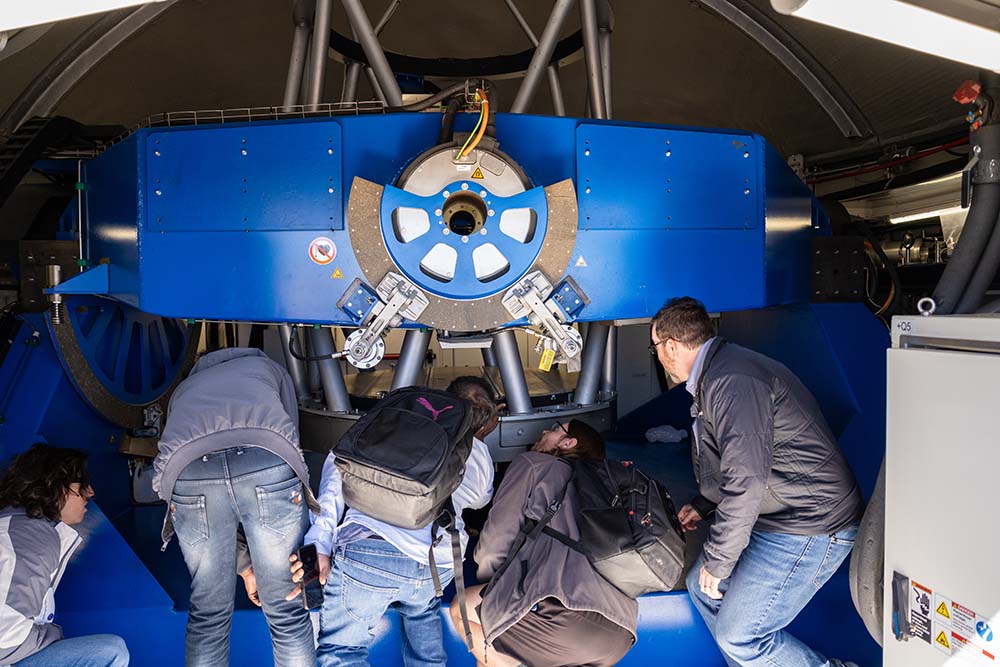
Visitors look at the inner-workings of the MROI.
Hands-on Optic Interferometry
The three-day CHARA and MROI Science Meeting was followed by an interactive workshop, New Visions in Optical Interferometry, organized in part by Dr. Norris and structured to train the next generation of astronomers.
Over the course of two additional days and ten presentations, experts in the field introduced participants to best practices in planning interferometric observations. They also explored how to use software tools, reduce interferometric data, use models, and reconstruct images of astronomical sources.
Hands-on sessions included exercises to measure a stellar diameter, detect a binary companion, model a circumstellar disk around a young star, and image starspots on the surface of a star.
The MROI installation was developed in partnership with the University of Cambridge, UK and the U.S. Air Force Research Laboratory. In May 2025, Dr. Norris received a CAREER award from the National Science Foundation to produce high resolution imaging of Red Supergiants via optical interferometry using the CHARA Array and MROI. The grant is $809,874 over five years.
CHARA Array was initiated at Georgia State University in 1977 and published its first scientific results in the July 20, 2005, issue of Astrophysical Journal. The array uses six telescopes spread across Mount Wilson in Southern California. It is funded by the National Science Foundation (grant AST-2407956).
Organizers acknowledge support for the workshop through the Heising-Simons Foundation. This includes travel support for students and postdoctoral scholars.
By Kimberley Clementi
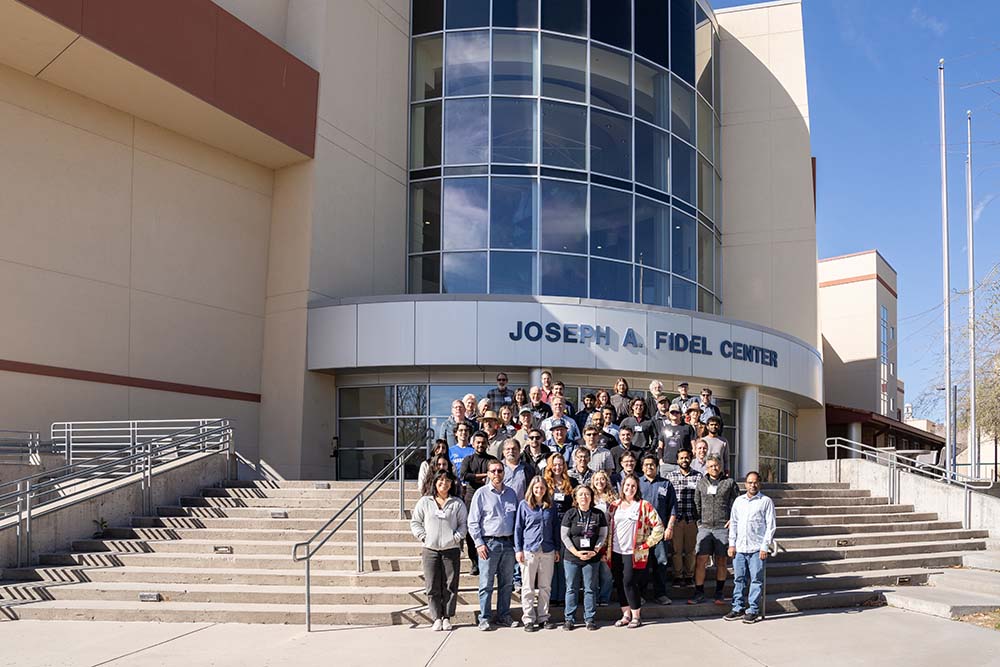
Conference attendees in front of New Mexico Tech’s Fidel Center.