New Mexico Tech Astronomers Team Up with NASA to Create a Network of Space Defenders Against City-Killer Asteroids
Oct 9, 2026
An asteroid stretching up to 90 meters in size, or nearly 300 feet, hurtles through space at roughly 38,000 miles per hour. Its trajectory suggests a direct collision with Earth. Depending on crucial variables – such as mass, composition, and angle of impact – the object could punch a hole in the planet’s surface with a blast wave comparable to a nuclear weapon. The threat of a ‘city-killer’ asteroid is real. But is this the one?
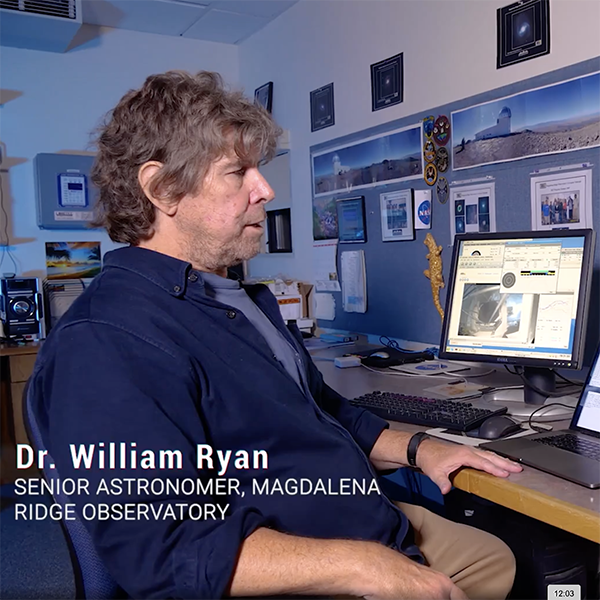
A new documentary, which debuted on NASA+ and YouTube recently, recounts the discovery of asteroid 2024 YR4 and its potentially catastrophic course toward Earth. The film Planetary Defenders: This Is Not an Exercise features key members of NASA’s Planetary Defense network, including Drs. William and Eileen Ryan—the senior astronomer and director, respectively, at the Magdalena Ridge Observatory’s (MRO) 2.4 telescope at New Mexico Tech. Both have been NASA Hazardous Asteroids researchers since 2008.
Recently, NASA’s 360 documentary crew visited New Mexico Tech for a behind-the-scenes look at the Ryan’s work related to 2024 YR4 as they and other scientists tracked the asteroid’s path and calculated the impending risk of impact in 2032.
A Blip on the Radar
Asteroid 2024 YR4 was discovered December 25, 2024 by Dr. Larry Denneau at the University of Hawaii. Initially, it appeared to be nothing more than a non-descript Near-Earth Object (NEO), one of many in a crowded field of 200+ objects found throughout the year. Then mathematical modeling upped the stakes.
On January 27, 2025, asteroid 2024 YR4 crossed the threshold of 1.2 percent chance of striking Earth. The moderate bump was enough to raise alert levels for NASA and its global team of night sky observers. As the odds of 2024 YR4 impacting Earth continued to climb higher – peaking at an unprecedented 3.1 percent – scientists knew the clock was ticking.
NASA’s Planetary Defense network only had a few months to collect data during the asteroid’s first apparition. Its next appearance wouldn’t come until 2028. And in 2032, one doomed city could be completely wiped out.
A Calm Outpost in the Line of Defense
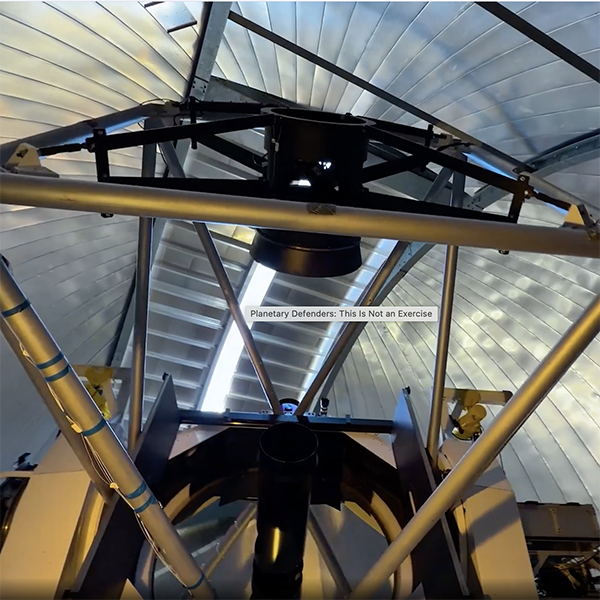
From a serene, mountain-top perch overlooking Socorro, New Mexico, the Drs. Ryan became mission critical as 2024 YR4’s orbit brought it within the Magdalena Ridge Observatory’s field of view. Led by Dr. William Ryan, also a member of Tech’s research faculty, the two New Mexico Tech astronomers tracked the asteroid nightly from January to March 2025.
Over the two-month period, the university’s fast-tracking MRO 2.4-meter telescope derived physical characterization data – such as spin rates and spectral composition – to better assess the potential danger. With the help of a mirror initially built for the Hubble Space Telescope, the powerful telescope collected data at magnitudes that exceeded the telescope's known capabilities and helped define 2024 YR4’s orbit through high-precision astrometric positional follow up.
“The Magdalena 2.4-meter telescope is one of the largest in NASA’s Planetary Defense network and was well suited to making ground based observations of 2024 YR4, as the asteroid was very faint at visible magnitude V~24,” said Eileen Ryan.
Based on data collected by MRO, the 4.3m Lowell Discovery Telescope in Arizona, and other telescopes internationally, researchers eventually downgraded the risk of a direct strike to 1.5% on February 19 and 0.27% the following day. Observations by the network continued through April 1, when astronomers were able to completely retire the asteroid’s impact risk. Simply put, the risk of 2024 YR4 impacting Earth reached zero percent.
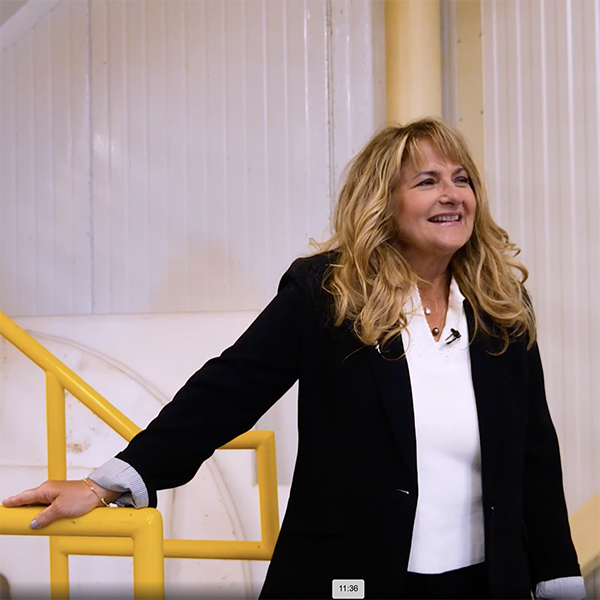
“This was an excellent demonstration of NASA’s Planetary Defense network doing its job to assess risk via ground based observations and plan accordingly,” said Ryan.
While the asteroid 2024 YR4 was not the “city-killer” scientists feared, a vigilant watch on NEOs remains essential. Astronomers believe the next Earth-impactor is out there, waiting to be found.
NASA’s Planetary Defense network is a global, collaborative system of ground-based telescopes and space-based assets that detect and mitigate potentially hazardous NEOs. The network, which dates to the 1990s and was once called “Spaceguard,” is part of NASA’s broader plan to understand, forecast and prevent NEO impacts and improve emergency preparedness.
Dr.Eileen Ryan is director of MRO and its technical, financial and operational activities and leads the development of scientific and military initiatives. She is renowned for her work in the physics of collisions and catastrophic fragmentations. Dr. William Ryan is renowned for his work on asteroid characterization studies. In 2022, both researchers were participating scientists on NASA’s Double Asteroid Redirect Test (DART) spacecraft mission, which successfully demonstrated NASA’s ability to alter the orbit of an asteroid.
By Kimberley Clementi