Math and Physics Combine to Spark Lightening Research from New Mexico Tech
Sep 15, 2026
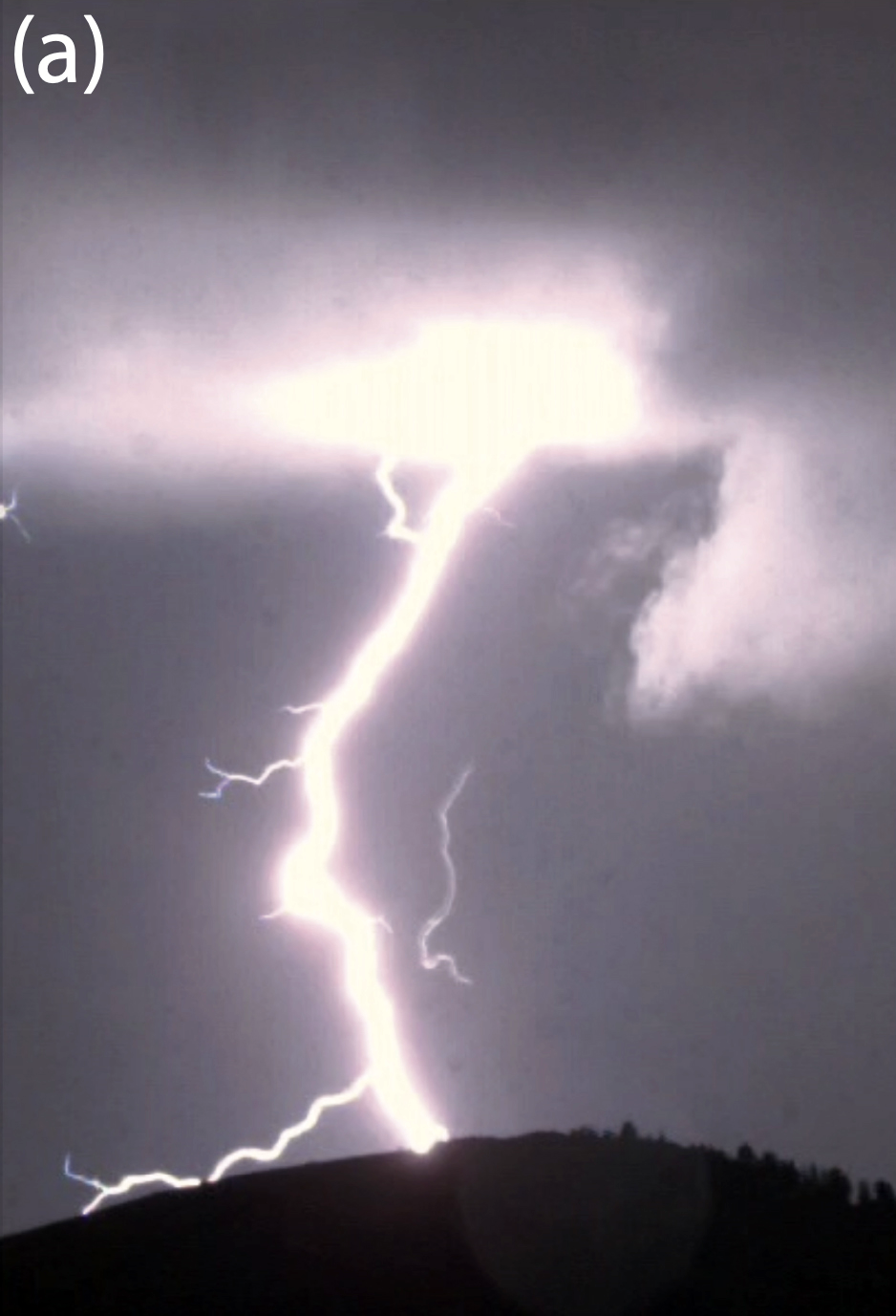
Photograph of a lightning return stroke. Credit: da Silva
Scientists from New Mexico Tech recently joined forces to study one of the most powerful natural phenomena in the Earth’s atmosphere: lightning. Dr. Caitano da Silva, an associate professor in physics, and Saulo Orizaga, an associate professor in mathematics, combined their expertise to study the surge of electric current—the return stroke—that rushes upward through a lightning channel after lightning strikes the ground.
In a new article published in Reviews of Geophysics, da Silva, Orizaga, and student co-authors adapted a set of equations, called the Telegrapher’s Equations, to model the lightning channel. The equations, which were originally developed to describe how electrical signals move through transmission lines, were utilized to explain the lightning current’s signature shape at ground level and its anomalies in both speed and power over distance.
The researchers wrote a collaborative summation of their approach for their publisher, American Geophysical Union, noting, “We model the lightning channel as two concentric cylinders: a thin core that carries the current and a wider sheath that stores the associated charge.” The model’s biggest strength is speed paired with insight, running orders of magnitude faster than other simulations.
According to da Silva, two student researchers from two New Mexico Tech departments contributed heavily to the article: Jacob Wemhoner, who at the time of the study was pursuing his Ph.D. in Physics, and Logan Baeza, an undergraduate who earned joint degrees in physics and mathematics this spring.
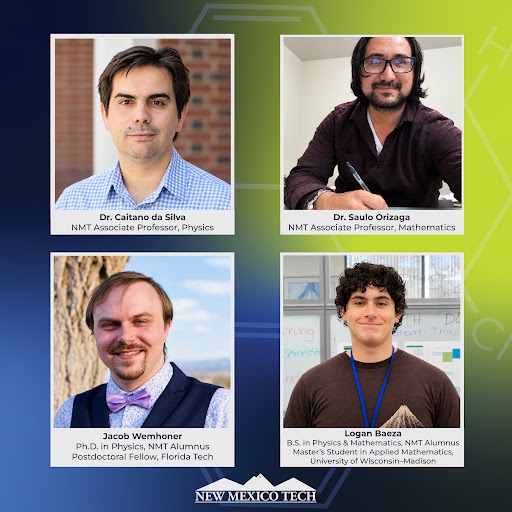
“These two Techies are proof that lightning can strike twice. As students, they earned recognition from one of the most influential journals in geophysics. And most deservingly, they have already landed their next positions,” said da Silva.
Wemhoner, currently a Postdoctoral Fellow at Florida Tech, acknowledges how influential da Silva and Orizaga’s collaborative study has been on both his dissertation and continued efforts in lightning physics.
“My work on this research ran me directly into a verification problem, which led me to design, develop and deploy the instrument that set up the foundation of my dissertation: SOPAPILLA (Spectrally-resolved OPtical Automated Photometric Instrument at Langmuir LAb),” said Wemhoner.
Specifically, Wemhoner became interested in modeling the temperature of lightning’s return stroke. Previous high-speed camera studies were limited to 5 lightning flashes at 671,000 frames per second. These speeds resulted in data slower than the model.
SOPAPILLA works like a camera but at a higher speed. Some might suggest it’s ‘lightning fast.’ The instrument measures 16 lightning flashes at 1.4 million frames per second, which is roughly 2.1 times faster than any previously recorded data.
While the New Mexico Tech study reconciles decades of field and laboratory measurements, the model also anchors how the return stroke is taught in the “Physics of Lightning” graduate course at the university. Students derive lightning’s key features from first principles rather than taking them on faith.
“This opportunity gave me insight into how modern research is conducted and also the different modes of research,” said Baeza, who is pursuing a Masters Degree in Applied Math at the University of Wisconsin-Madison.
Orizaga said the students took his classes prior to this paper, and encountered challenges that naturally arise from high-level mathematics. “Rather than stepping back, they engaged directly. I watched that growth continue across multiple courses as they developed a stronger command of PDEs, and that steady progress eventually culminated in a genuine collaboration on this article. It was a team effort from start to finish, and I'm very proud of their work," he said.
The project is consequential as scientists study lightning’s real-world impacts, including damage to infrastructure, the ignition of wildfires, and atmospheric hazards such as nitrogen oxides.
It also provides a practical guide for future researchers, connecting physical principles with past studies to explain what controls lightning's power, speed, and energy losses.
“Our mathematical framework can be used in adjacent fields as well, not just lightning physics. It models the process using language that’s accessible and not too highly technical,” said Baeza.
New Mexico Tech is the state’s leading STEM institution and is distinguished by the research opportunities it provides for students at all levels.
By Kimberley Clementi