Magdalena Ridge Observatory Interferometer Achieves “First Fringes”
jan. 16, 2026
Infrared project hits benchmark for proof of concept
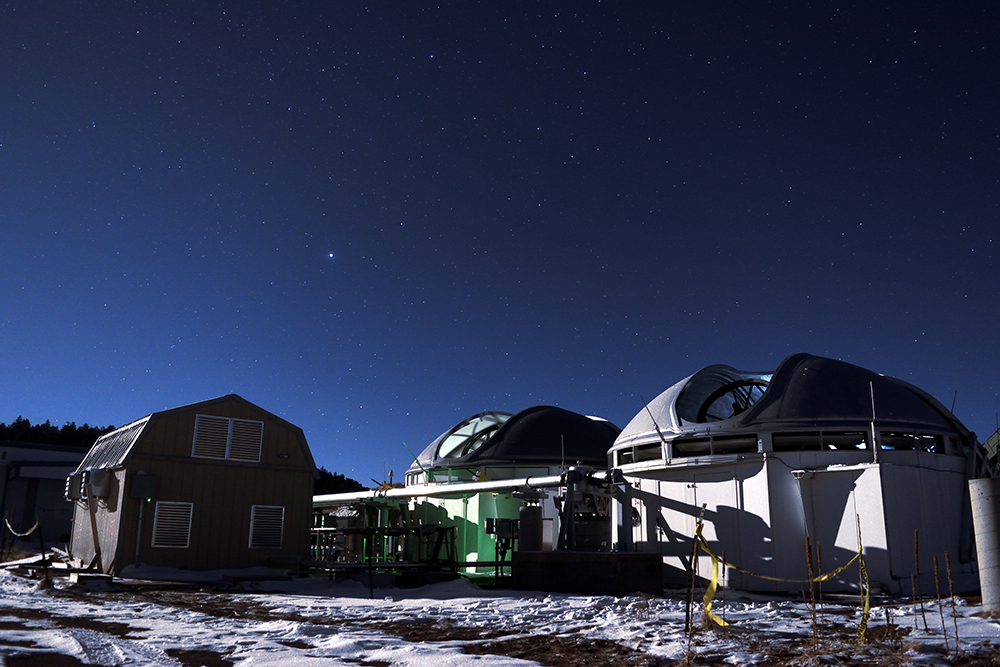
The Magdalena Ridge Observatory Interferometer (MROI) is an ambitious astronomy installation developed by New Mexico Tech (NMT) in partnership with the University of Cambridge, UK, and the U.S. Air Force Research Laboratory. On Saturday, July 12, the interferometer successfully achieved “first fringes.” This long-awaited proof-of-concept marks a critical step in a project more than two decades in the making and signals the dawn of a new era in high-resolution imaging of the cosmos.
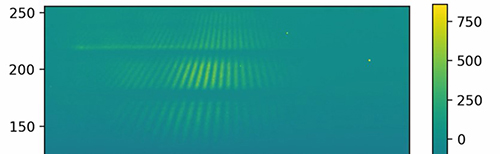
The milestone measurement was recorded shortly before 3 a.m. local time (Mountain Daylight Time), when MROI combined the light from two of its telescopes for the first time.
Dr. Michelle Creech-Eakman, professor of physics and MROI Project Scientist at NMT, said, “We targeted Epsilon Cygni. For proof of concept, the team needed to look at a very bright, nearby, familiar celestial body. This bright star in the Swan constellation was perfect. The resulting interference pattern, known as ‘fringes,’ confirms that the instrument’s complex systems—from its telescopes and vacuum-sealed delay lines to its cryogenically cooled detectors—can work in precise, real-time coordination."
The MROI is designed to be exceptionally sensitive, requiring its light-guiding delay lines to be held in vacuum tubes and aligned with precision finer than the width of a human hair.
“Every component, down to the concrete piers and the half-dozen mirrors in the light path, had to perform perfectly. Achieving first fringes is the equivalent of successfully flying the glider you’ve built from a kit; it proves the fundamental design is sound. This success is a testament to the incredible dedication of our international team over the last 20 years.”
Cambridge University Professors Chris Haniff and David Buscher said, “This is a fantastic achievement for the whole project team and a long-awaited validation of a design that was first put on paper years ago.” Haniff and Buscher, along with colleagues at the Cavendish Laboratory in Cambridge, have led much of the design of the MROI. “Getting these results so soon after we set up the first instrument augurs well for our next steps, which are to push the robustness and sensitivity of the telescopes even further, so we can study much dimmer stars and objects in space with a level of detail that has never been before possible for astrophysics here on Earth.”
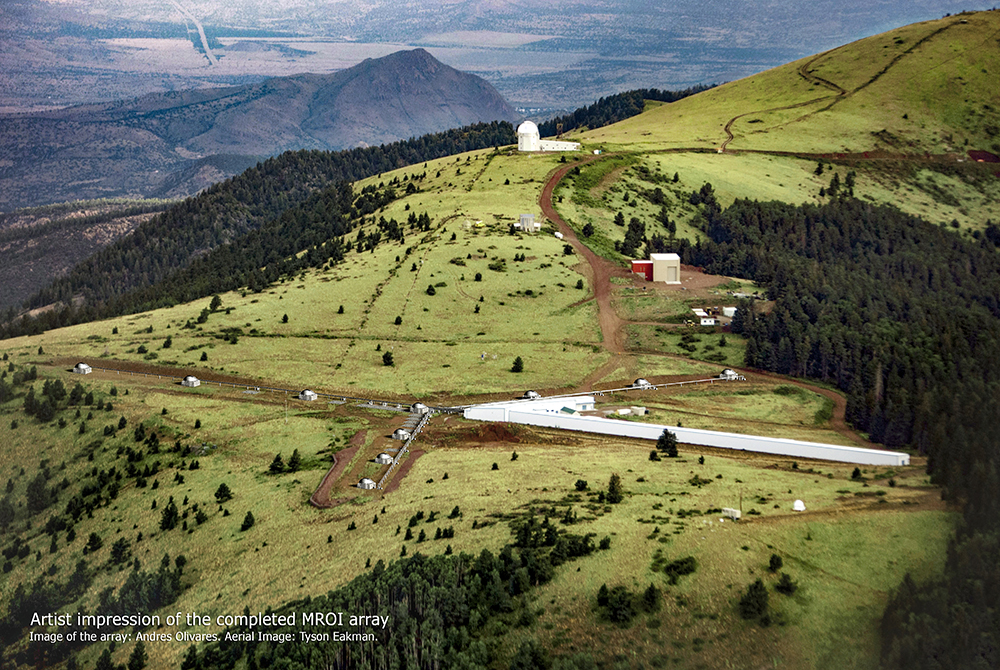
This initial success, achieved with an 8-meter separation between telescopes, sets the stage for the facility’s future. When complete, the MROI will feature 10 telescopes with separations of up to 340 meters. It will produce images with unprecedented detail and is designed to observe astronomical targets more than 100 times fainter than what is possible with similar instruments today, as Dr. Creech-Eakman said, “providing a resolution equivalent to measuring the height of a small child standing on the Moon.”
(Update November 19, 2025) Since obtaining first fringes, the project now captures fringes on multiple targets during a single observing night on objects that range down to magnitude 8.9 at H-band. All indications are the instrument will be able to capture fringes on much fainter targets.

Resources for the Media
For all media inquiries, please contact:
- Katie Ismael, New Mexico Tech Director of Marketing and Communications, katie.ismael@nmt.edu
- Vanessa Bismuth, Communications Manager, Cavendish Laboratory - Department of Physics, University of Cambridge, Communications Office, vanessa.bismuth@phy.cam.ac.uk, +44 (0) 1223 336 031
- MRO website
- “BIg Think” article
- “Big Think” podcast
- TEDX talk