An Operational Demonstration in Optical Interferometry
June 9, 2026
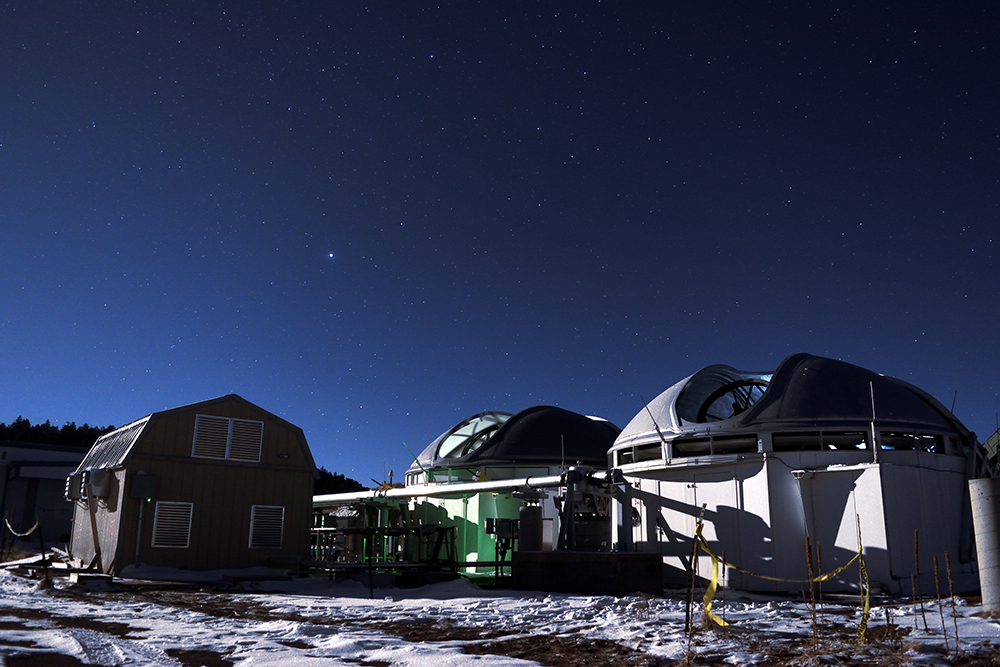
An Optical Interferometer Tracks an Object in Space
Recently, in the dark skies over the Magdalena Ridge Observatory Interferometer (MROI), an optical interferometer conducted an operational demonstration: capturing data on a satellite in geosynchronous orbit (GEO). This recent evaluation marks an instance where an optical interferometer has been able to interrogate a man-made object at such distances.
The observed satellite, a communications platform, orbits at geosynchronous altitudes above Earth. At this altitude, its orbital period matches Earth's rotation, allowing it to remain fixed over a single longitude.
The evaluation was accomplished by combining light from multiple separated telescopes, a technique known as optical interferometry. This approach enables angular resolution that provides critical capabilities to the warfighter, allowing researchers to detect structural details at extreme distances.
"This is a moment highlighting long-term development efforts,” said Dr. Van Romero, Professor of Physics at New Mexico Tech and Principal Investigator for MROI. “There has long been skepticism that a ground-based optical system could resolve a man-made object in geosynchronous orbit. This evaluation provides data indicating that it can be done."
Dr. Michelle Creech-Eakman, MROI Project Scientist and Professor of Physics added, “Many in the astronomy community believed this was not possible. Others have attempted it previously. This evaluation provides data on both the instrument and the underlying technique.”
Strategic Capabilities of High-Resolution Observation
Located at a high-altitude site, MROI is designed to advance high-resolution imaging to provide strategic insights for national security. By combining light from multiple telescopes, the interferometer effectively creates a much larger “virtual telescope," overcoming the resolution limits of traditional instruments.
The current system includes multiple operational telescopes. During a previous evaluation, the MROI observed celestial targets to gather baseline performance data. Since then, the facility has observed numerous astronomical and man-made targets, including the surroundings of an external supermassive black hole (AGN).
The ability to resolve satellites in GEO has strategic implications. Modern satellites include solar arrays, antennas, and, in some cases, maneuvering or defensive capabilities. Highresolution observation enables determination of a satellite's orientation, configuration, and condition.
"We want to quickly assess a satellite's position and orientation—and understand its behavior,” Romero said. “This is an evaluation toward providing that level of insight."
Creech-Eakman emphasized the broader scientific potential: “With this level of resolution, we will be able to measure changes across the universe in great detail. Ultimately, we aim to produce time-resolved imaging—even ‘movies' of distant astrophysical systems.”
Implications for Space and Science
As the number of satellites in orbit grows rapidly, the need for precise monitoring of their location, condition, and activity has become increasingly urgent. MROI’s capability represents an essential tool for both national security and the commercial space sector.
"Before this demonstration, it was unclear whether interferometric data could be used to reconstruct meaningful images of satellites,” Romero said. “We have now gathered data showing that the technology works.”
MROI is designed to expand the number of telescopes, creating a large virtual aperture. As the array grows, its sensitivity and imaging capability will increase.
The facility is a collaboration between university partners and the U.S. Air Force Research Laboratory.
By Kimberley Clementi and Katie E. Ismael