An Innovative SPIDER Designed by New Mexico Tech Students Could Make NASA’s Moon Base Safer
Aug. 31, 2026
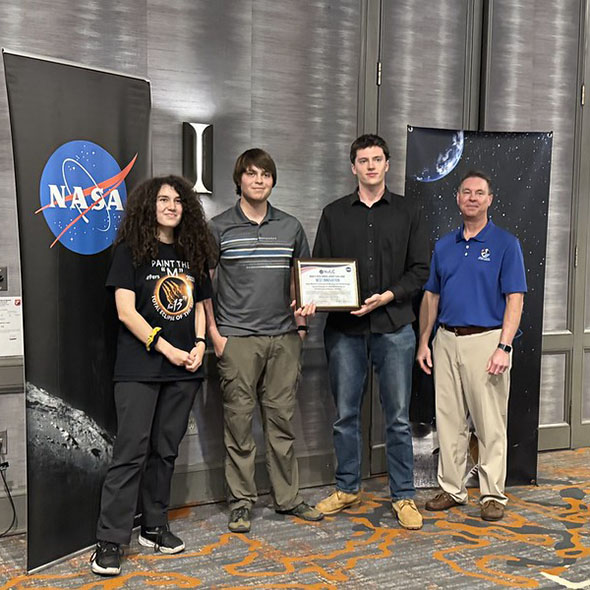
Students Shawna Dodge, Riley Morris, and Thomas Pierson recently won Best Innovation Award at NASA’s 2026 Human Lander Challenge (HuLC).
Three Mechanical Engineering students from New Mexico Tech have designed a structural health monitoring sensor with low power demands and an astounding potential to broaden NASA’s hazard monitoring capabilities on its planned Moon Base.
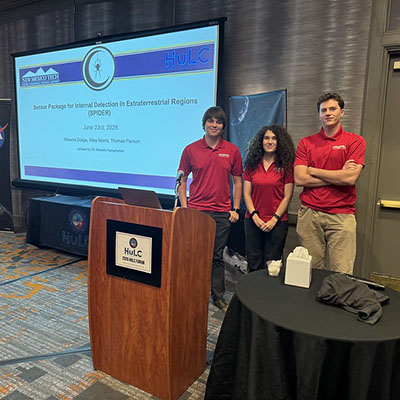
Students Shawna Dodge, Riley Morris, and Thomas Pierson recently won Best Innovation Award at NASA’s 2026 Human Lander Challenge (HuLC) for their project Sensor Package for Internal Detection in Extraterrestrial Regions, or simply SPIDER. The team was one of 10 from across the country invited to present in the final round of HuLC held this summer at the NASA Marshall Space Flight Center in Alabama.
Finalist teams shared concepts for innovative, systems-level solutions that improve critical aspects of Long Duration Spaceflight Environmental Control and Life Support System (ECLSS) performance.
Each team was given 25 minutes to present their design in front of a panel of NASA and industry experts and then 20 minutes to answer questions. “The questions were grueling!” said Thomas Pierson.
The New Mexico Tech team used their allotted time to unveil the benefits of SPIDER. Aptly named, the sensor prototype resembles a 5-legged spider with thin wires and nodes splayed from its compact body. The nodes monitor internal space habitats to detect and alert astronauts to hazards arising from micro meteoroid impacts and changes in temperature and humidity levels.
By 2032, the Techies envision a network of SPIDERs across space-based environments – interacting with each other and sharing data to strengthen the web of protection throughout lunar infrastructures.
“We placed a strong emphasis on the innovative capabilities of our sensor package and the value it could provide to future space missions, so it was incredibly rewarding to see those efforts recognized with the Best Innovation Award,” said Dodge.
Adding Strength and Redundancy
Currently, NASA’s structural health monitoring system combines the Fiber Optic Sensing System (FOSS) with the Stanford Multi-Actuator Receiver Transduction (SMART) layer. While the duo provides reliable and effective monitoring, it does have shortcomings. The systems have high power demands. Additionally, few modalities are included.
SPIDER was designed to address these specific limitations. First, the team tackled energy consumption, looking at the challenge from two directions: how to increase power to their device while simultaneously lowering its demand.
Their solution paired strategy with hardware. By adjusting SPIDER’s operational cycle – allowing more time between data inquiries and reducing telemetry bursts to only one a day – the device was able to remain in low power mode until activated. This increased the prototype’s battery life to 60 days, a comfortable cushion for a 30-day lunar mission.
For the second-half of the energy equation, the students added photovoltaic cells to the sensor’s power hub. Unlike solar panels, these cells are capable of harvesting power from LED lights in an indoor environment. The hub also houses a thermoelectric generator with a battery as supplemental power. These built-in redundancies ensure SPIDER stays online monitoring for health hazards, even if one or more systems fail.
“Working on a project with direct applications to future human spaceflight showed me how classroom knowledge can be translated into real engineering solutions,” said Morris.
Keeping the mission in mind—the imperative to alert astronauts to dangerous conditions in their environment—the student’s engineered SPIDER with multiple modalities. FBG Optical Sensors and Piezoelectrics were implemented to calibrate strain in life support systems and help localize impacts. They also integrated colorimetric sensing. When thermochromic paint senses potential health hazards, it fluoresces, or changes color. Various paint colors could be used to identify different hazards.
Preparing for the competition took months of research, design, testing, and refinement. In the first stage of the competition, the Techies were among the top 10 selected to advance and received $9,000 from NASA to support their project. From there, they developed prototypes, validated their sensing methods, and began working on their technical paper and presentation.
“Each interaction strengthened both our project and our understanding of the engineering design process. It was truly a team effort, and we learned a tremendous amount from working together,” said Morris.
The team has an accepted paper at 2027 AIAA Sci Tech Conference, where they will be sharing their research with the broader aerospace community. They hope this event will allow them to continue project development and build valuable industry connections.
“Many of the NASA engineers are interested in seeing our sensor package idea come to fruition. I learned there really is room for innovation in this field,” said Pierson.
NASA's Human Lander Challenge (HuLC) is an initiative supporting its Exploration Systems Development Mission Directorate’s (ESDMD’s) efforts to explore innovative solutions for a variety of known technology development areas for human landing systems (HLS). Through this challenge, college students contribute to the advancement of HLS technologies, concepts, and approaches.
Mostafa Hassanalian, the chair of the Mechanical Engineering Department, said Tech students have a strong record of participation in NASA competitions, including NASA MINDS since 2021, NASA Lunabotics since 2021, as well as the NASA HuLC, which was a first for New Mexico Tech. “These competitions provide great experiential learning opportunities for our students, allowing them to apply what they learn in the classroom to real engineering challenges and gain hands-on experience,” he said.
By Kimberley Clementi