Night at the Nuclear Museum Celebrates NMT’s Connections with Sandia Labs and Manhattan Project
Nov. 25, 2026
By Steve Simpson and Katie E. Ismael
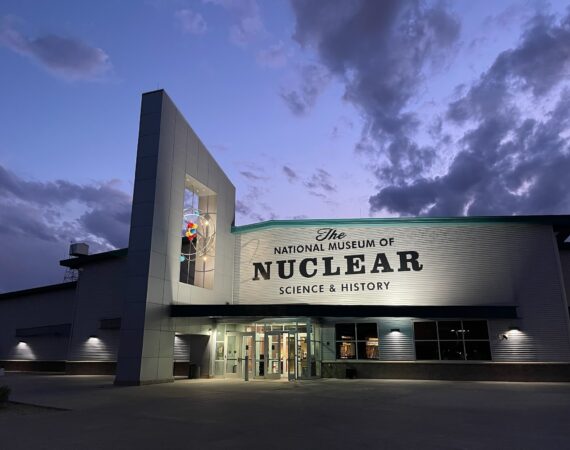
The National Museum of Nuclear Science and History in Albuquerque, where NM Tech alumni and Sandia National Lab employees gathered earlier this month to celebrate the intertwined history between the university and the lab. (Photo credit/ National Museum of Nuclear Science and History)
The long and rich history between New Mexico Tech (NMT), Sandia National Laboratories (SNL) and the unprecedented, top-secret Manhattan Project was on display during the Night at the National Museum of Nuclear Science and History in Albuquerque earlier this month that brought out about 120 alumni and Sandia employees.
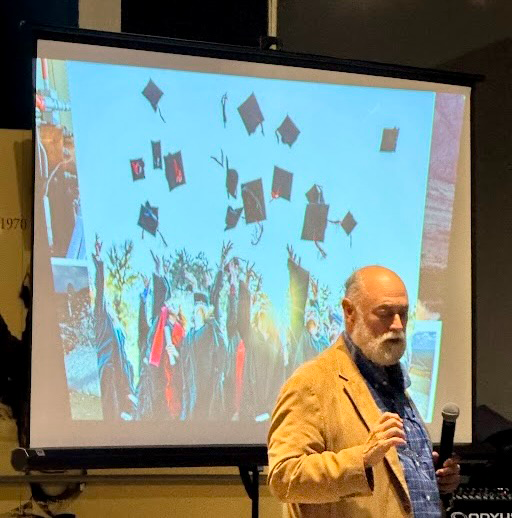
A highlight was a presentation from Van Romero, who received his BS and MS in physics from NMT, served as Vice President of Research from 1997 to 2022 and worked closely with many faculty featured in his presentation. Romero was also instrumental in helping maintain a strong pipeline between SNL and NMT.
Today, approximately 466 NMT alumni work at SNL, according to Amanda Armenta, Community Relations Specialist for Sandia National Labs.
The connection between SNL and NMT traces back to the arrival of E.J. Workman at what was then the New Mexico School of Mines in 1946. Workman served as NMT president from 1946-1965.
As historians tell it:
Before NMT, Workman was professor and Department Chair of Physics at the University of New Mexico (UNM) and held a government contract for the development of the proximity fuse in conjunction with the Applied Physics Laboratory at Johns Hopkins, a device that used radar echoes to detonate an explosive device as it neared its target.
After a dispute with an incoming University of New Mexico president, Workman severed connections with UNM and trucked his enterprise down to Socorro, along with numerous researchers and UNM physics faculty. He also leased space at the former Sandia Girls School in Albuquerque where he continued research until the Atomic Energy Commission (AEC) sought ownership of the building in 1949.
The Z Division of the Manhattan Project was colocated on the east side of Albuquerque, and when Workman vacated the Sandia Girls’ School, the Atomic Energy Commission quickly moved to take over the property. Z Division expanded into the new property and Sandia National Laboratories was formed.
Over the years, SNL and NMT have maintained a strong collaboration, and the lab has frequently made use of NMT facilities and resources.
More recently, SNL and NMT teamed up to formulate the 3-1-1 rule that allows passengers to carry liquids on to passenger airlines. In 2006 a terrorist plot to use liquid explosives to take down an airliner was foiled and all liquids were banned from passenger carry ons. SNL and NMT quickly teamed to address the issue. Within months EMRTC/NMT provided the data and SNL performed the analysis that led to the new rule.
To this day, SNL and New Mexico Tech researchers retain strong partnerships through SNL’s Lab Directed Research and Development (LDRD) program. Additionally, SNL research staff serve on advisory boards for academic programs and offer internships for NMT students.
NMT’s Connection with the Manhattan Project
With the summer 2023 release of Oppenheimer, many at New Mexico Tech have revisited the historical Manhattan Project connections.
Around this same time, Chuck Zimmerly, former NMT student and regent and president of the Socorro County Historical Society, discovered an intriguing video of Robert Oppenheimer in downtown Socorro, walking in a 49ers parade sometime in the early 1950s.
In the years following the close of the Manhattan Project, New Mexico was flush with physicists. Workman himself was involved in the Manhattan Project—his University of New Mexico office served as a mail drop for the atomic bomb project—so when he relocated his research enterprise to Socorro, he recruited several notable researchers to join his budding atmospheric physics research program.
Marvin Wilkening was one of the more notable of Workman’s recruits. Wilkening joined the faculty in 1948 and stayed at NMT for 40 years, with stints as chairman of the Langmuir Laboratory Committee, graduate dean, and advisor for a young Van Romero.
Wilkening, who worked under Enrico Fermi, was present in Chicago when the first nuclear reactor went critical on December 2, 1942. He was then sent to Oak Ridge, Tennessee, which enriched uranium for atomic weapons, and later on the “Site Y,” also known as Los Alamos.
Wilkening joined Fermi and others at the Trinity Site in New Mexico, where the first atomic bomb was tested. He recounted to Romero his experience watching Enrico Fermi test the explosion’s yield with a piece of paper, a story immortalized in the Oppenheimer film.
Also featured in the Oppenheimer film is Giovanni Rossi Lomanitz who started at NMT in 1962 and served as chair of the Physics Department. In the film, Lomanitz was Oppenheimer’s student at UC Berkeley and worked in the Berkeley Radiation Lab.
Lomanitz was brought before the House of Un-American Activities Committee (HUAC) for previous ties to the Communist Party and eventually blacklisted from research activities for refusing to identify other researchers with Communist ties.
Many NMT alumni speak highly of Lomanitz’s classes and share stories at 49ers of his epic chain smoking during class.
Guests gather at the National Museum of Nuclear Science and History. (Photo credit/ Chiefy Loma)
(Photo credit/ Chiefy Loma)
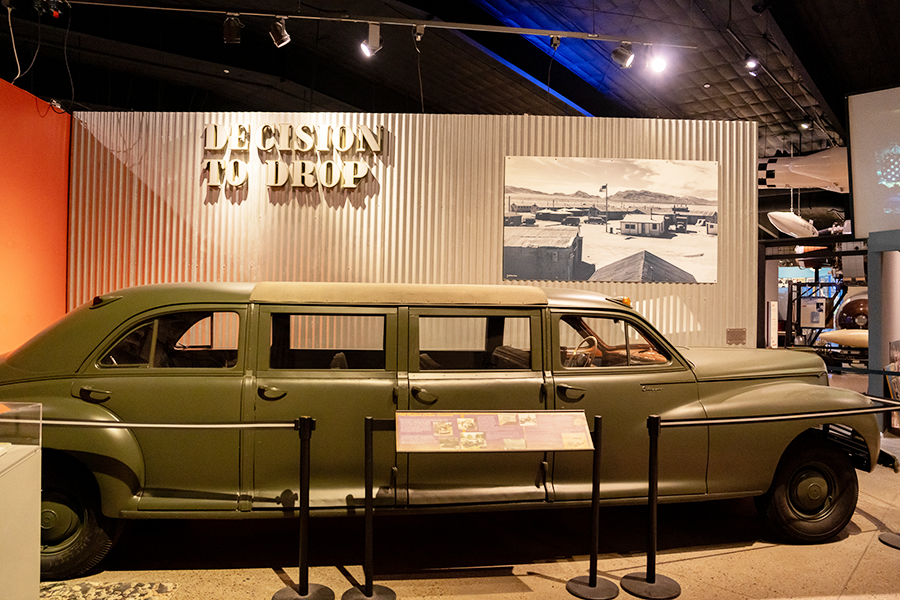
Inside the National Museum of Nuclear Science and History. (Photo credit/ Chiefy Loma)