December skies
Dec. 2, 2025
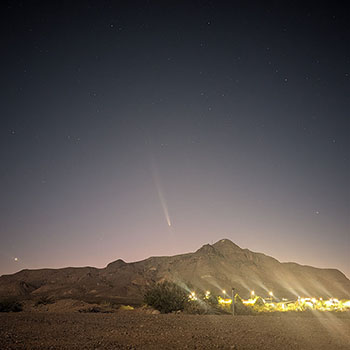
Good viewing for meteor showers seems to prevail through the fall and early winter months. This month we have two showers worth noting. On the night of December 13-14, the Geminids should put on a fine show with the peak of 100 meteors per hour at about 3 a.m. Nevertheless, mid evening viewing should produce quite well. The waning crescent Moon will rise around 2:30 a.m. and will provide little competition to the shower. A lesser-known shower, the Ursids, will peak around 3 a.m. MST on the morning of the 22nd. The Moon will not be a factor. The shower is the result of the passage of comet 8P/Tuttle which left a fresh trail of debris in 2023. To view the shower, find the constellation of Ursa Minor as the radiant should appear to be from the bowl of the Little Dipper.
Saturn and Jupiter continue to dominate the nighttime sky. In addition to its encounter with the Moon on the 26th there is a bit of a challenge to observing the ringed planet. Saturn’s rings are very close to being edge on. A small to medium sized telescope made aid you in your quest to find them.
Mercury is putting on its best apparition for 2025 and on the morning of the 6th, about 20 minutes before sunrise, look to the southeast a few degrees above the horizon to see it at its greatest elongation and shining at magnitude -0.5. A bonus is the planet Venus to the left and below Mercury appearing to hover just barely above the horizon.
The Moon will be full on the 4th, last quarter on the 11th, new on the 20th, and first quarter on the 27th. Looking East on the third and starting around 6:42 pm, the full Moon will move right through the famous Pleiades star cluster. A small telescope will be your best bet because the Moon is so much brighter than the stars. Binoculars might help but a small to medium-sized telescope will definitely be better. Looking East-Northeast on the 6th around 8 p.m., the waning gibbous Moon will be directly above Jupiter. Looking to the South on the 26th, halfway up and about 45 minutes after sunset, the waxing nearly first quarter Moon will be just above and to the right of Saturn.
The longest night of the year is ushered in on 21st at 8:03 a.m. MST as we reach the Winter Solstice for the northern hemisphere.
The first Saturday star party will be held on Saturday December 6, at the Etscorn Campus Observatory. To reach the observatory take Canyon Dive past the golf course. At the stop sign turn right on Buck Wolfe Drive. At the top of the dip in the road, turn left and follow the signs to the observatory.
Clear Skies!
Jon Spargo
New Mexico Tech Astronomy Club
December 2025