August 2025 Skies
August 5, 2025
By Jon Spargo
New Mexico Tech Astronomy Club
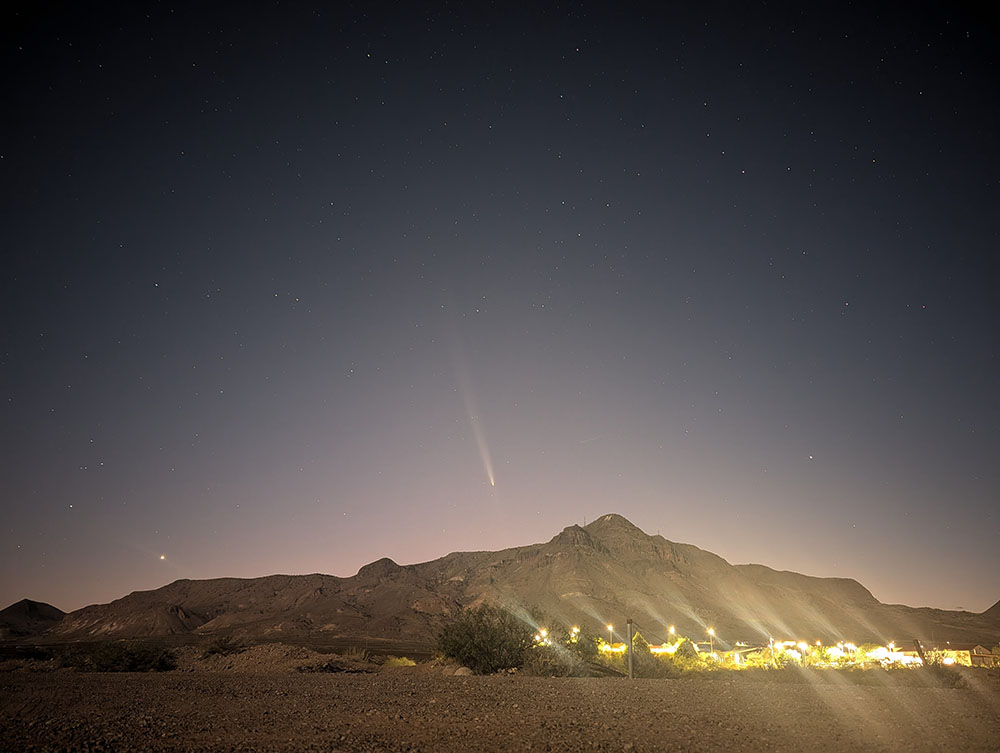
The night of August 12-13 will mark the peak of the famous Perseid meteor shower as the Earth plows through one of the debris trails left by comet Swift Tuttle. With a period of 133 years, the comet crosses the plane of the Earth’s orbit as it follows its own orbit around the Sun. On the darkest of nights with no Moon, we can expect 50 to 100 meteors per hour coming from a point in the constellation Perseus in the northeastern sky. This year, a bright waning Moon will likely allow only the brightest meteors to be visible resulting in only 20 to 25 meteors per hour.
The planetary headliners this month are Venus and Jupiter who will show us what is called a conjunction. Venus at magnitude -4.0 and Jupiter magnitude -1.9 will appear in the early morning sky on Aug. 12, with an apparent separation of just under 1 degree. Close conjunctions like this are very rare. The next one will occur on Nov. 9, 2028, when Venus and Jupiter will be separated by just 37 minutes of arc.
The Moon and Saturn join the conjunction parade this month, also on the morning of Aug. 12. If you look to the south-southwest, the waning gibbous Moon will be about 3.5 degrees to the right of Saturn. Saturn shines at magnitude +0.8 so it should be readily visible even with a bright Moon nearby. Mercury puts in a nice early morning appearance above the eastern horizon about a half hour before sunrise. Shining at magnitude -0.3, it should be quite easy to spot.
The Moon will be in the first quarter on Aug. 1, full on Aug. 9, last quarter on Aug. 16 and new on Aug. 23. Looking to the south on Aug. 3, about an hour after sunset, the waxing first quarter Moon will be just below the red giant star Antares. Looking east on Aug. 12, about 30 minutes before sunrise, we are in for a tripleheader as Jupiter and Venus will be separated by only 1 degree and if you look below them and just above the horizon you may be able to spot Mercury. On Aug. 19, the waning crescent Moon joins in by appearing just above Jupiter. Then on Aug. 20, it’s to the left of Jupiter and finally on Aug. 21, just above and to the left of Mercury.
There will not be a First Saturday star party this month at the Etscorn Campus Observatory.
Clear Skies!