ThermoCon 2024 advances worldwide study of critical minerals, hydrothermal chemistry
June 28, 2024
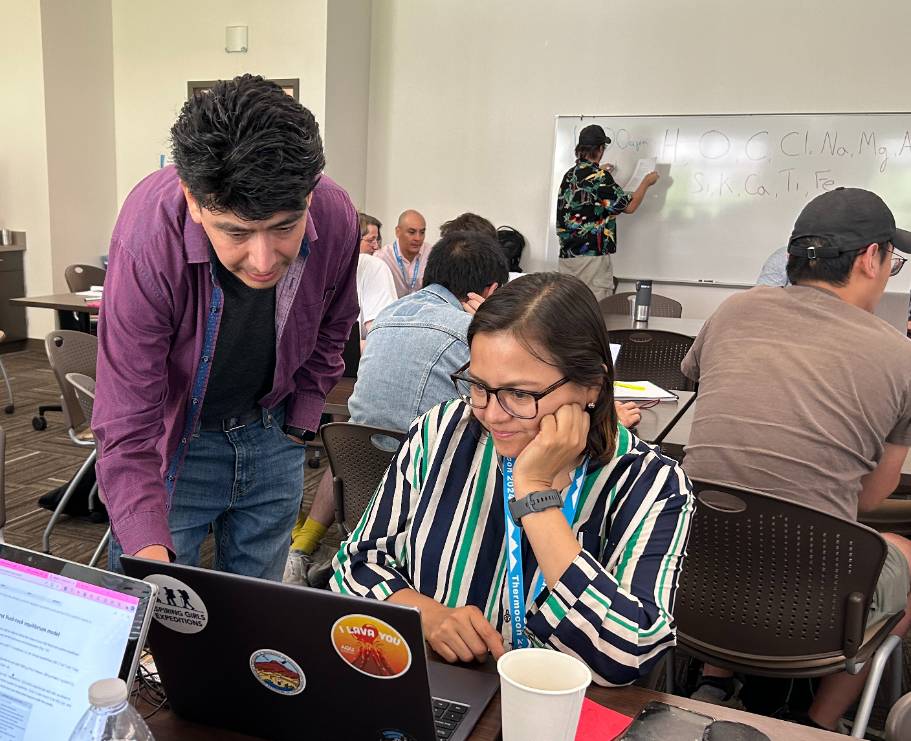
from left, Yerko Figuera-Penarrieta, an NMT PhD student, helps Perla Rodriguez Contreras, PhD student, University of Texas.
In early June, the Hydrothermal Geochemistry and Critical Minerals conference—aka ThermoCon 2024 was held at the New Mexico Bureau of Geology in Socorro, N.M.
In all, 43 participants from all over the world attended, including about 12 PhD students, three Master’s and four Bachelor’s students, and two postdoctoral fellows. The goal of the meeting was to form a community across disciplines to advance cutting-edge science on critical minerals and hydrothermal geochemistry.
The meeting, hosted by NMT Earth and Environmental Science faculty Alexander Gysi, Nicole Hurtig, and Laura Waters, focused on critical minerals, thermodynamics, molecular dynamics, ore-forming processes and extraction techniques for a range of critical elements of strategic importance to the U.S.
Critical minerals are mined form ore deposits that from in magmatic-hydrothermal systems, which often involve high temperature fluids that are responsible for the transport and enrichment of these elements. Surprisingly little is known about the thermodynamic properties of critical elements, in particular at the high temperature and pressure conditions of ore-forming processes that are important to understand their enrichment in the crust.
The field of thermodynamics touches many aspects of geosciences, chemistry, material sciences, and much more, and is currently seeing a renewed interest because of critical minerals. This renewed interest is echoed by governmental agencies, the public, and scientists because of the importance of critical minerals for high-tech and green technologies.
Representatives from geothermal energy industry attended, from national laboratories (Sandia, Ames, LANL, PNNL), from the USGS, from several research institutes (Paul Scherrer, GEOMAR, CSIRO, GFZ Helmholtz Center Potsdam) and from academia (University of Wyoming, University of Texas-El Paso, Washington State, Washington University in St. Louis, Institut des Sciences de la Terre d’Orléans (France), University of Cologne (Germany)).
In the evenings at Deju House, graduate and undergraduate students presented posters of their research projects.
Throughout the day talks were held at the New Mexico Bureau, including a GEM-Selektor workshop and lab tours visiting the new ODCM (Ore Deposits Critical Minerals) lab from Dr. Gysi, the Raman Spectroscopy lab from Dr. Hurtig, and the high temperature high pressure laboratory from Dr. Waters at the Department of Earth and Environmental Science.
In addition to presentations and workshops, there were excursions to Bosque Del Apache Wildlife Refuge and a field trip to the Lemitar Mountains, just north of Socorro.
Dr. Gysi talked about REE occurrences and resources in New Mexico and the relevance of mobilization of REE in hydrothermal fluids. Eric Ruggles, a Master’s student in Earth and Environmental Sciences, presented some of his findings on the hydrothermal veins that contain REE minerals overprinting the Lemitar carbonatite dikes.
Waters and Hurtig introduced the general geology of the Rio Grande Rift, Socorro magma body and the volcanic activity in the area.
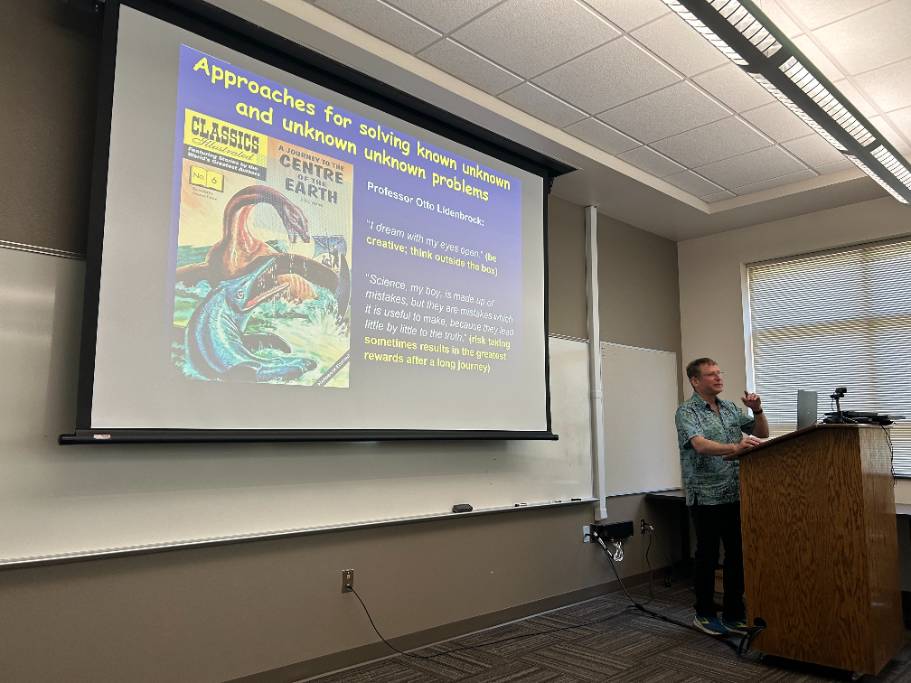
An intriguing presentation at ThermoCon24.
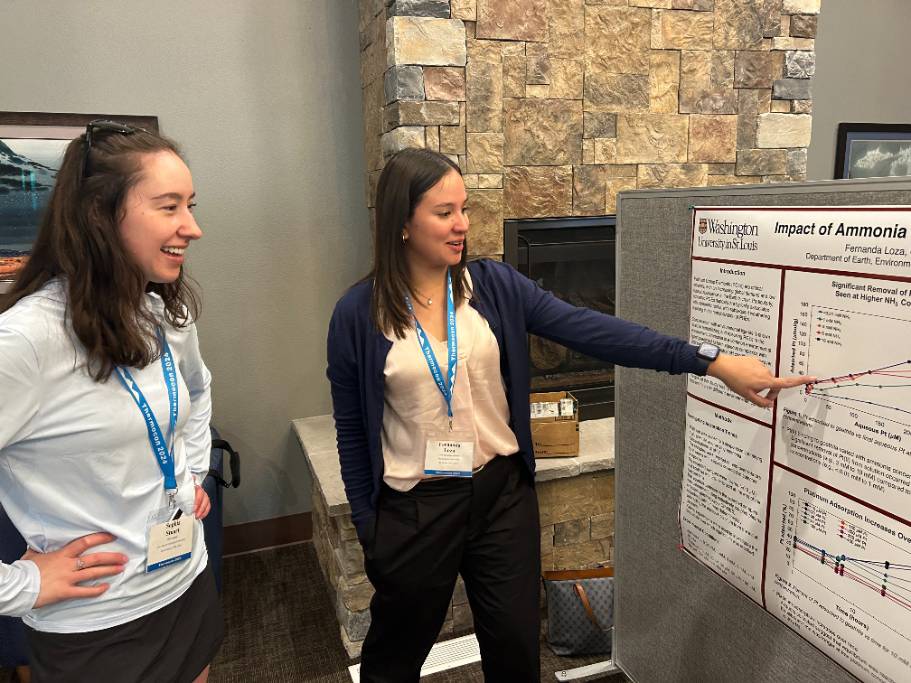
Fernanda Loza, BSc student, Washington University in St. Louis (right) presents her research of PGE elements to Sophie Stuart, a PhD student at Los Alamos National Laboratory.
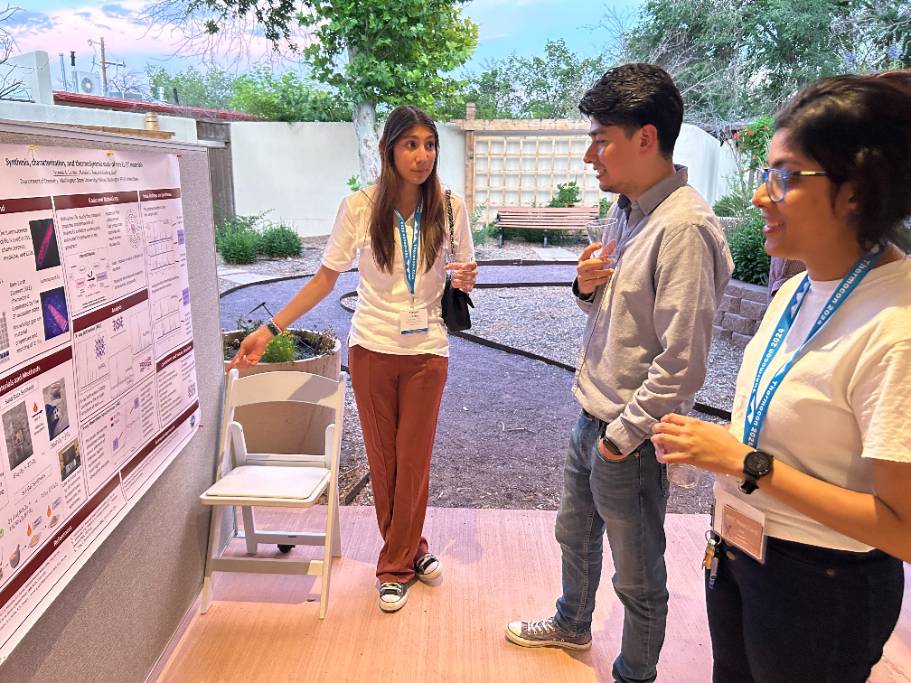
from left, Yecenia Cortez (BSc student, Washington State University) presents her work on Eu reference materials to Yerko Figuera-Penarrieta (NMT PhD student) and Debarati Banerjee (NMT PhD student).
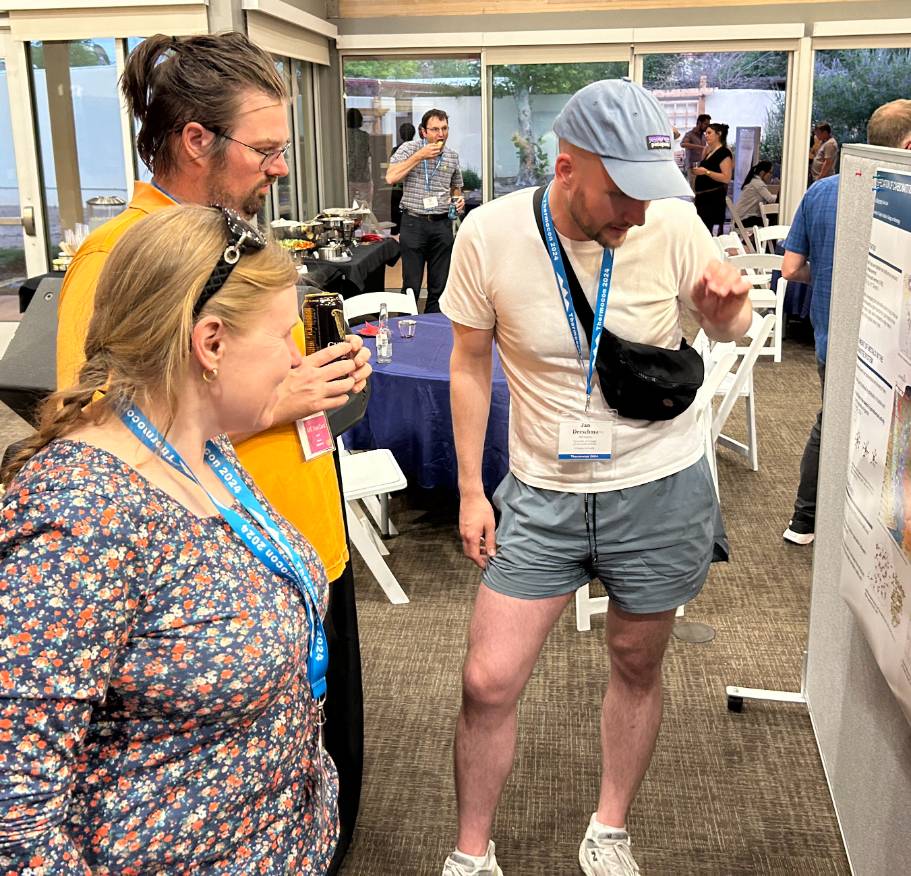
(right) Jan Dreschmann (PhD student, University of Cologne, Germany) presenting his research on speciation in of REE in carbonatite brine-melts to (back) Bryan Maciag, NMT postdoctoral student, and (front) Sarah Smith-Schmitz, an NMT postdoctoral student.