Dr. Alex Rinehart Awarded $920,000 DOE Grant for Rock Fracture Research
Nov. 22, 2024
NMT associate professor is principal investigator for a five-year multi-discipline collaboration
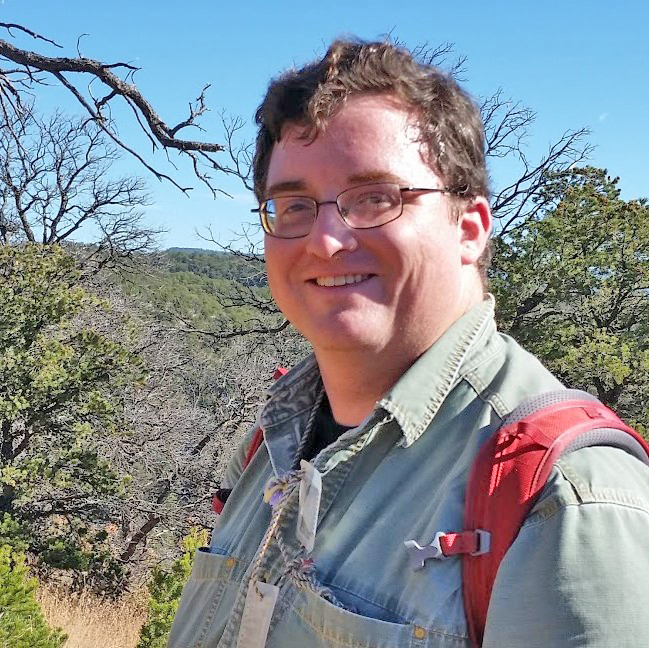
Dr. Alex Rinehart, an associate professor in Earth and Environmental Science at NMT, has received a prestigious Early Career Research Program award from the U.S. Dept. of Energy. The $920,000 grant, awarded for a five-year project, supports his pursuit to understand the complex mechanisms behind rock fracture.
The title of the project is “Chemical and Loading Rate Controls on Fracture: Toward a Universal ‘Phase-Diagram’ of Factors Controlling Fracture Networks from Creep to Dynamic Failure.” Rinehart and his fellow researchers aim to create a comprehensive framework that could unify the vast range of fracture phenomena, from the slow weathering of rocks to the violent breakage caused by asteroid impacts.
Dr. Alex Rinehart
“Fractures are everywhere in nature, but we don't yet have a complete understanding of how and why they occur at different speeds and scales,” Dr. Rinehart explained. His research seeks to bridge this gap by combining experimental work with molecular simulations and focusing on how fractures form and propagate in silicate rocks, which make up much of the Earth’s crust.
The project will explore fracture behavior across 12 orders of magnitude in rate, spanning from extremely slow weathering, like a boulder breaking apart in the desert, to rapid fractures, such as those caused by geothermal stimulation or even asteroid impacts. Despite the common occurrence of fractures and their role in various engineering systems, no systematic study has been conducted across the full spectrum of fracture rates, he said.
Dr. Rinehart and a team of collaborators will explore various factors that influence rock fracture, including chemical reactions, mechanical stress, and flaws in the material.
- Rinehart will primarily work on experimental methods and lower-rate testing in his lab.
- He and his Ph.D. student will visit Dr. Jamie Kimberley’s lab at Merrimack College for the high-rate testing. Dr. Kimberley was formerly at New Mexico Tech.
- NMT Associate Professor of Materials and Metallurgical Engineering Dr. Deep Choudhuri will supervise a Ph.D. student simulating chemical and rate impacts on fracture at the molecular level.
- NMT Assistant Professor of Earth and Environmental Science Dr. Laura Waters will collaborate with Rinehart and his student on making glass out of rock in a high temperature furnace. Analyzing glass will allow direct testing of their ideas.
- Dustin Crandall (National Energy Technology Laboratory) and Wenfeng Li (Los Alamos National Laboratory), specialists in X-ray tomography and imaging, will help analyze the deformation patterns around fracture tips.
- Other NMT collaborations include Dr. Nicole Hurtig’s Raman confocal microscopy facility at the New Mexico Bureau of Geology and Mineral Resources, and, from the Materials and Metallurgical Engineering, Dr. Bhaskar Majumdar’s scanning electron microscope and Dr. Paul Fuierer’s visual fractography system. Material index testing will be performed in Dr. Omid Moradiann’s rock mechanics laboratory in Mineral Engineering.
The team’s goal is to develop a unified “phase diagram” that explains how different factors, such as flaw types, chemical reactions, and material properties, influence the energy required to break rocks. The scientists hope the research will offer a new perspective on the behavior of fractured rocks and may lead to applications in fields ranging from geophysics to engineering. More knowledge about fracture mechanics could have an impact on many concerns—from natural disasters to energy production.
Rinehart’s award is part of a broader DOE initiative that invests in the next generation of scientific leaders. The Early Career Research Program, launched in 2010, supports promising early-career scientists and is critical to maintaining America’s leadership in scientific innovation. In total, 91 researchers were awarded grants this year, covering topics from artificial intelligence to fusion energy. Rinehart was one of the few awardees in geoscience.