NSF CAREER award goes to New Mexico Tech engineering professor
Mar. 13, 2024
Dr. Deep Choudhuri will receive $590,000 for work on emergent structures
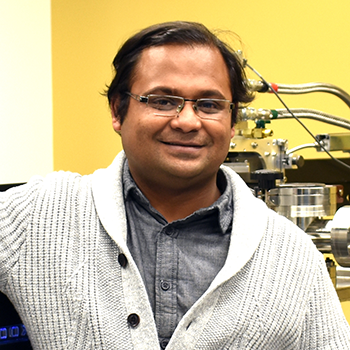
Dr. Deep Choudhuri of the Materials Engineering Department at New Mexico Tech will receive a CAREER award from the National Science Foundation for his work in simulations of crystallization. The grant is $590,000 over five years and comes from NSF’s Faculty Early Career Development Program.
The award will allow the investigating team to combine atomistic simulations with machine-learning and artificial intelligence approaches to gain insights into emergent structures and their influence on crystallization.
Crystallization, a process central to engineering applications, occurs when solids form within a liquid in a specific structure. In certain chemicals, atoms and/or molecules can self-organize into geometric or non-geometric structures for a very short time that are called emergent structures. Sometimes, they convert themselves into new materials that can trigger crystallization, which is all happening in a liquid phase.
Understanding this process is important but physical exploration of these materials requires expensive custom instrumentation. Likewise, atomistic simulations by themselves are bound by space and time constraints; thus, machine-learning and AI approaches make observation of emergent structures feasible.
This project will integrate research and education to establish a pathway for undergraduate and graduate students from underrepresented communities to join New Mexico Tech, an HSI university with a significant Native American community as well. Both of these communities currently face limitations in gaining access to STEM programs.
The award will be used for two projects: 1) the development of two month-long summer camps, named Camp PyMatter, for 10-11th grade students and teachers from local high schools, which will introduce the basics of Materials Science using the Python programming language, and 2) outreach to Navajo Technological University’s School of Engineering, Math & Technology by developing inter-university faculty collaborations and engaging their students with alloy fabrication techniques and computational Materials Science-based topics.