New Mexico Tech Professor Awarded $200,000 Grant in Statewide Entrepreneurial Pitch Contest
August 28, 2024
Dr. Ashok Ghosh Has Breakthrough Brackish Water Filtration Technology
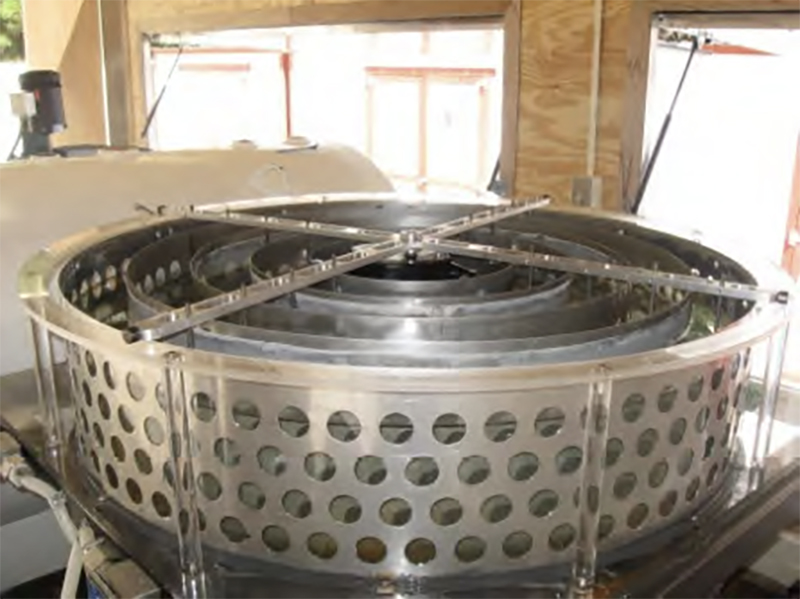
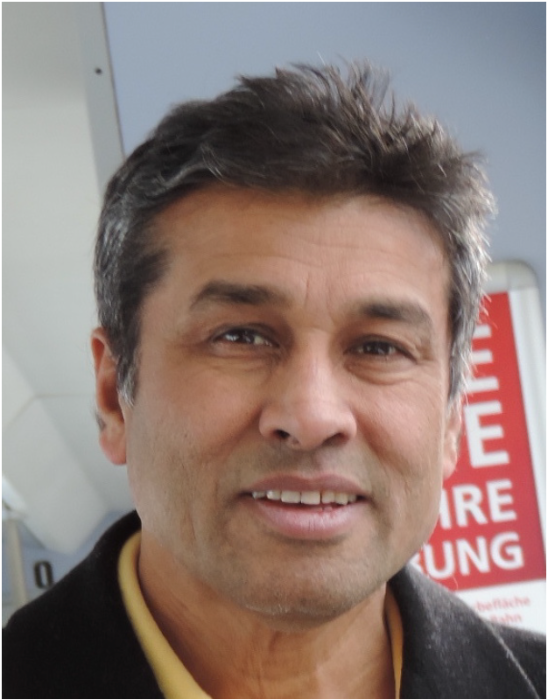
Above, the circular raceway that uses far less energy to filter brackish water. Right, Dr. Ashok Ghosh
New Mexico Tech Associate Professor of Mechanical Engineering Dr. Ashok Ghosh’s faculty/student start-up company was one of three ventures out of 14 applicants recently invited to make a short presentation at the New Mexico Research University Team Pitch Award Pilot Program. This program is a competitive state-funded grant that awards non-dilutive grant funds and consultation assistance to science and technology commercialization proposals from faculty/student teams at New Mexico universities.
The NMT project won a $200,000 grant, plus entrepreneur consulting that amounts to another $50,000. This technology has been years in the making, and many of Dr. Ghosh’s students and other NMT faculty collaborated on the project.
“I am honored to receive this grant from New Mexico Economic Development Department’s newly introduced program that was open to all three research universities in New Mexico,” said Dr. Ghosh. “At present, we are working very hard to transition this innovative technology to market.”
Select researchers were invited to present a 10-minute pitch and then answer questions from a panel of judges. Dr. Ghosh presented “Sattwa-toyam – Creating New Fresh Water from Brackish and Sea Water.”
The key development is called “Forward Osmosis,” a patented water desalination technology that generates additional water, reduces waste brine volume, and lessens membrane fouling. The goal of his pitch was to establish the cost effectiveness of creating a new water source from brackish deep-water sources. This invention can be paired with renewable energy production for operation, he explained.
By contrast, in reverse osmosis desalination, membrane fouling draws more energy, making the process expensive on a commercial scale. Dr. Ghosh’s system uses a gradient in osmotic pressure that consumes virtually no energy, he continued.
“New Mexico Tech is excited to support Dr. Ghosh’s startup as it brings this game-changing technology from NMT’s research labs to market,” said Vice President of Research and Economic Development Dr. Mike Doyle. “Dr. Ghosh’s innovative desalination technology achieves 65 times higher water flux than previous solutions and can treat highly saline water—up to 120,000 parts per million of total dissolved solids—that traditional reverse osmosis systems can’t handle cost-effectively. By reducing the volume of high salt wastewater by 90% and producing 40% more clean water, this breakthrough offers significant economic and environmental benefits over competing approaches and has potential applications in both new and existing desalination systems.”
R.T. Hanson, hydrologist and president of One-Water Hydrologic and an NMT alumnus (1976, BS in both Mathematics and in Geology), said that the grant is “a critical next step” and agrees with Dr. Doyle: “This technology will be a game changer as decentralized desalination, similar to solar energy and other new green technologies, needs a new approach at the local scale that can service a wide variety of applications, including saline aquifers, seawater intrusion of aquifers, treated sewage effluent, food and agricultural processing waste, reclamation of hydrocarbon fluids, geothermal waste fluids, and hydrothermal lithium mining, plus mine and tailings pond discharge.”
A large number of NMT faculty and students were involved during the years of developing the technology.
Faculty and staff included the following: Dr. Van Romero, then-VP for Research; Richard Cervantes, now Vice President of Administration and Finance; Michael Hensley, Director of Special Projects; Fred Yarger, consultant; Paul Fairchild, Magadalena Ridge Observatory; Bikasha Panda (postdoctoral fellow); Michael Pulin (Chemistry); the late Robert Bowman (Earth and Environmental Science); Clint Richardson (Civil and Environmental Engineering); Tom Kieft (Biology); and Andrew Tubesing (Electrical Engineering).
Some of the graduate students involved were: Hilda Asempro (Civil and Environmental Engineering); Naitram Birbahadur (Mechanical Engineering); Gideon Sarpong (Civil and Environmental Engineering); Christopher Turner (Mechanical Engineering); Byron Morton (Mechanical Engineering).
The undergraduates who participated included: Siona Briley (Biology); Michael Peters (Mechanical Engineering); Morgan Harry (Mechanical Engineering); Derek Nieman (Mechanical Engineering); Ian Luders (Mechanical Engineering); Everest Sewell (Mechanical Engineering); Chad Cooper (Mechanical Engineering); and Holi Chamberlain (Mechanical Engineering).