New Mexico Tech Students Showcase Their Knowledge, Skills at Research Symposium
April 25, 2022
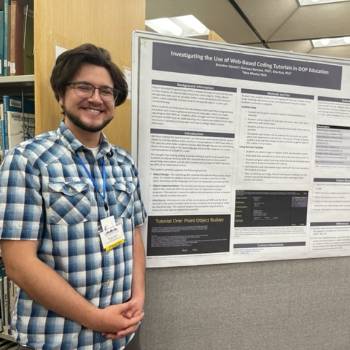
SOCORRO, N.M. – Developing and practicing the skills they need to communicate effectively in the classroom – as well as in a future boardroom – is the goal of students participating in New Mexico Tech’s annual Student Research Symposium. This year’s three-day forum, which was produced by the university’s Office for Student Learning (OSL) and held April 20 to 22 at the Joseph R. Skeen Library, showcased undergraduate and graduate students’ collaboration, presentation and communication skills, in addition to their research abilities.
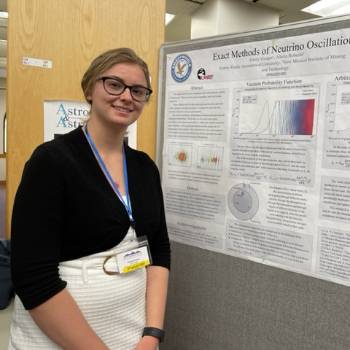
The 11th annual Student Research Symposium featured several different venues for individual students and student groups to employ to communicate about their research projects:
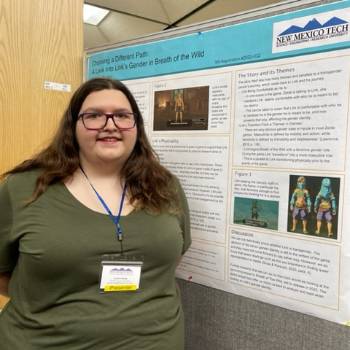
- Poster sessions: Individual students and student groups display information about their research in a visual format, featuring the project’s title, authors, advisor(s), purpose, methods, results, conclusions, and acknowledgements.
- Oral presentations: This format gives students up to eight minutes to provide an overview of their research project, use up to 10 slides to provide information in a visual format, and answer questions from the audience.
- Three-minute speech competition: Students use one presentation slide and must encapsulate their project’s main points, including purpose, research methods, and conclusions in a brief “elevator speech.”
In addition to the four general research poster sessions, the symposium includes 15 departmental showcases featuring the work of specific academic areas of the university. Evaluators, faculty, alumni, and fellow students attend the poster sessions to hear directly from students involved with each project about their research. The graduate student session also includes a cash prize for the outstanding poster creator.
According to Dr. David Cox, director of the Joseph R. Skeen Library and the Office of Student Learning, the Student Research Symposium enhances the education process by providing students with a valuable venue to practice different methods of communicating about their research and to acquire the skills and experience needed for presentations at conferences and at competitions. Students are able to get ready for the symposium by taking preparation courses through the OSL.
“It forces them to be focused,” and not use scientific or research jargon, he said. “We want to make sure our students can communicate to a general audience. We have great technology – but they need to communicate it.”
Steve Simpson, Ph.D., professor of Communication and dean of Arts and Sciences, said the Student Research Symposium encourages students to collaborate with others on research projects and then use their communication skills to present technical information, similar to what happens in industry when different types of engineers working on a project would present a proposal to a boardroom.
“A lot of students are kind of siloed in their department” for their field of study, he said. The Student Research Symposium helps them “get outside of their shells and talking to other students.”
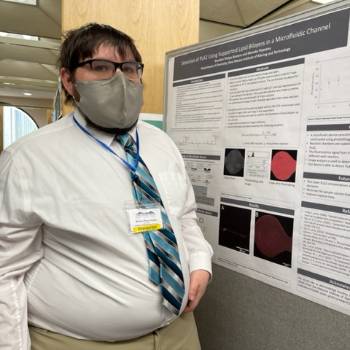
Chemistry master’s student Brandon Phelps-Romero from Santa Fe said he appreciated the feedback from evaluators and others who stopped by his poster display during the Student Research Symposium, titled “Detection of PLA2 Using Supported Lipid Bilayers in a Microfluidic Channel.” Phelps-Romero’s research involves methods to detect PLA2, an enzyme that’s a known biomarker for cancer, cardiovascular disease, and Alzheimer’s disease.
“The outside views from others are valuable,” he said, adding that the research he presented on his poster is also his master’s thesis research. Phelps-Romero said he’s looking forward to its possible use in biomedical applications.
Alisha Roberts, a junior astrophysics major, said creating a visual aid of her project assisted her learning the importance of formatting and readability, and helped her see her research in a different light.
“Being able to discuss research with people not in your field – that’s the most important skill you can have,” as a scientist and researcher, she said. “Talking about it makes me excited about it.”