New Mexico Tech Biology Students Publish Their Research
Nov. 7, 2022
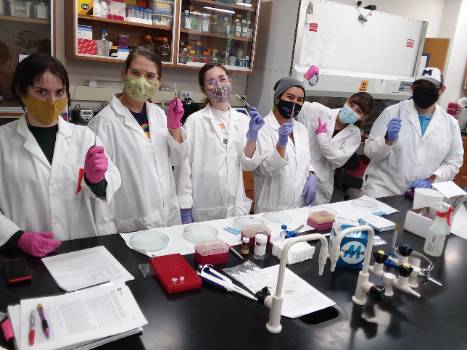
From left: Ella Eleven, Cassandra Skaar, Alivia Abernathy, Marisa Garcia, Ashley Bradshaw, and Nathaniel Jobe show off their techniques in the biology lab.
SOCORRO, N.M. – Thanks to a biology curriculum that helped them learn the steps involved in scientific research and lab work, a group of New Mexico Tech undergraduates can now call themselves published scholars. Eight students who participated in the two-semester Science Education Alliance Phage Hunters Advancing Genomics and Evolutionary Science (SEA-PHAGES) curriculum under Dr. Linda DeVeaux, Dr. Kaarin Goncz, and Dr. Joel Sharbrough during their freshman year last year are now listed as authors on a genome announcement article to be published in the American Society for Microbiology’s journal, Microbiology Resource Announcements, along with other peer-reviewed papers.
New Mexico Tech is the first university in New Mexico to offer the SEA-PHAGES curriculum, and last year’s class was Tech’s inaugural class, according to Dr. DeVeaux, biology professor and Biology Department chair. The curriculum aims to increase undergraduate interest and retention in the biological sciences by giving undergraduates research, lab, and publishing opportunities.
“The ownership of the research is a really big part of it,” she said. “It engages them. The assessment has shown that students who go through this are much more likely to be retained in a STEM field.”
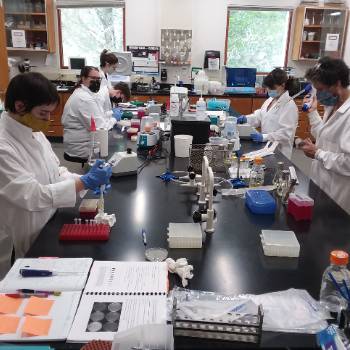
Students began their work by digging in the dirt at various locations around campus and in the Socorro area and returning soil samples to the campus biology lab, where they isolated, analyzed, and characterized novel viruses, called phages or bacteriophages, that infect a particular bacterial strain supplied by the SEA-PHAGES program. The students took extracts of the soil and put it on the bacterial host to isolate the virus. After isolating the phages, the students sent them off for electron microscopy, measured their size, and characterized their morphology, all the while learning how to fully analyze and annotate the virus DNA following microbiology techniques.
The two phages isolated and studied by the New Mexico Tech students in the 2021-22 academic year were dubbed “PokyPuppy” and “LilyPad.” Their samples also were submitted to a permanent national data bank at the University of Pittsburgh, where they could potentially be used for phage therapy in cases where antibiotics have proven useless to combat infections.
“We are already seeing the benefits,” Dr. DeVeaux said. “It gives the students confidence. It promotes a cohort feel.”
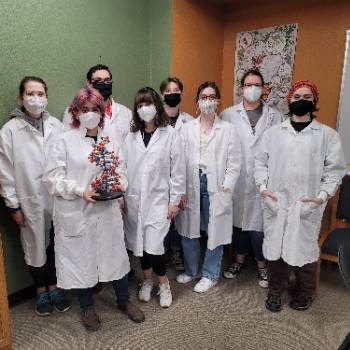
Students participating in the SEA-PHAGES curriculum – Alivia Abernathy, Ashley Bradshaw, Ella Eleven, Casia Esparza, Marisa Garcia, Nathaniel Jobe, Kennedi Pyper, and Cassandra Skaar – are excited to be published along with Dr. DeVeaux, Dr. Goncz, and Dr. Sharbrough.
Ella Eleven said that this type of bacteriophage research is very applicable to other fields since the same fundamental microbiological techniques like culturing and DNA sequencing are used.
“Of course, phage therapy is very exciting since it's going to be developed a lot more in the coming years, and anything involving disease and treatment is pretty cool,” she said. “Doing the lab work, making the posters, presenting and organizing the DNA sequences – it all comes together in one professional, concise, and Google-able paper.”
Ashley Bradshaw said the SEA-PHAGES curriculum provided her and some of her colleagues with the experience and expertise to now work in a biology lab alongside graduate students and researchers.
“Overall, it feels pretty great to have a published paper within my first year at NMT,” Bradshaw said. “In all honesty, during my high school career, I never imagined participating in research, much less actually having a resulting publication. SEA-PHAGES, in general, gave me the knowledge of classic microbiology procedures that I will utilize for the rest of my life.”
Besides writing the paper, titled “Genome Sequences of Gordonia rubripertincta Phages LilyPad and PokyPuppy,” the students created posters and videos about their research and presented it at the Student Research Symposium, at a Tri Beta Biology Club meeting, and at Biology Department information sessions. Bradshaw also was selected to present the research virtually to more than 500 participants at the 2022 SEA-PHAGES Symposium.
“I gained knowledge on not only scientific techniques but how to communicate the results from said scientific techniques,” she said. “The presentation was a unique experience that I will always look back on and treasure.”
More than 200 other colleges and universities in over 40 states participate in SEA-PHAGES, which is jointly administered by the University of Pittsburgh and the Howard Hughes Medical Institute's Science Education division.