NMT Experiment To Be Installed On the International Space Station
October 3, 2019
SOCORRO, N.M. – Dr. Andrei Zagrai and a team of his students in Mechanical Engineering are sending an NMT experiment to the International Space Station later this month.
 The team has designed and built a payload housing the new structural health monitoring
experiment that will launch on the Cygnus NG12 mission from Wallops Flight Facility
in Virginia on October 29. The project is funded by the NASA EPSCoR program (Established
Program to Stimulate Competitive Research).
The team has designed and built a payload housing the new structural health monitoring
experiment that will launch on the Cygnus NG12 mission from Wallops Flight Facility
in Virginia on October 29. The project is funded by the NASA EPSCoR program (Established
Program to Stimulate Competitive Research).
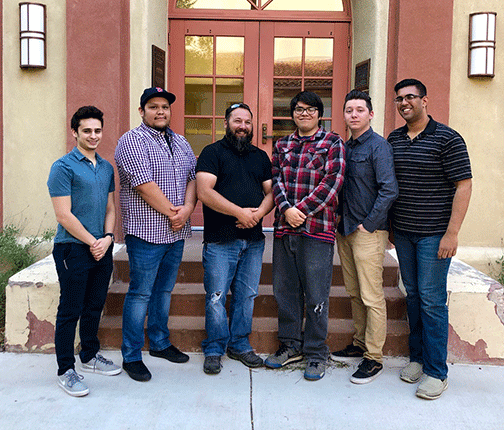
(Pictured at right are (from left) Daniel Pacheco, Carl Bancroft, Douglas MacNinch, Isaac Flores, Matthew Rue, and Arjun Tandon.)
The project has supported two grad students who worked on the experimental parts of the payload and several undergraduates who worked on the design and construction of the mechanical portion of the payload.
 “The main purpose of this research is to make space travel safer and more affordable,”
Zagrai said. “We need a system to monitor the structural condition at all times.”
“The main purpose of this research is to make space travel safer and more affordable,”
Zagrai said. “We need a system to monitor the structural condition at all times.”
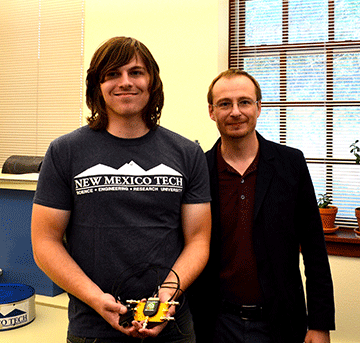
(Pictured at right are grad student John Sanchez and professor Dr. Andrei Zagrai.)
Zagrai and previous teams have done suborbital launches from Spaceport America. This will be the first launch that will take one of Zagrai’s instruments to space. The instrument will be installed on the exterior of the ISS on an MISSA platform. The instrument is not allowed to monitor the entire space station, so they’ll just observe the structural condition of the payload itself.
 Grad student John Sanchez has been lead the way. He hopes to travel to Virginia for
the launch, along with undergrads Douglas MacNinch, Isaac Flores, and Matthew Rue.
Grad student John Sanchez has been lead the way. He hopes to travel to Virginia for
the launch, along with undergrads Douglas MacNinch, Isaac Flores, and Matthew Rue.
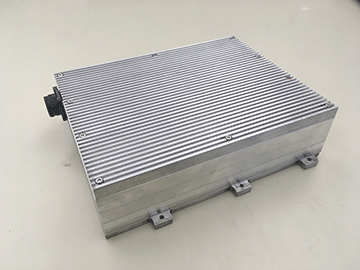
(Pictured at right is the instrument that will be installed on the International Space Station.)
The team has written a paper that MacNinch will present at the 2019 International Mechanical Engineering Congress & Exposition in Salt Lake City in November. Other team members and authors are Daniel Pacheco, Carl Bancroft, and Arjun Tandon. Sanchez has presented an investigation of payload structural health monitoring at an international workshop at Stanford University in September.
“We will explore crack damage and bolts – since most space structures are held together by bolts,” Zagrai said. “We’ll look at the performance of piezoelectric sensors as well.”
The instrument will stay aboard the ISS for one year, then be brought back to New Mexico Tech for a performance review.
– NMT –