Free Chamber Concert Features Emerson Concord Trio
October 23, 2019
SOCORRO, N.M. – The Emerson Concord Trio will perform works by two female composers in the second Presidential Chamber Music Series concert of the 2019-2020 Performing Arts Series at 7:30 p.m. Friday, Nov. 1, at the Macey Center.
Courtesy of NMT President Stephen Wells, the concert is free to all.
The revamped Presidential Chamber Music Series reflects a move toward greater diversity in the program, in hopes to generate wider interest in the long-standing series.
 Prior to this concert, Tech Club Macey will host a Wine Expo from 5:30 to 7:15 p.m.
featuring wine samples and presentations from nearby wineries, anchored by Black Smuggler
winery. Light snacks will be served, and glasses and bottles of wine available for
sale. Tickets are $10 for members and $15 for non-members, available by calling 835-5688.
Prior to this concert, Tech Club Macey will host a Wine Expo from 5:30 to 7:15 p.m.
featuring wine samples and presentations from nearby wineries, anchored by Black Smuggler
winery. Light snacks will be served, and glasses and bottles of wine available for
sale. Tickets are $10 for members and $15 for non-members, available by calling 835-5688.
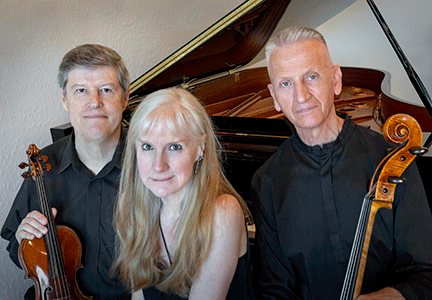
Violinist Endre Balogh, cellist Antony Cooke and Donna Coleman on piano comprise the Emerson Concord Trio. The name is homage to American Transcendentalist Ralph Waldo Emerson, known for his philosophy and literary discourses.
“All three musicians are extraordinarily talented and experienced, with impeccable and diverse resumes,” PAS Director Ronna Kalish said. “And the program they will perform showcases the works of two female composers, both celebrated in their own right.”
The trio will perform Trio opus 17 in D minor by German pianist, composer and piano teacher Clara Wieck (1819 – 1896), the direct inspiration for the series of three piano concertos by her husband, Robert Schumann (1811 – 1856); Trio opus 150 by American pianist and composer Amy Marcy Cheney Beach (1867 – 1944); and closing with Robert Schumann’s Trio opus 80 in F Major.
Both women were child prodigies with fascinating histories, briefly detailed here.
This year marks the 200th birthday of Wieck, who, by the time she was a teenager, was renowned as one of the best pianists in Europe. At age 11, she met the already-famous Schumann, but her father took him to court to prevent their marriage until a day shy of his daughter’s 21st birthday in 1840.
Wieck and Schumann were known to inspire and support each other creatively, he mostly as a composer and occasional conductor, she mostly as a concert pianist and mother to their eight children, composing works that stand alongside those of her husband as equal masterpieces.
Wieck outlived Schumann by 40 years, left to the task of child-rearing, concertizing and serving as muse, friend, and advisor to illustrious musicians Johannes Brahms, Joseph Joachim, and others.
Beach was the first successful American female composer of large-scale art music. Her “Gaelic” Symphony, premiered by the Boston Symphony Orchestra in 1896, was the first symphony composed and published by an American woman.
She was able to sing 40 songs accurately by age one and capable of improvising counter-melody by age two. The child taught herself to read at age three and at 16 made her concert debut at Boston’s Music Hall. At 18, she married Dr. Henry Harris Aubrey Beach, a Boston surgeon 24 years her senior.
Beach was restricted by the social mores of the time; but, following her husband’s death, she used her status as the top female American composer to further the careers of young musicians. Though she had agreed not to give private music lessons while married, she was able to work as a music educator during the early 20th century.
Meet the musicians:
Balogh has performed as violin soloist with orchestras world-wide, working with such eminent conductors as Zubin Mehta, James de Priest, Milton Kamins and Christoph von Dohnányi. His many concert tours of the U.S. and Europe included live televised recitals in Amsterdam and taped performances for the BBC. An accomplished chamber music performer, Balogh won several Coleman Chamber Music Awards, and toured with the Pacific Trio for nearly 30 years.
Cooke, an author, composer, Hollywood studio musician, cellist, composer, conductor, teacher and astronomer, began life in Australia, trained principally in London, and built a brilliant career as a cellist in Europe before settling in the U.S., where he also is a citizen. He held two academic positions before relocating to Los Angeles, where he quickly established himself as one of the luminaries in the Hollywood recording industry, and composed music for primetime television as well.
Coleman’s performances of American music earned fellowships, including from the National Endowment for the Arts, the Rockefeller Foundation, National Endowment for the Humanities, the Fulbright Foundation, and Second Prize in the first John F Kennedy Center International American Music Competition, among others. She recorded internationally acclaimed discs of Charles Ives’s music for Amsterdam’s Et’Cetera Records, two for ABC Classics, and for her own label, OutBach®. Donna Coleman and the trio are in their second year of presenting the OutBach Festival of (Mostly) Women’s Music, held at the San Miguel Chapel in Santa Fe.
– NMT –