Biology Prof Co-Authors New Edition of Desert Ecology Text
October 28, 2019
Dr. Ben Duval contributed new sections on climate change and invasive species
October 27, 2019
SOCORRO, N.M. – Biology faculty member Dr. Ben Duval has co-authored the second edition of the text book “Ecology of Desert Systems,” along with his former master’s advisor Dr. Walter Whitford of NMSU.
Duval made significant contributions to the book, including new chapters on invasive species and global climate change. The first edition covered all aspects of desert ecology including soils, geomorphology, plants, animals and human impacts. The second edition includes new work in all of those areas, as well as expanded discussion of invasive species.
 “Walt asked me to write the new chapter on climate change,” Duval said. “The editors
approached Walt and they wanted new sections on invasive species and climate change.
He wanted to do it, but needed some help. He asked me to help about two years ago.”
“Walt asked me to write the new chapter on climate change,” Duval said. “The editors
approached Walt and they wanted new sections on invasive species and climate change.
He wanted to do it, but needed some help. He asked me to help about two years ago.”
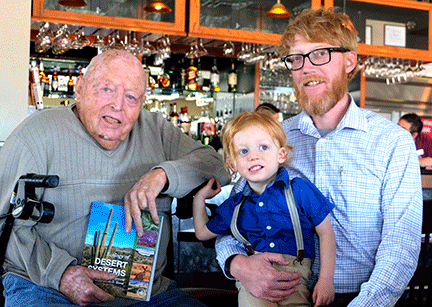
(Pictured at rigth are Walter Whitford, Ben Duval and his son Gustav.)
Much of Duval’s research focuses on anthropogenic climate impacts to plants and soils, and so it was natural that Whitford would approach his former student and colleague for the task.
New Mexico State University hosted an open house and book signing on Saturday, Oct. 19, for Whitford and Duval, as well as two authors of another book. Duval said the event was a great way for the academic community to show gratitude to Whitford for his lengthy and distinguished career.
Duval said he expects the second edition of "Ecology of Desert Systems" to be a valuable resource for students, researchers, land managers and policy makers focused on issues facing arid lands now and in the future. He expects to use the text for upper level courses at NMT in the future. He’s been contacted by professors at other Southwest universities who want to use the text as well.
“We added a lot of new work on China and Asian deserts that wasn’t in the first edition,” Duval said. “The climate change chapter focuses on all deserts, including our Chihuahan and Sonoran in the US. The Sahara and China deserts are getting much more attention from a research perspective and we wanted to offer a global perspective related to how climate change is impacting arid regions. We are constantly learning more about how climate patterns are changing, particularly with the gulf streams and oceanography and how changes like sea temperature rise is influencing the interior of continents. We thought it was important for our audience to understand that all aspects of global change influence desert ecosystems.”
Whitford, 84, has more than 60 years studying desert systems around the globe, and over 400 peer-reviewed publications. The original text "Ecology of Desert Systems" (2002) met with very favorable reviews, given both the depth and breadth of information on all aspects of desert ecology including soils, geomorphology, plants, animals and human impacts.
“He’s done so much for me and my career,” Duval said about Whitford. “Being involved with a book of this scope is certainly edifying, but working on this specific project seemed like a way for me to pay back Walt a little bit. The first edition of his book is a big reason that I wanted to work with him in grad school. Beyond our publications together, I’m just incredibly grateful for his mentorship and friendship.”
Whitford is among the eminent authorities on desert ecology. His knowledge spans the globe’s deserts, including South America, Australia, China, the Sahara, and Israel.
– NMT –