NMT Students Successfully Launch Weather Balloon To 80,000 Feet
December 14, 2018
 SOCORRO, N.M. – New Mexico Tech students (new freshmen and transfers) in the Electrical Engineering
Space Vehicles class successfully launched a weather balloon Monday, December 10,
sending instruments over the New Mexican desert and reaching an altitude of 80,000
feet above sea level.
SOCORRO, N.M. – New Mexico Tech students (new freshmen and transfers) in the Electrical Engineering
Space Vehicles class successfully launched a weather balloon Monday, December 10,
sending instruments over the New Mexican desert and reaching an altitude of 80,000
feet above sea level.
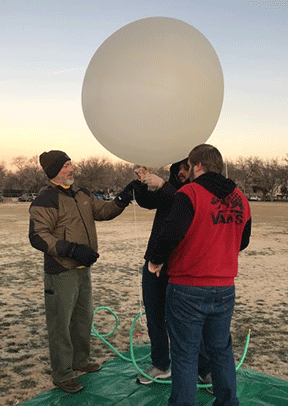
(Pictured at left: Dr. Kevin Wedeward (left) and students inflate a test balloon prior to Monday's official launch.)
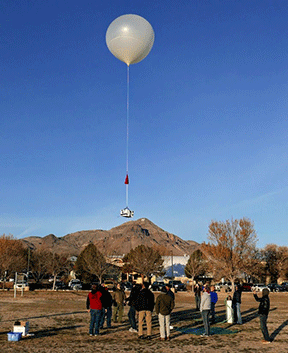
The launch culminated the semester for 17 students in Electrical Engineering 189: Space Vehicles. During the semester, the students got introduced to electrical engineering topics like instrumentation and microcontrollers. The helium balloon carried a small ice-chest sized payload with an array of sensors that tracked altitude, temperature, barometric pressure, humidity, acceleration, and GPS location, plus a still camera and a GoPro video camera.
 The payload was also equipped with an Automatic Packet Reporting System (APRS) that
allowed real-time tracking of the balloon, through the World Wide Web, and eventually
it’s recovery.
The payload was also equipped with an Automatic Packet Reporting System (APRS) that
allowed real-time tracking of the balloon, through the World Wide Web, and eventually
it’s recovery.
The class is taught by electrical engineering professors Dr. Aly El Osery, Dr. Ken Eack, and Dr. Kevin Wedeward.
“We are trying to introduce students to space vehicles, communications, instrumentation, and learning about how to launch something on a one-way street,” said professor Dr. Kevin Wedeward. “It all went surprisingly well. We are always nervous before a launch, but it went off without a hitch.”
The team used a flight landing predictor developed by Cambridge University to estimate the balloon’s path and allow the search team to get a head start on its recovery by leaving before the launch. Once the balloon reached about 80,000 feet, the helium had expanded enough to burst the latex balloon. The instrument case then parachuted to Earth, landing near the Valley of Fires lava field near Carrizozo.
 The team was very anxious as they tracked the payload. It seemed that it might land
in the middle of the lava flow. This would have deemed it impossible to recover, which
means no cool videos or data.
The team was very anxious as they tracked the payload. It seemed that it might land
in the middle of the lava flow. This would have deemed it impossible to recover, which
means no cool videos or data.
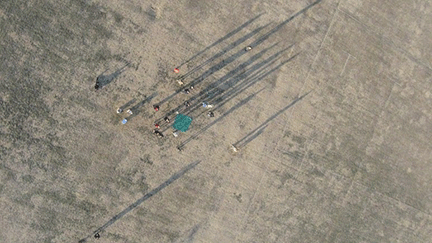
(Pictured at right: Students on the Athletic Field, as seen from the launched balloon).
The load landed 100 feet from the lava flow and the students were able to hike to it, and eventually recover the payload with all the instruments and cameras intact. The cameras collected dramatic still images and videos throughout the launch, flight, and descent.
The students in EE189 divided into three teams for the semester: Logistics, Communications, and Payload. The Logistics Team oversaw the balloon prep, launch, tracking, and development. The Communications Team developed the system to transmit data from GPS and some instruments to the ground. The Payload Team was in charge of data logging, cameras and additional instrumentation.
– NMT –