Chicago Museum Features Tech Personalities In Video Exhibits
September 9, 2010
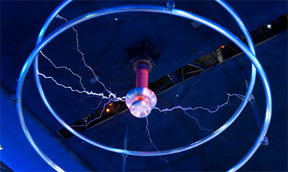
Dr. Olivia Castellini, the museum’s senior exhibit developer, said she was pleased
with the production trip to Socorro. She oversaw the filming by Cortina Productions
of California. The crew filmed two segments with two different “screen stars.” Castellini
designed the new permanent exhibit called “Science Storms,” which was unveiled earlier this year. The 26,000 square-foot exhibit is dedicated
to basic physics and chemistry.
The Chicago Museum of Science and Industry opened in 1933 and is the largest science
museum in the Western Hemisphere. The museum has dozens of exhibits, an IMAX theater,
special events, live science experiments, hands-on activities and regular tours.
“We are committing ourselves to a presentation of basic science,” Castellini said.
“Science is our natural desire to understand natural phenomena and how they work.
The idea with Science Storms is that we are learning about science through these natural
phenomena like fire, combustion and lightning.”
Senior Research Chemist Dr. Christa Hockensmith is featured in a 4-minute video explaining
the chemical reactions in explosions. Former Master’s of Science Teaching student
Elissa Eastvedt is the star of another 4-minute video – an interactive digital video
exhibit discussing how thunderstorms become electrified and produce lightning. She
then explains how she and other physicists trigger lightning by firing rockets into
overhead thunderstorms.
“This exhibit means we’ll have international exposure that we couldn’t buy,” Hockensmith
said. “I’ll bet our peer institutions will be green with envy. These exhibits will
be there day after day, every day. The people who go to this museum are folks who
have an interest in science and engineering. We are extremely lucky they chose us.”
One of Castellini’s staff members heard Hockensmith speak at the ETech Conference
in California in early 2009 and suggested the Tech scientist because of her straight-forward
speaking style and dynamic personality.
“This project has been going on for several years,” Castellini said. “We did extensive
content research to find the people who are the tops in their fields and we came across
New Mexico Tech.”
The film crew visited during the inaugural Explosives Camp that Hockensmith organized
through the Energetic Materials Research Testing Center, or EMRTC. Hockensmith’s video
is part of the “Fire” portion of the exhibit.
Hockensmith spent a good deal of time explaining why she chose science as a career,
including a movie about Marie Curie she saw as a child.
“Go to the laboratory and discover something new. Then go to lunch. Then come back
and discover something new. I thought, ‘That’s a cool way to live’,” Hockensmith said.
“It’s a physical high and a mental and emotional high to discover something new.”
Hockensmith was filmed mostly at work – in the field, in the lab and in the classroom;
but she was also filmed in front of a green screen.
“With Christa, we approached the idea of understanding the chemistry of explosives
to allow people to be more informed about chemistry and how it allows people to do
cool research,” Castellini said.
Eastvedt spent several months writing her script. Her screen experience was predominantly
several hours talking on camera in front of a green screen. She repeated her scripted
lines until the film crew got it just right. A resident of Long Beach, Calif, she
is a high school physics teacher and has spent nine summers working at Langmuir Lab
at New Mexico Tech. Much of job and research involves lightning, firing rockets and
triggering strikes. She first was inspired to work at Langmuir Lab after watching
a Nova program about lightning that included footage from Langmuir Lab.
“My job is to launch rockets and make sure everyone gets data [from lightning strikes],”
Eastvedt said. “The high-speed camera gives you a new perspective of what’s going
on. It shows a lot of unanswered questions.”
Four years ago, she entered the Master’s of Science Teaching program at New Mexico
Tech. She earned her degree earlier this year.
For the Chicago museum video, Eastvedt talks about lightning and thunderstorms. The
result of her interactive exhibit is that museum-goers are able to launch virtual
rockets that trigger lightning. Castellini compared Eastvedt’s portion of the exhibit
to a digital video game.
“You walk up and get to see me talking and explaining what goes on in a thunderstorm,”
Eastvedt said. “Then, you’ll get to try to launch a virtual rocket. You’ll touch a
button and launch one of three rockets. The end of the show will be high-speed video
of triggered lightning. So, kids will think they’ve just triggered lightning.”
For the museum exhibit, Eastvedt explains how scientists are expanding their knowledge
of lightning and electricity by analyzing data captured on high-speed video. She said
this Chicago Museum of Science and Industry exhibit gives great exposure to the cutting
edge research happening at New Mexico Tech.
The new “Science Storms” wing is an ambitious undertaking for the Chicago museum,
with the goal of explaining both the fundamentals of science and chemistry, as well
as shedding light on how research is conducted.
“This exhibit is as large as some medium-sized museums,” Castellini said. “We are
the largest science museum in the country and this is an entire wing. There is nothing
else like it in the world.”
By Thomas Guengerich/New Mexico Tech