Badrul Mohamed Jan Publishes Paper on Fracking With Graphene
November 5, 2019
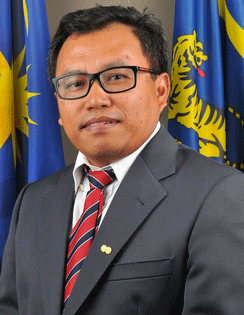 The Journal of Petroleum Technology published a paper by three-time NMT grad Badrul
Mohamed Jan (pictured) in the latest issue. Jan earned his bachelor's, master's and
Ph.D. at New Mexico Tech in petroleum engineering. He is currently a faculty member
in the Department of Chemical Engineering, University of Malaya in Malaysia.
The Journal of Petroleum Technology published a paper by three-time NMT grad Badrul
Mohamed Jan (pictured) in the latest issue. Jan earned his bachelor's, master's and
Ph.D. at New Mexico Tech in petroleum engineering. He is currently a faculty member
in the Department of Chemical Engineering, University of Malaya in Malaysia.
Here is an excerpt of his paper. Click the link at the bottom to read the full article.
To drill or not to drill? To damage or not to damage? These are compelling questions. Recent research has put extensive focus on the magic of graphene in drilling fluids. Graphene, because of its thermal, electrical, chemical, and mechanical properties, improves mudcake stability and minimizes fluid loss that eventually reduces formation damage.
The term “graphene” was introduced in 1986, and, in 2004, the extraction of graphene was presented, which later made it commercially available. In 2010, the Scotch-tape method was announced to peel off the tiny graphite flakes into a monolayer, 2D graphene layers with the fewest possible defects. The rest, as they say, is history.
The significant attention on graphene as a drilling-fluid additive has increased because of its Newtonian fluid behavior, low fluid loss, and formation of firm and stronger mudcake. The addition of graphene or graphene oxide can improve the control of fluid loss, the stability of shale, and lubrication. The addition of graphene nanoparticles to drilling fluid has presented a significant surge in the proportion of dispersion, a reduction in torque, and an increase in drilling bits deprived of the destructive effects of the rheological properties of drilling mud.
Click here for the full article.