IEEE Spectrum magazine highlights NMT's Lightning Mapping Array in Switzerland
July 15, 2019
 IEEE Spectrum, the official magazine of the top most electrical engineering professional
organization, published a feature article about NMT's Lightning Mapping Array. NMT
scientists Bill Rison and Mark Stanley (pictured at right) visited Switzerland to
oversee the installation of Tech's proprietary instrument that maps lightning.
IEEE Spectrum, the official magazine of the top most electrical engineering professional
organization, published a feature article about NMT's Lightning Mapping Array. NMT
scientists Bill Rison and Mark Stanley (pictured at right) visited Switzerland to
oversee the installation of Tech's proprietary instrument that maps lightning.
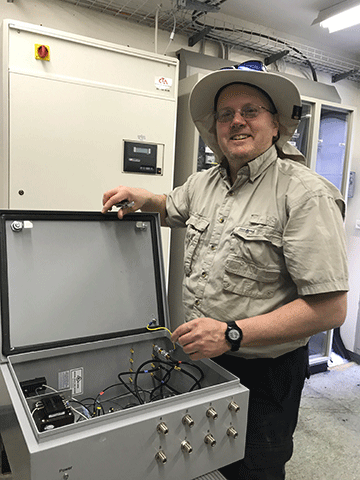
(Pictured at right is Mark Stanley with one of the Lightning Mapping Array stations. Photo courtesy of Farhad Rachidi/Swiss Federal Institute of Technology).
Spectrum news director Amy Nordrum interviewed the NMT scientists and their counterparts at the Swiss Federal Institute of Technology for her feature-length article.
Here is an excerpt of Nordrum's article. Click the link at the bottom of this page to read the full article.
This Cell Tower in the Swiss Alps Is Struck by Lightning More Than 100 Times a Year
Säntis Tower is struck so often, researchers adorned it with instruments to try to better understand how lightning forms
 Atop a rocky peak in the Swiss Alps sits a telecommunications tower that gets struck
by lightning more than 100 times a year, making it perhaps the world’s most frequently
struck object.
Atop a rocky peak in the Swiss Alps sits a telecommunications tower that gets struck
by lightning more than 100 times a year, making it perhaps the world’s most frequently
struck object.
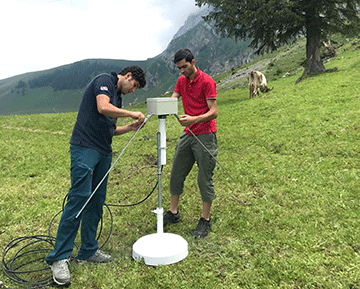
(Pictured at right: Antonio Sunjerga and Amir Hossein Mostajabi of the Swiss Federal Institute of Technology and Mohammad Azadifar with Switzerland’s School of Business and Engineering Vaud (from left to right) install a very high-frequency antenna that points at Säntis Tower from a nearby hillside in the Swiss Alps. Photo courtesy of Farhad Rachidi/Swiss Federal Institute of Technology
Taking note of the remarkable consistency with which lightning hits this 124-meter structure, researchers have adorned it with instruments for a front-row view of these violent electric discharges.
On Wednesday, a small team installed a new gadget near Säntis Tower in their years-long quest to better understand how lightning forms and why it behaves the way it does. About two kilometers from the tower, they set up a broadband interferometer that one member, Mark Stanley of New Mexico Tech, had built back in his lab near Jemez, New Mexico.
“You can’t really go to a company and find an instrument that’s built just for studying lightning,” says Bill Rison, Stanley’s collaborator who teaches electrical engineering at New Mexico Tech. “You have to build your own.”
Click here to read the full article.