Magdalena Ridge Observatory efforts to establish optical array featured in Big Think e-zine
June 24, 2024
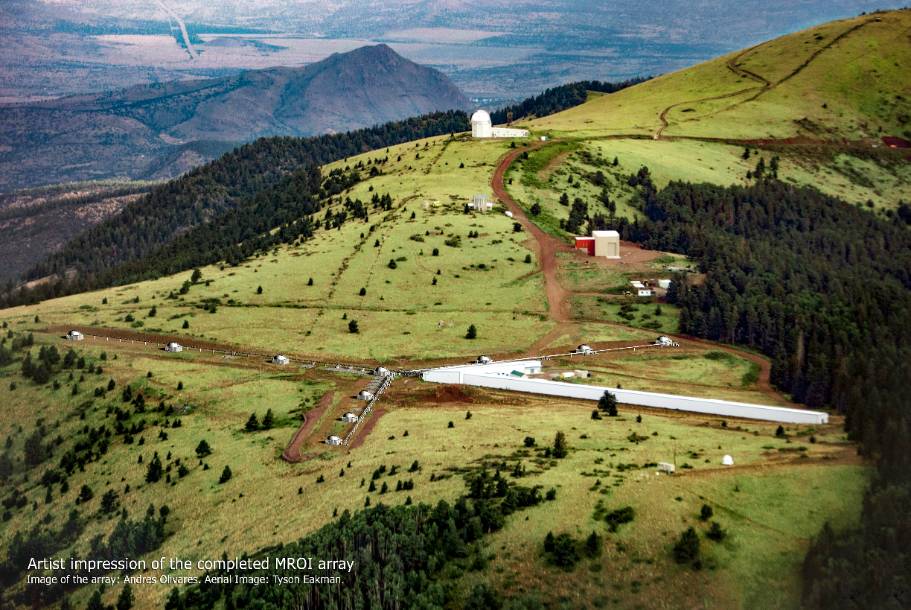
Both New Mexico Tech’s MRO and the NRAO’s VLA are featured in a June 19 article on BigThink.com, a newsletter that presents big thinkers and big ideas.
“Astronomy’s secret weapon in the resolution wars: Interferometry” was written by Ethan Siegal, a columnist who writes “Starts with a Big Bang” for Big Think.
The article explains how multiple telescopes synced up—an array—can see stellar surfaces, star and planet forming regions in full resolution. Magadalena Ridge's will observe optical light, while the VLA observes radio waves.
Construction of the second telescope at MRO is underway and might deliver the first measurements in the next several months. The entire array, pending funding, will be online in the early 2030s.
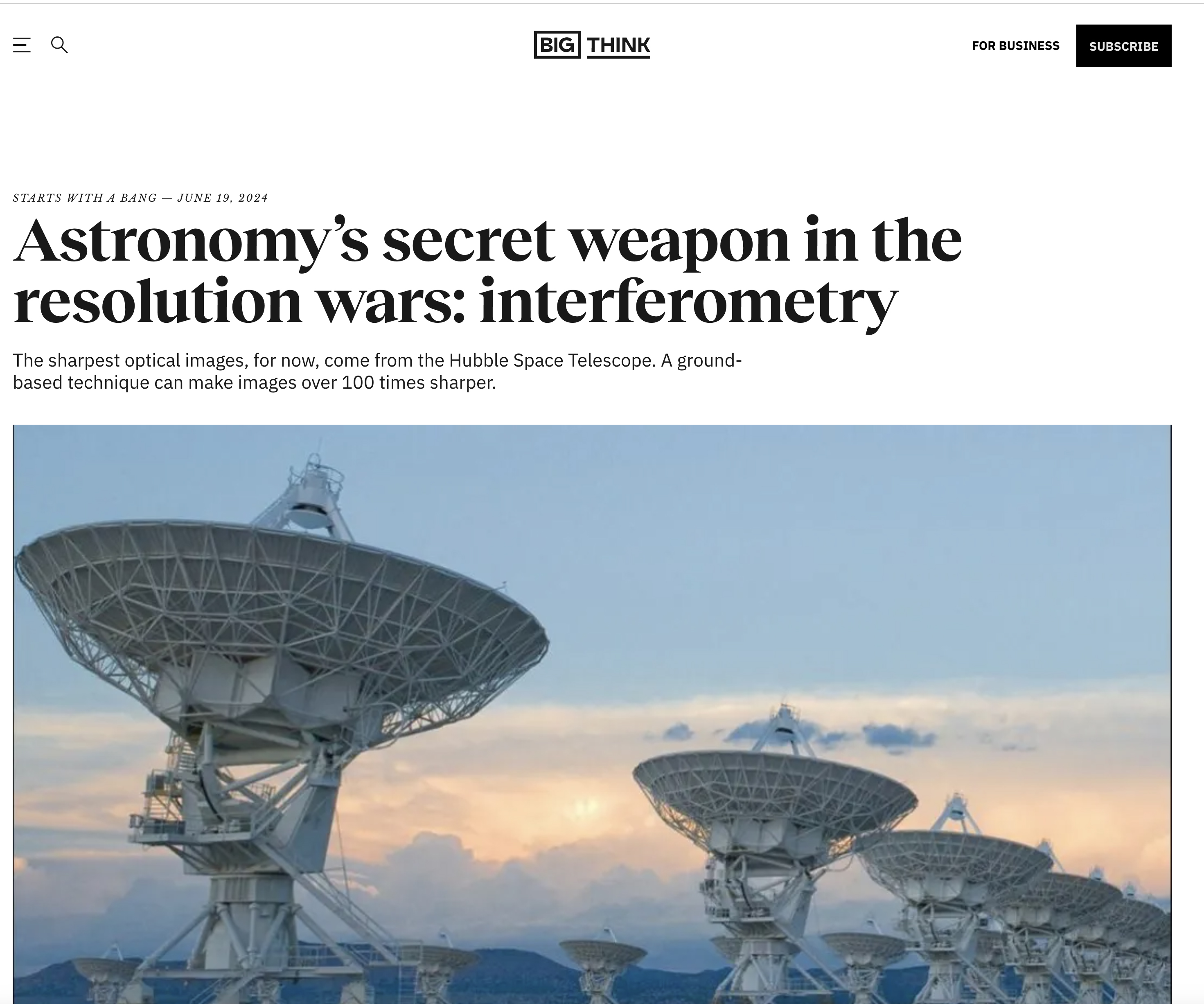
Screenshot from BigThink.com, showing the VLA
More about the MROI
By Dr. Michelle Creech-Eakman, Professor of Physics and Project Scientist MROI
The MRO Interferometer project was started with the inception of the Magdalena Ridge Observatory in the early 2000s. It is located on the same mountain research park as Langmuir Laboratory of Atmospheric Science.
The Environmental Impact Survey for MRO was completed in 2003 with design and groundbreaking shortly thereafter. (See these pages for photos and info: January 2023 & April 2023.)
The design, assembly and testing are being undertaken by a small team of scientists and engineers at NMT and Cambridge University. When completed, the MROI will be a 10-telescope, movable, optical interferometric array in a Y configuration at 10,500 feet altitude, fully capable of resolving stellar surfaces, star-forming and planet-forming regions, and the nearby surroundings of massive black holes in the hearts of external galaxies.
The efficiency and sensitivity of the MROI are designed to surpass existing arrays in the world today and will permit rapid imaging (called snapshot imaging) and statistically significant characterization of thousands of systems.
We are installing the second telescope this year (2024), and anticipate our first “fringe” measurements in the next several months. Due to the much shorter wavelengths (optical/near-infrared) and the up to 347-meter telescope separations (called baselines) along the array arms, MROI is equivalent in resolution to the VLA (working at radio wavelengths) with antennas spread across the entire Earth.
We are currently funded by Air Force Research Laboratory for demonstrations of Geosynchronous Satellite observations, through deployment of the third MROI telescope. If the rest of the funding were available today, we could complete the entire 10-telescope array by the early 2030s.