Research Interests
Calorimetry studies associated with the curing of DGEBA epoxy with hardener diethanolamine (DEA). Curing involves a complex series of reactions (including zwitterion formation, anionic chain growth, and termination). The tertiary amine formed after initial reaction of the secondary amine to form an adduct acts to open the epoxide ring to form the zwitterion which then propagates in chain growth. The hydroxyls accelerate the reaction. Currently we are acting to separate contributions by studying DGEBA reaction with dibutylamine and octanol.
Recent Publications
The reaction of diglycidyl ether of bisphenol A (DGEBA) epoxy cured with diethanolamine: Dependency on temperature and extent of reaction, McCoy, Ancipink, Maestas, Draelos, Devries, Kropka, Thermochimica Acta (Submitted 2018)
The insulating effect of the low thermal conductivity of epoxy on the resolution of the heat of reaction during polymerization by differential scanning calorimetry, Arechederra, Draelos, Ancipink, McCoy, Kropka, Thermochimica Acta 656, 144 (2017)
Cure mechanisms of diglycidyl ether of bisphenol A (DGEBA) epoxy with Diethanolamine, McCoy, Ancipink, Clarkson, Kropka, Celina, Giron, Hailesilassie, Fredj, Polymer 105, 243 (2016)
Recent Presentations
Influence of hydroxyl concentration on the cure kinetics of diglycidyl ether of bisphenol A (DGEBA) epoxy in the presence of a tertiary amine, McCoy, M. House, E. House, S. Comeau, C. House, Kropka, Poster, American Physical Society, Los Angeles, CA (2018)
Effect of hydroxyl mobility on the cure kinetics of diglycidyl ether of bisphenol A (DGEBA) epoxy in the presence of a tertiary amine, D. Devries, M. House, E. House, S. Comeau, C. House, McCoy, Kropka, Poster, American Physical Society, Los Angeles, CA (2018)
Effect of Hydroxyl Groups on the Tertiary Amine Curing of Epoxy, M. House, E. House, S. Comeau, C. House, McCoy, Kropka, Poster, AiChe Annual Meeting, Minneapolis, MN (2017)
Complex Cure Kinetics of the Tertiary Amine activated Reaction in DGEBA Epoxy Hardened with Diethanolamine, Ancipink, McCoy, Clarkson, Kropka, Celina, Giron, Hailesilassie, Fredj, Poster, American Physical Society, New Orleans, LA (2017)
Complex Cure Kinetics of the Hydroxyl-Epoxide Reaction in DGEBA Epoxy Hardened with Diethanolamine, Ancipink, McCoy, Kropka, Celina, Poster, American Physical Society, Baltimore, MD (2016)
Thesis
Cure Kinetics of the Tertiary Amine Activated Reaction in DGEBA Epoxy Hardened with Diethanolamine – Ancipink (2017)
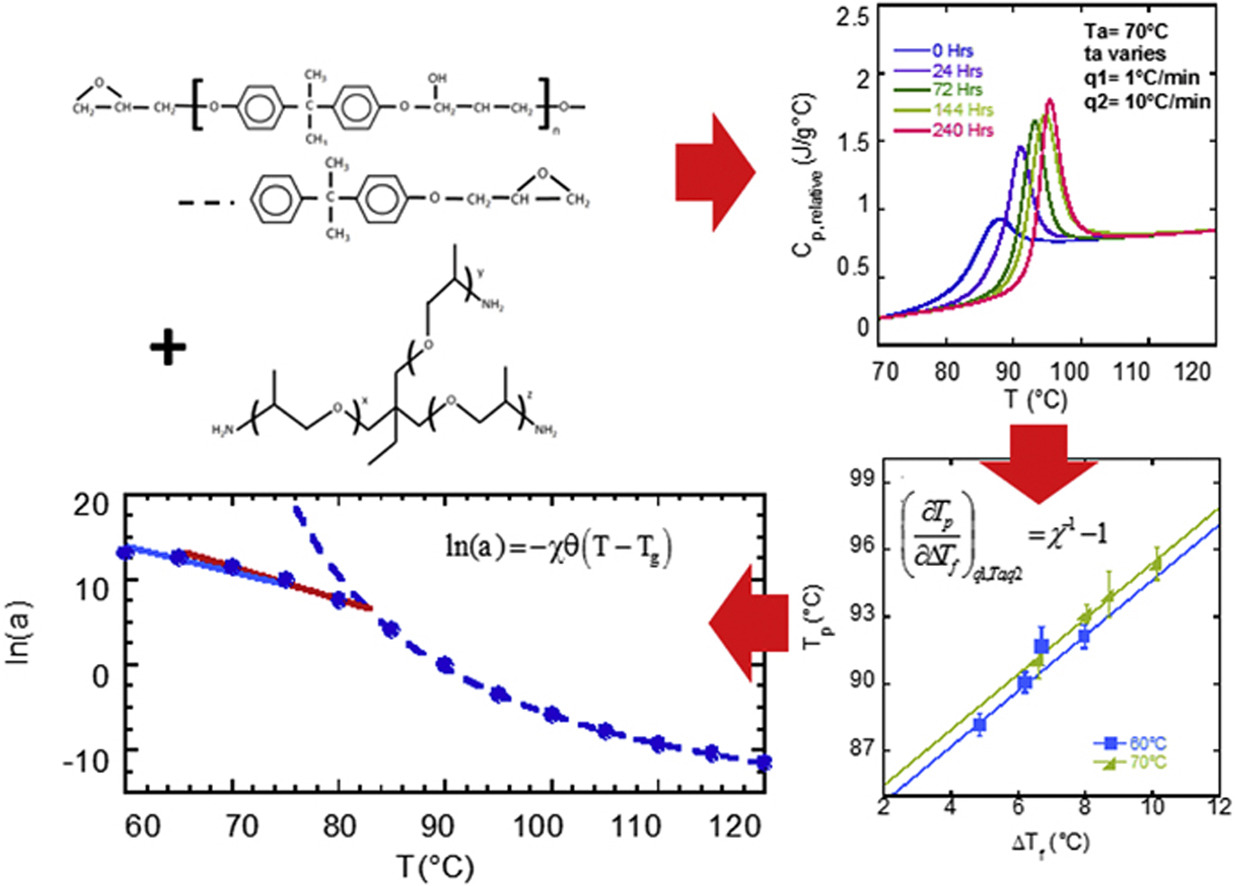
Thermal and mechanical properties of glasses vary with time as they “age” at temperatures below their glass transition. Two epoxies have been studied. DGEBA cured with diethanolamine (DEA) and DGEBA cured with a polyamine Jeffamine T-403. Use is made of simple theories of aging (e.g., KAHR and Eyring Models) to understand the aging process. Particularly interesting is the effect of compressive stress on the effects of aging, both small, sub-yield stresses and large, post-yield stresses are studied.
Recent Publications
Evolution of Thermomechanical Properties of the Diethanolamine Cured Diglycidyl Ether of Bisphenol-A (DGEBA) Epoxy, Arechederra, McCoy, Kropka, Polymer (To be Submitted - Draft)
Enthalpy recovery and its relation to shear response in an amine cured DGEBA epoxy, Clarkson, McCoy, Kropka, Polymer 94, 19 (2016)
Recent Presentations
The calorimetric signature of aging in an epoxy glass following mechanical rejuvenation, Comeau, M. House, E. House, Hoo, McCoy, Kropka, Poster, American Physical Society, Los Angeles, CA (2018)
Evolution of Yield Stress during Structural Relaxation for the Epoxy 828DEA, Arechederra, McCoy, Kropka, Poster, American Physical Society, Baltimore, MD (2016)
Relaxation Characteristics of 828 DGEBA Epoxy Over Long Time Periods, Hoo, Reprogle, Wisler, Arechederra, McCoy, Kropka, Long, Poster, American Physical Society, Baltimore, MD (2016)
Thesis
Evolution of Mechanical Properties during Structural Relaxation of the 828/DEA Epoxy Thermoset, Arechederra (2017)
The Effects of Physical Aging in a Polyetheramine-Cured DGEBA Epoxy, Wilson (2018)
A problem of long standing interest is how the thickness of a film affects the glass properties (e.g., glass transition temperature and relaxation behavior). Two of us (Curro and McCoy) proposed a Density Functional Theory based theory of how and Tg varies with film thickness. In collaboration with former student, Stevenson, we are exploring this connection with Molecular Dynamics Simulations. Current work is focusing on relaxation times.
Recent Publication
The glass transition temperature of thin films: A molecular dynamics study for a bead-spring model, Stevenson, Curro, McCoy, Journal of Chemical Physics 146, 203322 (2017).